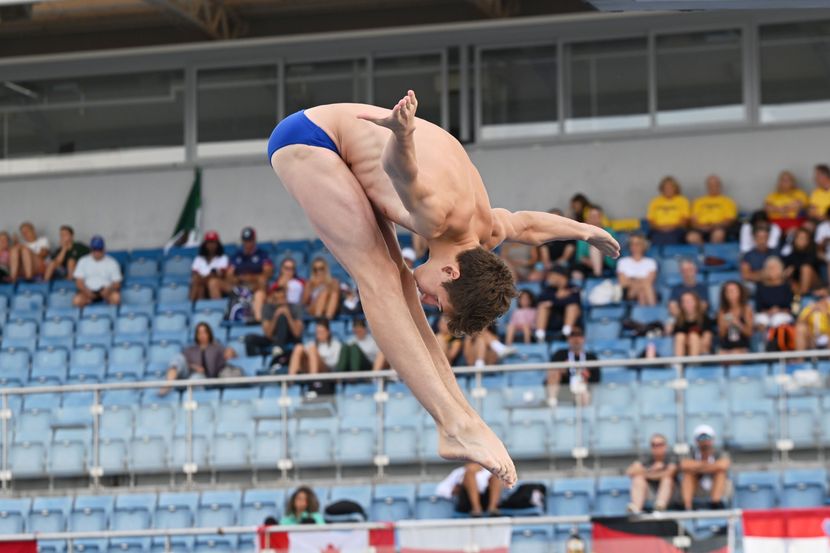
Day 5 was all springboard at the 2026 World Aquatics Junior Diving Championships. Russia’s Matvei Pomoshnikov took the boys’ title on 1m (for ages 16-18) after the Cueva Lobato twins won gold in girls 3m synchro.
RIJEKA, Croatia – Matvei Pomoshnikov called it.
Three days ago, he said the boys’ A 1m final would be interesting – and it was. The Russian capitalised on a mistake by Germany’s Finn Awe in the fourth round to capture the lead – and the title – with his last two dives.
Also on Tuesday, the 15-year-old Cueva Lobato twins, Mia and Lia, not only beat all the 3m synchro pairs to win gold, but they delivered Mexico’s sixth medal in Rijeka. What’s remarkable is that their family (including their older sister, Suri) had a hand in five of them.
Find out who else made the podium on Day 5 and what the medalists had to say.
Boys’ 1m – Group A (ages 16-18)
On Saturday, Pomoshnikov wasn’t satisfied taking silver behind Awe on 3m.
He said to watch the 1m for one reason: “because I’ll win.”
He was right.
But nobody started with a clean slate in the final; the first five scores from prelims carried over. That meant Awe started with a 9.95-point edge over Pomosnikov, and made it hard to catch him. With two dives to go, Pomoshnikov was still trailing – but only by a hair (1.20 points). In the fourth round, Awe had an uncharacteristically splashy reverse 2½. Pomoshnikov saw it because he was the next diver on the board.
Pomoshnikov did a cleaner version of the same dive to take a 4.80-point lead in that penultimate round.
Both divers had saved their hardest dive for last: a forward twisting 2½ (with 3.2 DD). Awe went first, and ripped it. Pomoshnikov needed 65.60 points to tie for gold. Instead, he earned the highest score of the final (76.80) to capture the gold and leave Awe with silver, 11.20 points in his wake.
Awe’s silver meant that he completed a set of every colour medal from Rijeka.
“I’m not happy about it” Awe confessed, looking at his silver. “The reverse 2½ in the morning [preliminary round also] was not so good. So I tried to focus on the things my coach told me. He told me to rip it – and focus on every single thing I could do.”
In the end, it was Pomoshnikov’s day. After bagging two silvers (in 3m and 3m synchro) and one bronze (in mixed team), he finally had his gold.
Due to the start order, he said, “I saw every one of Finn’s dives because there was no way to not see it.
"I decided if he did great, I needed to be greater and one-up him"
Mission accomplished.
Meanwhile, Canada’s Arnaud Corbeil, 18, earned the bronze decisively – 14.40 points behind silver medallist Awe and nearly 30 points ahead of fourth place.
Corbeil usually keeps an eye on the scoreboard, but not on Tuesday. Still, he said, “I knew I was up there with the other guys because I know when I dive good.” Corbeil started diving when he was 3 and grew up admiring [four-time Olympian and two-time 3m silver medallist] Alexandre Despatie. “He was everywhere!” said the Montreal native, “but by the time I grew up, he was done.”
Girls’ synchro 3m
The last synchro event of the 2026 Junior World Championships ended up being a battle between the divers who finished 1-2 on the 1m springboard in the 14-15-year-old age group against the girls who went 1-2 in the 3m event for the 16-18-year-old age group.
In the end, youth prevailed, as Mia and Lia Cueva Lobato won Mexico’s second gold medal this week.
Lia said:
"I was so nervous in this competition, but Mia calmed me"
The twins had the hardest dive list in the field and led after all but one round to finish 24.39 points ahead of the 18-year-old runners-up, Viktoria Kazantseva and Nadezhda Trifonova, of Russia.
Canada’s Lila Stewart, 18, and Mackenzie-Mai Van Houtte Cachero, 17, claimed the bronze, less than two points behind Russia.
The twins have been synchro partners for seven years – nearly half their lives. Mia, who also won gold on 1m for her age group, said that in synchro, “I tried to trust my training.” The twins each have two events remaining.
The Russian silver medallists had been synchro partners nearly as long as the twins. Kazantseva said “the key is to know each other so many years.”
Trifonova, distinguished by her multiple ear piercings, added that they thought their individual medals were a bit more valuable, referring to Kazantseva’s gold and Trifoniva’s silver on 3m the day before. Back home, both plan to put their medals on a “medalnica,” featuring a rack and a shelf – a common tradition in Russia.
The Canadian bronze medallists led after the second dive, but otherwise bounced between fifth and third place. They had only been synchro partners for about a month.
“Today was about having confidence, not wanting to hold anything back,” Stewart said. “We really wanted to have fun, too, our last day of competition. For me, the last dive [inward 2½] was most fun. I knew we had the potential for the podium, I knew we needed a good one, everyone was cheering super-loud. It was an amazing feeling being up there with Mackie on the board.”
Van Houtte Cachero added, “We’re really happy super proud, had a lot of fun. It was a good way to end our week.”
Coming Up
The older A Group will have a rest on Wednesday, while Day 6 medals will be awarded in boys’ 3m (for ages 14-15) and girls’ platform (for ages 14-15).