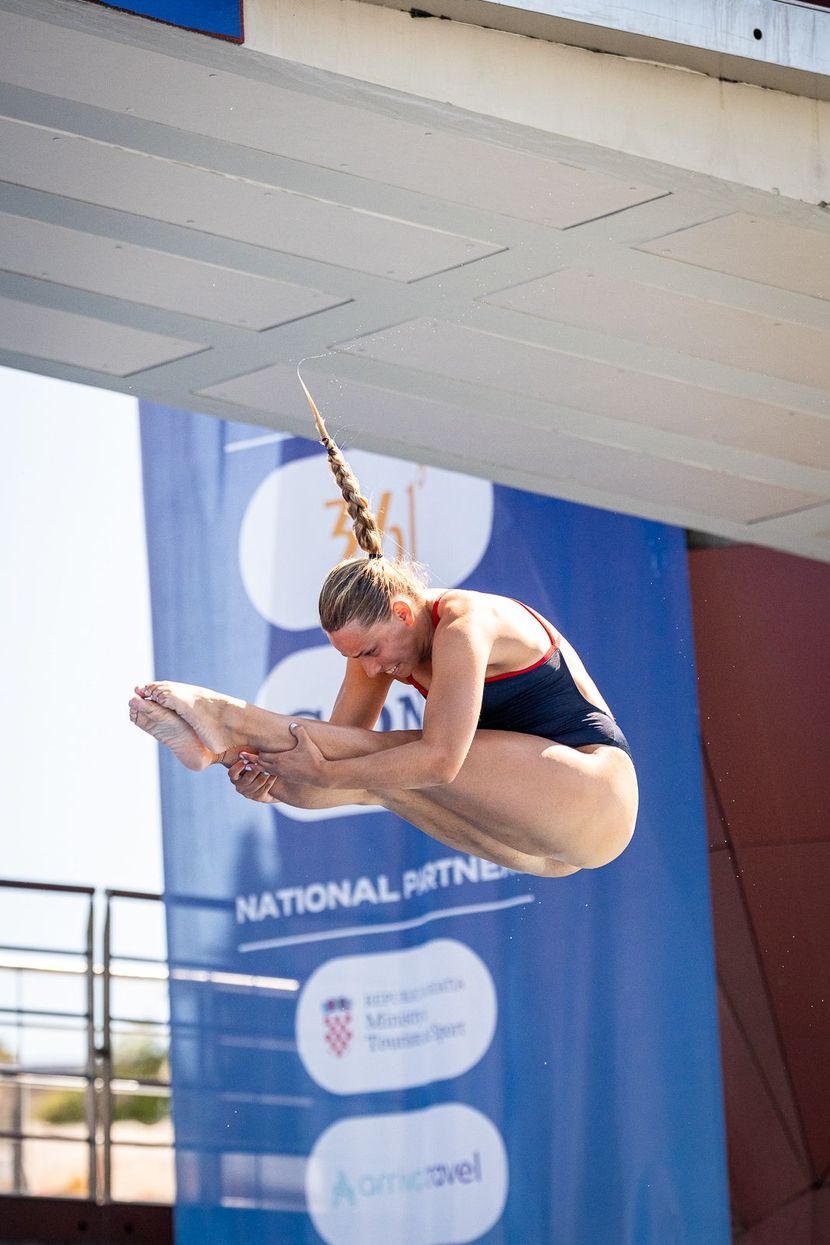
Six nations claimed the six medals awarded on Sunday at the 2026 Diving Junior World Championships. Germany and Russia seized the golds. Canada and China claimed the silvers. Mexico and Australia each collected a bronze.
RIJEKA, Croatia – The skies couldn’t have been sunnier and the medal distribution couldn’t have been wider on Day 3 of the 2026 Diving Junior World Championships.
In girls’ 1m springboard for 16- to 18-year-olds, Emily Deml extended her red-hot summer. After winning her second consecutive junior European title on 1m in June, Deml made her junior world championship debut in Croatia and took gold on Sunday by 12.25 points over Canada’s Lila Stewart, and 21.80 points ahead of Mexico’s Rut Paez. Paez, now 17, was a breakout star at the last junior world championships, in 2024, where she won three junior world titles and a silver in the younger age group. This year, the 1m was Paez’s lone event.
Next, in the boys’ platform final for 14- to 15-year-olds, Miroslav Kiselev of Russia took the lead in the third round (of four), where he earned a competition-high 85.80 points for his back 3½ – en route to winning gold by 10.95 points over runner-up, Kan Zilong of China. Yet earlier on, some of the loudest cheers were for bronze medalist Hayden Brinckley of Australia, who threw down the proverbial hammer in the first round with a textbook inward 3½ (with 3.2 DD) that scored 84.80 points.
“I surprised myself on that one,” Brinckley said. “It’s not usually like that.”
Six medals, six nations on the podium. Find out what all the medalists were saying afterwards.
Girls’ 1m – Group A (ages 16-18)
Girls’ 1m winner Deml, 18, said Sunday’s victory ranked a bit higher than her junior European titles in Group A “because the field was a lot more competitive and harder to beat; I’m really proud of myself.”
Runner-up Stewart, 18, said she didn’t mind diving last in the start order. “I always like going last. It kind of adds pressure, and I like to feel pressure,” she explained.
"I always like going last. It kind of adds pressure, and I like to feel pressure."
“I really wanted to end my junior career on a high note so really happy with this first medal.” The Montreal university student plans to compete in the individual 3m and synchro springboard later this week.
A subdued Paez said the bronze “wasn’t the result I was looking for or what I was training for” – especially after capturing four medals at the last edition of the junior world championships – “but I’m really happy to bring a medal to my country.” It was Mexico’s fourth one so far.
Boys’ Platform – Group B (ages 14-15)
Boys’ platform artist Kiselev, 14, was delighted with Sunday’s gold. “I didn’t expect this result,” he said, “because it’s a big fight, a lot of countries, the Australian guy, China.” Even so, he said,
"I tried to make beautiful dives so everything was clear."
Asked how he planned to celebrate, he said, “It’s too early now because I will dive tomorrow in synchro and team, and 3 meter and 1 meter, the whole program, like Terminator.”
Silver medalist Kan, 14, had been in fourth place until his final (and best) dive: a back 2½ with 1½ twists that scored 81.60 points. Even so, he said he felt “a little bit pity for silver because I wanted the gold. I had the capacity to claim the gold medal.”
Aussie bronze medalist, Brinckley, 15, who woke everyone up in the first round, admitted that the 407C isn’t even his best dive. “I think I was just really confident going into the entry today,” he explained. He said he’s been diving for about three-and-a-half years and is coached by the 2014 Commonwealth Games champion on 3m, Esther Qin, in New South Wales. Brinckley, like Kiselev, has many events remaining: team and synchro platform on Monday and the individual 3m on Wednesday.
Coming Up:
Monday will mark a triple header featuring three finals, starting with Boys’ Synchro Platform at 14:00 local time, Girls’ 3m – Group A (ages 16-18) at 16:00, and the re-scheduled Mixed Team Event at 17:30