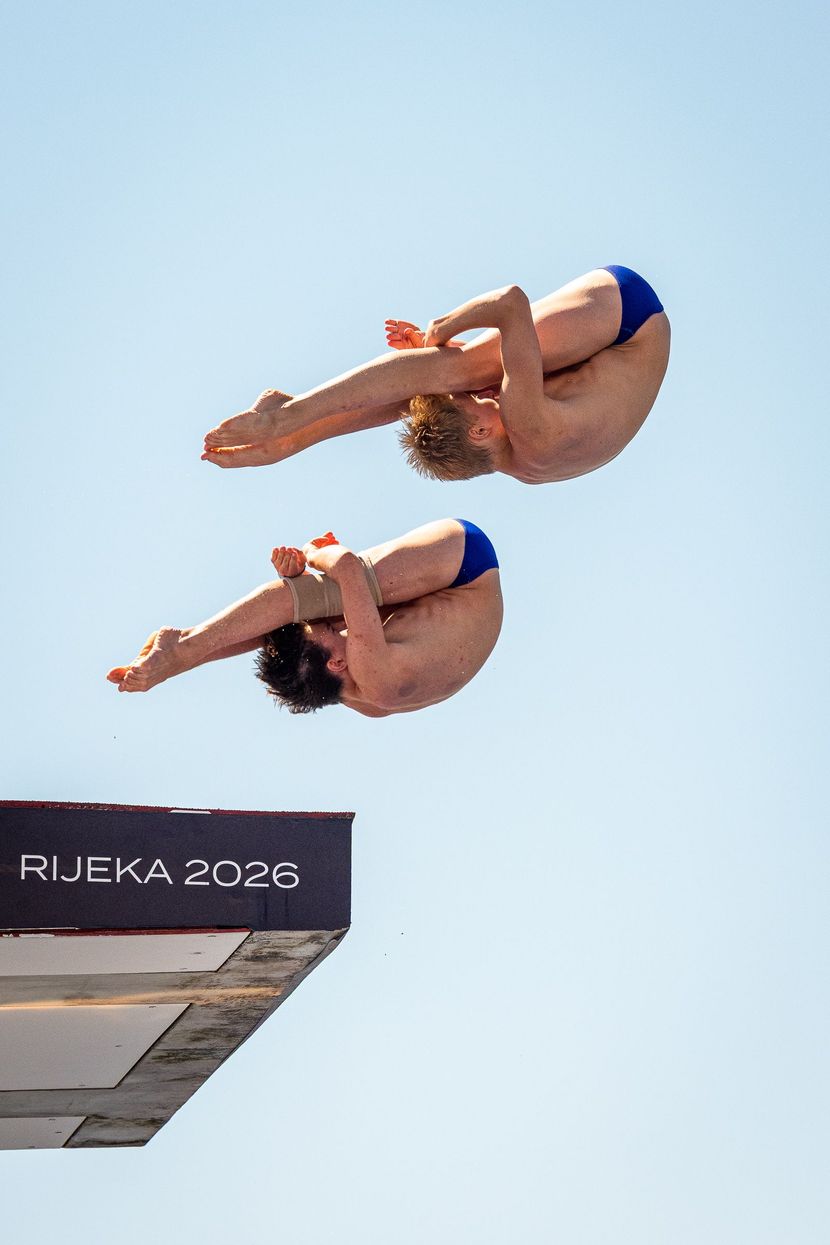
Russian divers won two gold medals on Day 4 of the junior world championships, plus an individual silver and team bronze. China seized the team gold thanks, in part, to Nie Jun’s huge 90.65-point dive on 10m.
RIJEKA, Croatia – Monday was a big day for young Russian divers, as they claimed four of the nine medals awarded on Day 4 of the 2026 Junior World Championships.
The day began with 14-year-old Miroslav Kiselev winning his second junior world title in two days – this time in boys’ synchro platform with Kirill Kosimov. Next, Viktoria Kazantseva defeated her teammate Nadezhda Trifonova in the girls A 3m final (for ages 16-18). And, finally, in the postponed mixed team event: China handily beat 14 other nations to take gold ahead of runner-up Mexico and Russia, the bronze medalist.
For notes and quotes, continue reading.
Boys’ synchro platform
The boys’ synchro platform final was so intense that the top five pairs all finished within 6.78 points of each other.
In the end, Russia’s Miroslav Kiselev and Kirill Kosimov pulled themselves out of sixth place to win the gold thanks to their last two dives, each of which earned at least 72 points. For the 14-year-old Kiselev, Monday’s gold marked his second junior world title in two days. On Sunday evening, he also won the boys’ B platform (ages 14-15). Kosimov pointed out that Monday’s triumph also marked a reunion for this partnership. The two had trained together back in May but in June, Kiselev won the junior European title in synchro platform with a different Kirill (Belavin).
After Monday’s gold, Kosimov, 15, said, “It’s a good decision to dive together because we look alike, have the same height (160 cm) and technique. There was a period when we didn’t match at all but we didn’t give up. We talked more, spoke to our coach, we became more tolerant of each other, and it gave us success. We hope we will dive together in the future because we have plans to make the program more difficult.”
Australia’s Hayden Brinckley, 15, and Archie Forsyth, 16, took silver by leapfrogging over four other pairs on their final dive, a back 2½ with 1½ twists that earned 74.88 points (the second-highest single-dive score of the contest). In the end, they trailed the Russian victors by only 1.38 points.
Just 1.05 points behind the Aussies were Britain’s Jorden Fisher Eames, 18, and Robbie Wood, 16, who earned the bronze.
For those paying close attention, the subplot of the competition was the troublesome 207C (a back 3½), the hardest dive of the contest (with 3.3 DD). It threw Italy out of the lead in the third round. It crushed Germany’s medal prospects, too. The Brits scored 68.31 for theirs – but none of the other teams tried it, including the gold and silver medalists.
Forsyth, a silver medalist, said, “Just a couple days ago we decided not to do 207C.” Brinckley, his partner said, “We did train it out here, but our reverse [2½] was just hitting every time, so we decided to chuck it.”
The British bronze medalists didn’t even know they were in the medal hunt. Even with the 207C, Fisher Eames said,
“we were just having fun. Before last dive, we gave each other a hug. It’s been the best year in synchro. I love being a synchro partner,”
even though Wood trains in Sheffield, about two hours’ drive from his base in London. Asked if they do virtual training online, Fisher Eames said, “No, we play video games together.”
Girls’ 3m – Group A (ages 16-18)
Next, in on girls’ 3m springboard, Kazantseva defeated her 3m synchro partner, Trifonova, by 30.30 points to take the individual gold – her second medal in Rijeka. Her first medal was a bronze on 10m synchro, making Kazantseva one of the few junior divers who have demonstrated excellence on both boards.
“I like both, 50/50,” she said, adding that as long as she obtains decent results on both, “I will train both, but I think there will be a moment when I have to decide which one to specialize in.” The one that feels more natural, she said, “depends on the mood, but today it’s the platform.”
While Kazantseva, 18, didn’t do the hardest dives in the four-round final, she carried over 206.55 points from prelims to give her – at minimum – nearly a 10-point advantage over the entire field from the beginning. She was also consistent enough to maintain her lead in each round.
Afterwards, runner-up Trifanova, 18, called the silver medal “a great achievement for this period because it’s a long season, with junior European championships and now this.” A few minutes later, she re-appeared in the team event and helped Russia take bronze – along with Kiselev who also did double-duty on Monday.
Kseniia Bochek of Ukraine, 17, captured the bronze, which was the fourth junior world championship medal of her career. She was a triple medalist at the last edition, in 2024. Since then, she changed her dive list. “All my optionals are new this year,” she explained, admitting that third place “is not what I wanted exactly, but I’m fine with it. I also have this thing [pointing to the squid mascot plushie given to all the medalists] so what could be bad?”
Mixed Team
As the sun started to descend over the foothills surrounding Rijeka, the mixed team event closed the day.
The contest featured 15 teams, and the top five teams after the 3m portion were: Russia, Mexico, China, Australia, and Hong Kong, in that order.
During the platform section, however, China took a monster-size lead when 17-year-old Nie Jun threw a forward 4½ that was so clean that it earned 90.65 points. (He had also been responsible for adding 72.00 points earlier in the individual 3m portion – the team’s second highest score of the event.) No one could top China, as Kan Zilong, 14, Xie Jianyi, 18, and Yuan Qingcheng, 14, also contributed to the victory.
Xie said of the gold, “This medal is comforting; it represents a teamwork spirit.”
Mexico never ranked lower than second and ultimately clinched the silver, 38.70 points behind China – which brought yet another pair of medals for the Cueva Lobato family, as both Suri, 16, and Mia, 15, participated, along with Ian Nava Gutierrez, 15, and Carlos Solorzano Parra, 17.
Solorzano Parra said,
“I trained a lot for this medal. I feel so happy now because this is my dream.”
Nava Gutierrez added, “This is my first junior world championship medal. I will put it on the wall in my room when I get home.”
Russia took bronze, 5.05 points behind Mexico – and it was the third junior world championship medal this week for Matvei Pomoshnikov, 18, and Miroslav Kiselev, 14, and the second for Aleksandra Kedrina, 16, and Trifonova, 18.
Pomoshnikov said, “I expected everything [today] I was ready for any scenario.”
Kiselev said, “I’m happy. Not all dives were as good as I expected, but I’m okay with the result because of the teamwork.”
Trifonova said, she felt “only positive emotions after the final. In the next event, girls’ 3m synchro, we will come back stronger because it will be my last junior world championships. The key is: don’t give up, just try harder.”
Coming Up:
On Tuesday, weather permitting, there should be two finals: girls’ synchro 3m, and boys’ 1m springboard for Group A (ages 16-18).