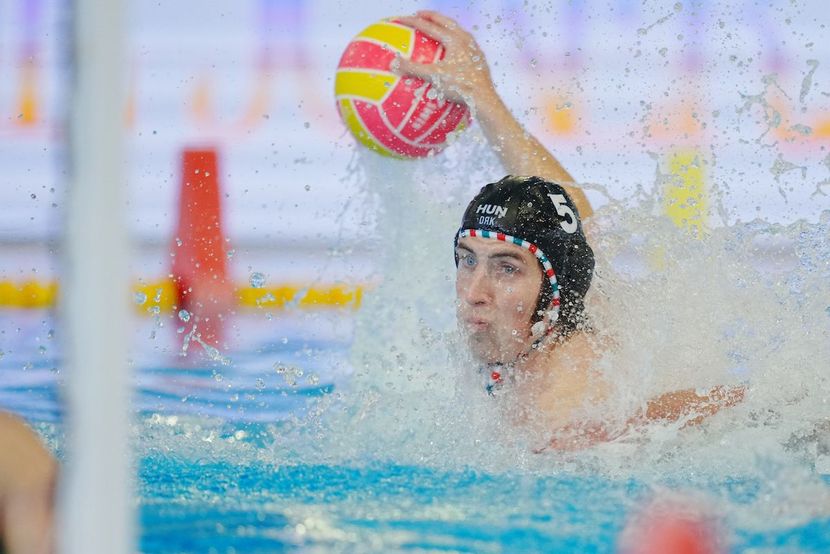
Dual reigning champion Spain will defend its crown when the 2026 World Aquatics Men’s World Cup Finals are staged at the famous Sydney Olympic Park Aquatic Centre from Thursday until Sunday.
Overview
Spain may be without its talisman, the now retired Felipe Perrone, but it will still provide plenty of punch as it shoots for a third straight World Cup crown following last year’s Podgorica series in Montenegro and the 2023 showing in Los Angeles, USA.
Spain defeated Greece 16-14 in a hotly contested final. Hungary triumphed in a penalty shootout to defeat Croatia 18-15 after drawing 14-14 in the bronze-medal encounter.
Croatia was fourth and Montenegro fifth last year with the “newcomers” this year being host Australia, Italy and Georgia. The latter will be making its first appearance at this level, following a resounding showing at the Division II tournament claiming the second and last place when making the final in Malta. The final clash, which had no bearing on qualification, left Montenegro the better at 19-17.
Serbia is the shock omission from the finals, finishing sixth in the Division I series in Alexandropoulos, Greece, one ahead of United States of America, another non-qualifier. Serbia and USA are both dual champions.
Tournament Structure
The quarterfinals will be played on Thursday; the round 5-8 semifinals on Friday; the classification matches 5-6 and 7-8 on Saturday, followed by the round 1-4 semifinals; and the medal finals on Sunday interspersed with the women’s finals.
Historical Note
Back in 1999, when the first FINA World Cup for men was staged in Australia, it was at SOPAC and the dais was filled by Hungary, Italy and Spain. At the Sydney Olympics a year later, Hungary started its extraordinary triple Olympic run followed by Russia and Yugoslavia
when the medal finals were held at SOPAC in front of 17,000 people. The preliminary rounds were held at the smaller Ryde Aquatic Centre
Therefore, SOPAC is no stranger to the nations, however, today’s current crop of players has rarely played an international in the city.
Missing In Action
Montenegro is bringing a youthful team and we will miss the likes of Konstantin Kharhov and Luka Bukic. Spain will be without the incomparable scoring machines Alvaro Granados and Alberto Munarriz while Greece’s Konstantinos Genidounias is attending his marriage. Hungary will be without the services of goalkeeper Soma Vogel.
World Cup History
The World Cup has been staged since 1979 when contested in Belgrade and Rijeka in the then Yugoslavia. Hungary beat United States of America for the gold.
Hungary is the undisputed king of the World Cup, winning four crowns from eight finals for nine medals in all. Four nations are tied on two crowns — Serbia, Spain, USA, USSR and Yugoslavia.
Lead-up Matches
The nations arrived in Sydney early and contested some closed-door international encounters with Australia going down to Greece 22-20 before beating Japan 18-16. Hungary beat Japan 19-14, lost to Greece 22-16 and defeated Australia 20-11.
How The Teams Stack Up
Spain — Twice champion and five times a bronze medallist.
Hungary — Four times champion (2018, 1999, 1995 and 1979), four times silver, three bronzes
Greece — Twice a beaten gold-medal finalist.
Australia — A silver and bronze medallist
Montenegro — no medals as sovereign nation but as Serbia & Montenegro won the 2006 version.
Croatia — One silver and one bronze.
Italy — Gold in Athens, Greece in 1993 among five finals with one bronze.
Georgia — Making its debut in Sydney.
Who To Watch
Stylianos Argyropoulos (GRE), who scored 24 goals in the Division I series this year; Matteo Iocchi Gratta (ITA); goalkeeper-captain Mauro Cubranic (CRO); Vince Vigvari (HUN); Bernat Sanahuja (ESP), Strahinja Gojkovic (MNE); Saba Tkeshelashvili (GEO) and Jacob Mercep (AUS).
Possibly another star to watch is Hungarian head coach Zsolt Varga. He last left SOPAC with a gold medal draped around his neck following the 2000 Sydney Olympic Games. Georgian head coach Revaz Chomakhidze was a silver medallist with Russia in 2000, also collecting bronze in 2004. Montenegrin head coach Dejan Savic collected bronze with Yugoslavia here in 2000 in his three-Olympic medal playing career before coaching Serbia to two Olympic golds.
Day 2 Quarterfinal Schedule
M1: 13:00, Italy v Georgia
M2: 14:45, Greece v Montenegro
M3: 16:30, Spain v Australia
M4: 18:15, Hungary v Croatia