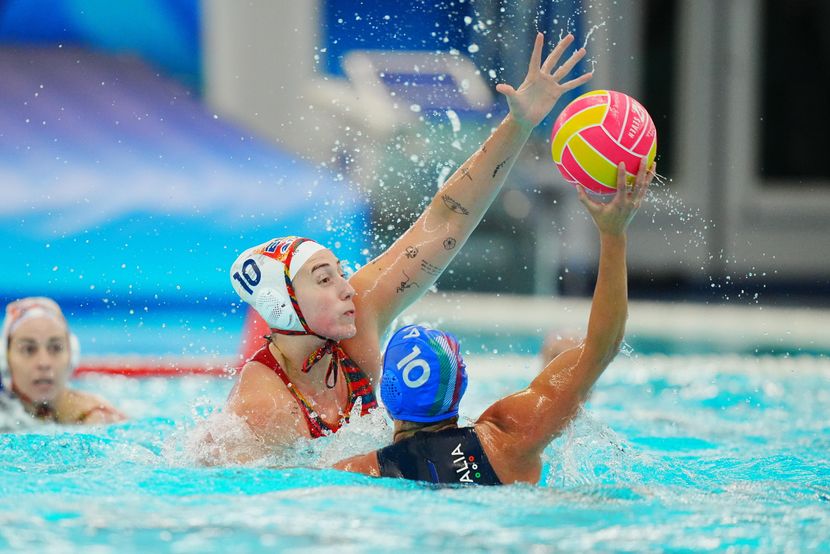
From not qualifying last year to being the standout favourite for this year’s crown is the lot of perennial champion United States of America when the 2026 World Aquatics Women’s World Cup Finals are staged at the famous Sydney Olympic Park Aquatic Centre on 22-26 July.
When International Olympic Committee President Juan Antonio Samaranch verbalised that fateful word back in the 1990s — Sid-n-eee — little did we know that it would be the start of something beautiful for women’s water polo.
Pressure was brought to bear on FINA’s president Mustapha Larfaoui, an IOC member, and then the IOC itself to get women’s water polo incorporated to the 2000 Sydney Olympic Games.
After all, Sydney Olympic Park Aquatic Centre (SOPAC), where the 1995 FINA Women’s World Cup was successfully staged, showcased what women could do. Host nation Australia won that tournament and thus was at the forefront to get parity with the men who had been in the Olympics 100 years already.
The rest is history, women were included, albeit with a six-team tournament; Australia won and the Olympics exploded in the sports-mad country with the last-gasp victory by Australia over United States of America lifting the prestige of the sport and women’s sport in particular.
That 2000 Aussie Stingers team will be attending the World Cup before being inducted into the Water Polo Australia Hall of Fame on Monday evening.
In 2010, an international women’s tournament between host Australia, Canada, China, Greece and United States of America — was contested en route to the World Cup in Christchurch, New Zealand — celebrating 10 years of that Olympic introduction. It was the last time a major women’s international event was staged in SOPAC.
On Wednesday, we return to SOPAC for a fourth major tournament and the anticipation is palpable with a shotgun four days of women’s action.
Season recap
The 2026 World Cup season started with the Division II tournament in Malta where Russia and China battled out a “meaningless” final as both had qualified the day before by winning the semifinals, but pride was on the line and Russia won 18-17. The unlucky semifinalists were Canada, who lost to Russia 24-6, and Croatia who bowed to China 23-11.
In the Division I series played in Rotterdam, Netherlands, reigning champion Greece and Japan were the unlucky losers, finishing seventh and eighth. For Greece it was a major letdown after winning the World Cup and the World Aquatics Championships last year.
Final Division I Rankings
United States of America and Netherlands were the strongest teams to emerge from Rotterdam and it no coincidence that they come to Sydney seeking another crown to the 13 they have between them.
Olympic champion Spain, fourth last year in Chengdu, China was third in Rotterdam and Italy fourth, but with few wins. Australia was fifth and Hungary needed to beat Australia to beat off Greece, which it did 9-7, to gain the sixth and final berth for Sydney.
World Cup History
The FINA World Cup was the “Olympic” peak that women could rise to between 1979 and 1986 when women’s water was included into the FINA World Championships. Australia was the inaugural champion.
The early World Cups attracted a wide variety of nations including B teams to expand numbers. Puerto Rico, France and Federal Republic of Germany were early contenders while the mainstay nations were Australia, Canada, Netherlands, New Zealand and USA.
Netherlands dominated the 1990s and has won eight titles to date with the first in 1980 and the last in 1999. Netherlands has been in 12 finals. USA is next best with five from 10 finals and Australia has three of the multi-winners from six finals.
Of the three teams who have won single titles, Canada and Greece are unqualified and Hungary claimed its crown in 2002.
This is the fourth time that Australia has hosted the World Cup, with the first in Brisbane in 1981 — won by Canada — the second in 1995 in Sydney where Australia pipped Netherlands; and the third in Perth in 2002 where Hungary triumphed.
Lead-up Matches
The nations arrived in Sydney early and contested some closed-door international encounters with the most amazing being the Australia-Hungary clash where the Europeans prevailed 30-29 after a mind-boggling, possibly world record, 38-shot shootout after the match was tied at 13-13.
Who To Watch
Ryann Neushul (USA) was named most valuable player in Rotterdam while the best goalkeeper was Spain’s Martina Terre (ESP). Goalkeeper Olimpia Sesena (ITA) will be another to watch closely as the best young player. Hungary’s Kata Hajdu is a scoring sensation and starting to embed herself into the national team. Australia’s Abby Andrews is a sparkling left-hand shooter and Netherlands’ Vivian Sevenich is a potent force. China’s Yan Siya scored seven goals against Croatia and will be hoping for more of that here. Russia’s main threat will be veteran Ekaterina Prokofyeva who has lost little since dominating the junior world championships so many years ago. She also has the claim to being the only woman to play here in the 2010 women's tournament, scoring twice in a 6-4 defeat of Greece.
One person who remembers this pool fondly is Taryn Woods, Aussie Stingers assistant coach, who was a member of that 2000 gold-medal team.
First-Day Action
While the schedule speaks for itself, any of these teams could make the grade come Sunday. All teams have had a chance to refine their plays, get international competition since earlier this year and even eye each other off during the training at SOPAC in recent days.
The main thing to consider is that this is a cut-throat competition with quarterfinals on day one, then 5-8 semifinals on day three; classification matches 5-6 and 7-8 on day four, followed by classification 1-4 semifinals. Day five sees the medal finals interspersed with the medals medal matches.
Day 1 Quarterfinal Schedule
W1: 15:00, USA v China
W2: 16:45, Netherlands v Russia
W3: 18:30, Australia v Italy
W4: 20:15, Spain v Hungary