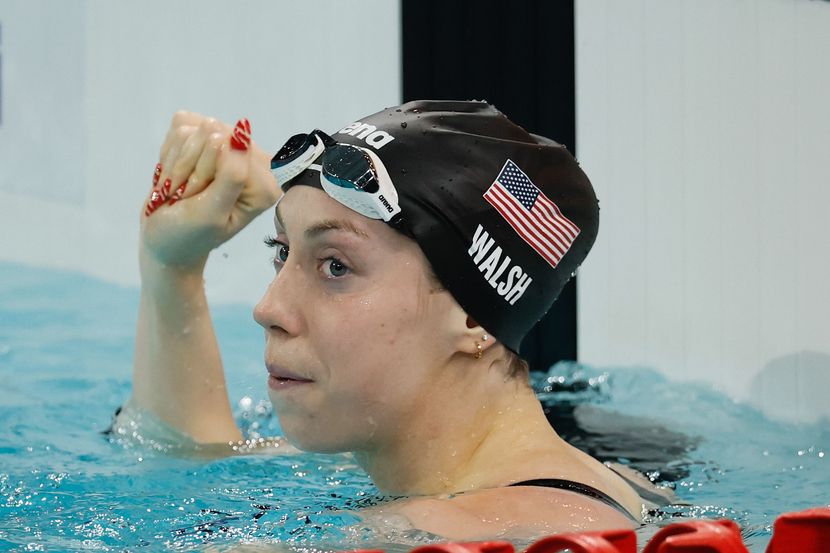
23-year-old Gretchen Walsh of the United States broke her own world record in the 100m butterfly on Saturday evening, lowering the mark for the fourth time to 54.33
The term “generational talent” can get thrown around way more than it is intended to. “Generational” is supposed to be one particular moment or face that encapsulates an entire group of people in a certain period of time. The length of time is dependent on the environment and those in it, and what they can contribute in their careers. It’s a special term that is used to label those athletes that have gone above and beyond what is thought to be possible in their respective sports. The term cannot be used loosely.
Oftentimes swimming is thought to be in this new era of “swimflation,” a term coined around 2022 describing the reaction to how swimming lost its “rest and taper” era and went into an era where fast swimming can come on any day of the week, any time of the year.
Is Gretchen Walsh the face of the “swimflation” era? On Saturday, she swam 54.33 in the 100m butterfly on the last day of the Fort Lauderdale Open on the grounds of the International Swimming Hall of Fame. When Sarah Sjostrom broke the world record to win gold at the 2016 Rio Olympics at 55.48, the record remained untouched for eight years. Walsh finally cracked that mark at the 2024 Olympic Trials to reset the standard to 55.18, and has broken it three times since, coincidentally all in the same facility. Walsh broke her own record she set last summer.
“There’s never a time when it can’t be done if you just don’t put your mind to it,” Walsh told reporters after the swim. “I didn’t go to the beach today, because I was thinking maybe there could be something special tonight. I was feeling confident after my warm-up, put on a new suit, and let the good juju flow my way.”
Walsh is coming off a career summer, winning her first individual World titles in 2025 in the 50m and 100m butterfly despite battling acute gastroenteritis in the lead-up to the meet, an inflammation of the stomach that can result in severe stomach cramps.
“It was a time I was wanting to go all summer (in 2025),” Walsh said. “I think that doing it now, there is no time like the present for something like that, so I’m really, really happy.”
Walsh’s success hasn’t been a surprise - as a 13-year-old, she was one of the youngest competitors at the 2016 Olympic Trials for her club team Nashville Aquatic Club. As a 14-year-old in 2017 she split a 50 freestyle in short course yards faster than many of the elite college athletes at the time. As a 16-year-old in 2019, she was a team captain for the United States team at her first ever World Junior Swimming Championships in Budapest, where she took home six gold medals.
The writing was on the wall for her to be great, but even some of the recent times she has put up have been mind-boggling to those who have followed her journey.
As a member of the University of Virginia women’s team, she set NCAA records in four different events in her four seasons, resulting in nine of a possible 12 individual national titles. In 2024, her 50 freestyle record time was so fast it, it was flagged by data site SwimCloud as “suspicious.” In 2025, her 100 butterfly record setting swim was so fast, she beat reigning Olympic champion Torri Huske by two full seconds.
In her first World Short Course Championships, she set nine individual world records in one week, en route to seven gold medals across the board.
It’s hard to remember the last time Walsh had an “off” meet, and even re-watching races where she gets beat is a strange visual.
In the last few years since initially breaking the 100m butterfly world record in 2024, Walsh has started to understand her role as one of the best swimmers in the entire world.
“That (world record at Olympic Trials) made me realize the role I have in this sport, and the fact I’m capable of being one of the greatest, which is so weird to say,” Walsh told World Aquatics before the 2024 World Short Course Championships. “That time is the fastest time a woman has ever gone in the 100m butterfly, ever, period, anywhere. To even say that is so cool to me and it makes me realize I can do these things that many people think are impossible.”
As of this writing, she has swum faster than anyone in history by over a second. Sjostrom’s 55.48, which stood as the global mark from 2016 - 2024, still makes her the second fastest performer ever. While nine total women have broken 56 seconds in the 100m butterfly, only Walsh has gone inside 55, and she is knocking on the door of getting to a 53 in the coming months.
In the preparation for this meet in Fort Lauderdale, the process was not much different than any other week for Walsh - a lift on Monday and Tuesday, with some “pretty intense (swim) workouts” the entire week before getting to the meet on Thursday. Admittedly, she doesn’t really taper at all for meets.
In this new “swimflation” era though, one where a taper doesn’t mean what it used to mean, the ceiling for what’s possible seems to have no limits. The old model of swimming used to be comprised of heavy training blocks, resulting in higher levels of fatigue that caused athletes to not put a lot of emphasis on performance in the regular season. At some point in the last ten years, that has shifted - athletes and coaches are training smarter throughout the year - less volume and more quality work, resulting in faster swims throughout.
In 2025, seven world records were broken in 2025 before July 1, compared to five in 2024. According to data published by SwimSwam in 2024, roughly 60% of all long course world records have been broken in either July or August, and only about 3% were broken in May. Walsh added yet another improbable statistic to her resume.
Of course, Walsh and her coach, Todd DeSorbo, were not the first people ever to figure out how to swim fast all the time. Katie Ledecky has been breaking world records at in-season meets since 2014, and Michael Phelps famously broke the 200m IM world record four times in one summer in 2003.
But this is the 15th world record she has broken in the last two years in both short-course and long-course meters. With the “swimflation” era gaining more and more steam, Walsh is at the front of that train car, guiding the sport into once-unthinkable ventures, and the fans are enjoying every second of it.