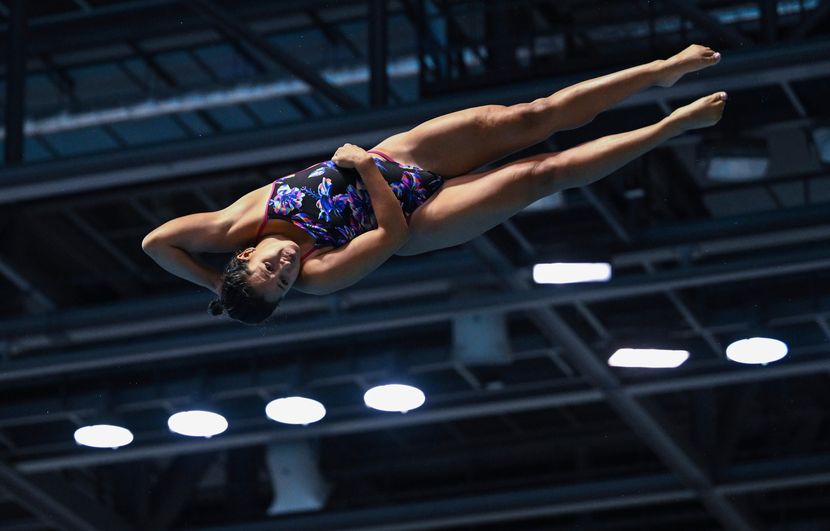
When Colombian diver Daniela Zapata Correa was six years old, she stood by a pool and watched people flip and twist above the water. That moment, she says, set her on the path she follows today.
"I liked water, and when I saw people doing somersaults and twists in the air, I was amazed," she recalled. "I thought, I want to do something like this. That's why I started diving."
Years later, Daniela is lining up against the world's best in the women's 3m springboard at the World Aquatics Diving World Cup Final. In Beijing, she competed in the head-to-head format and lost her match-up, which meant she did not advance to the semifinals. The result was not her main focus, though. For Daniela, this World Cup Final is a test and a lesson.
Growing up in a small diving community
"In Colombia, diving is not very popular," she said. "There are not so many divers, not really much. But I still chose this sport."
The difficulty of diving became part of its appeal.
"Sometimes it is scary and it is hard, but that gives me a challenge that I want to take,"
she said.
At home, she trains at least twice a day, combining pool and dryland sessions.
"Most of the days I come in the morning and back in the afternoon," she said. "We do diving and also dryland."
For her, the main test is consistency.
"The biggest challenge is the self-discipline to do every day what we have to do," she said. "Even when we are tired or scared, we must keep training."
Her teammates and former coach in Colombia helped her establish that standard.
"My teammates in Colombia have influenced me a lot, and my coach that I used to have there," she said. "He is one of the persons who pushed me to be better."
A new environment and clear progress
Daniela's career took a key step when she was invited to train in Toronto under a centralised programme with divers from different countries.
"I was very happy because it was a great opportunity," she said. "I knew it was something important in my life and in my career."
In Toronto, she found a very different training environment.
"I have all the equipment and all the requirements I need," she said.
"We have the facilities, the medical staff, and more competitions. The coaches are really focused on us, and we can be really focused on our goals."
Training and living with athletes from around the world has broadened her outlook.
"We train with people from different countries," she said. "We live together, we learn from others, from other cultures and other training. I think I have learned a lot, not only as an athlete but as a person."
Working alongside some of the sport's top names has been especially valuable.
"Even if I cannot compete with them right now, I can see them, how strong they are, how they compete, how they do their routines," she said. "I learn a lot just watching them."
Daniela feels the impact on both her technique and mentality.
"I think my performance has improved a lot in Toronto," she said. "I think my improvement is in the technical aspect and also the mental aspect."
She highlights one example: a reverse 2½ tuck from the 3m springboard with a 3.0 degree of difficulty.
"For a lot of women it is a really hard dive," she said. "That's one of the dives that I have improved a lot."
A World Cup Final as a learning step
In Beijing, Daniela's World Cup Final campaign in the women's 3m springboard ended in the opening round. Under the head-to-head format, she faced a Mexican opponent and was unable to win the duel, so she did not reach the semifinals.
"I did three dives," she said. "The first two were very good, but the last one was not so good. The first one was my best."
She admitted that in the last round she watched the scores.
"In my third dive, I was paying attention to the scores and how close I was to making the final," she said.
Before competing, she felt the pressure of a new level.
"I was feeling a little bit nervous because this was my first World Cup Final," she said.
"I also felt grateful and proud to be here, and to be here coming from Colombia. I tried to breathe and remind myself that I deserve to be here."
She sees this appearance as one step in a longer process.
"For the rest of the season I want to keep working and have more internationals, more competitions," she said. "We will have the South American Games in September. I am concentrating on that. I also want to be in the Central American and Caribbean Games."
Her long-term goals are clear.
"I want to be South American champion and Pan American champion," she said. "Like many athletes, my dream is to be a finalist at the Olympic Games."
Responsibility and the future of Colombian diving
As a young woman from a small diving community, Daniela is aware she represents more than herself.
"Yes, I feel that I carry a little responsibility on my shoulders," she said. "But I know how capable I am to carry this kind of responsibility. I want to show that women from Colombia can be strong in this sport and can handle this level."
Representing Colombia internationally is a source of motivation.
"I'm always proud to represent my country," she said. "I'm always happy when people see the Colombian flag. I think that is one of the best feelings an athlete can have, that people know where you come from."
She hopes her path can send a message to younger athletes in Latin America, especially in Colombia.
"If you put your goals in your heart and in your mind and you plan to achieve them, you will achieve them,"
she said. "Put goals that you are capable to do, plan to do it, and you will do it."
On the wider state of diving in Colombia, Daniela is realistic but optimistic.
"Right now we are working to improve little things," she said. "There are not so many divers, not really much. But I'm sure in a few years we are going to have a better performance and more athletes."
Looking ahead, she wants to bring her experience home.
"I want to bring what I have learned here back to Colombia, to help the next generation," she said.