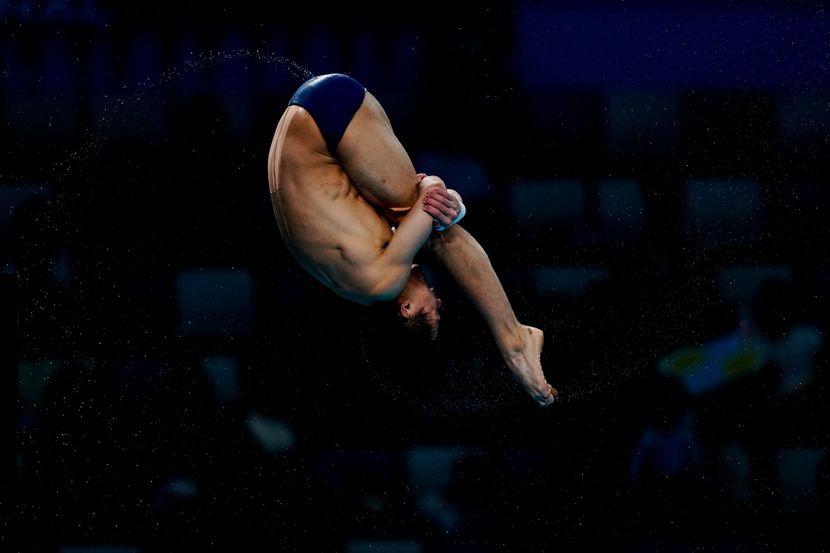
In the two closest finals this weekend, China pulled out the last two gold medals of the 2026 diving World Cup Super Final to finish undefeated in Beijing. But the men’s 10m event was so intense that it took 12 perfect scores of 10 just to earn the bronze.
Sunday’s diving was simply mind blowing.
China went 1-2 in the women’s 3m final, but it came down to an identical dive in the final round to learn who would win gold. Ultimately, an extra half a point from a single judge was enough to give Chen Jia, 21, the win and keep China undefeated through eight events, and edge just 1.35 points ahead of her teammate, the world and Olympic champion, Chen Yiwen, 26.
Then, in a blockbuster grande final, Mexico’s Randal Willars Valdez, 24, was poised to become the first diver to beat China in the Super Final. On the men’s 10m platform, the 11th seeded Mexican took the lead in round three and went on to rip the hardest dive of the competition on his final dive to rake in 106.60 points for a personal best 538.15 score. When the next diver, China’s Lian Junjie, 25, nailed a forward 4½ tuck to earn five perfect scores from the seven judges for a massive 111.00 points, and still trailed the Mexican by 31.35 points, Willars Valdez was all smiles.
All eyes were on the last diver, Bai Yuming, 19, to complete China’s gold medal sweep. Bai needed at least 96.95 points on his final dive. He had just thrown a 104.40-point dive in the penultimate round (which earned three 10s).
Bai ripped the same dive as Lian (without earning any 10s), scored 101.75 points and was able to win China’s ninth gold in nine events with 542.95 points, relegating Willars Valdez to second place by 4.80 points.
For more analysis and reaction, read on.
Men’s 10m
The men’s 10m contest simply lit up the water cube on Sunday night, but not all the key moments came in the final.
In the first phase of the event, the head-to-head elimination round, Bai Yuming (the gold medalist) squeaked past the Russian 12th seed, Ruslan Ternovoi, on his last dive by just three points. The second head-to-head matchup was almost as close as Randal Willars Valdez (the silver medalist) edged past 16-year-old Ukrainian Mark Hrytsenko by 3.05 points.
Next, in the semifinal portion, Australia’s two-time world champion Cassiel Rousseau, 25, was on the brink of elimination but nailed his back 3½ pike on the final dive to score 93.60 points and knock out the reigning world championship silver medalist Oleksii Sereda, 20, of Ukraine. Rousseau went on to finish fourth in the four-man final.
After clinching gold in the suspenseful finish, the 19-year-old Bai called the victory “a rewarding experience” and “a huge achievement” to win an individual event in his first World Cup Super Final.
“The gold medal is a starting point for me, and the result of all my hard work,”
Silver medalist Willars Valdez was especially satisfied with the silver considering his 538.15 points was a personal best and last year he didn’t make the final. “I enjoy a lot the competition,” he said. “I'm happy overall, despite some pain. For the future, if my physical condition is good, I may consider adding a dive with a higher degree of difficulty. [Already] my dives are very difficult and I chose them because my body can [perform them]. I trained a lot.”
China’s bronze medalist Lian Junjie, despite earning a total of 12 perfect 10s on Sunday, had trouble with his fourth and fifth dives, the 307C (which scored 49.30 points) and 207B (which earned 64.80 points). Still, Lian said, “I haven't been in the best form recently, so considering how I did today – even with a couple of mistakes – I'm overall satisfied. Last year my shoulder injury was pretty bad. [It] really set me back. My recovery is going better than I expected… but with age come ups and downs so today, being my first big world competition since [the] injury, I'm very happy. I'll keep working hard and gradually regain my confidence.”
Women’s 3m
Earlier in the day, it looked like the women’s 3m event would be drama-free when there were no upsets in the head-to-head matchups and all four of the top seeds advanced out of the semifinals to create a China vs. Australia final.
Australia’s reigning 3m Olympic silver medalist Maddison Keeney, 29, emerged with the highest score after the semifinals (even higher than the world and Olympic champion Chen Yiwen’s total and her teammate Chen Jia’s) but all scores were wiped clean for final so it didn’t impact the final standings.
In the final, Chen Jia led after three dives, but in the penultimate round, Chen Yiwen finally overtook her world championship synchro partner with a well-executed forward 3½ – but only by 15 tenths of a point. The gold medal came down to one question: whose final dive, a forward twisting 2½ (a 5152B), would be closer to perfect?
In the end, the difference turned out to be a single judge’s score of 9.0 for Chen Jia (and a 8.5 for Chen Yiwen). The tiny margin gave Chen Jia 374.40 total points to clinch China’s eighth gold medal of the Super Final and make Chen Yiwen the runner-up by just 1.35 points. Keeney captured the bronze with 339.00 points, ahead of teammate Alysha Koloi, 24, who scored 294.60.
Afterwards, gold medalist Chen Jia said she was in better form than she was at the World Cup opener in late February where she placed second behind Chen Yiwen. But the two events used different formats. In the Super Final’s knockout competition, Chen Jia said, “the pace is very fast. Your whole body is tense and elevated and you're constantly out of breath. In the semifinals, there was a transition round where I got a little distracted because you have to run back and forth.
"By the time I got to the final, I managed to get my full form back.”
Silver medalist Chen Yiwen, however, felt she had underperformed. “The mistakes today were really unnecessary,” she said. “I just don't feel as confident in my dives as I used to, especially with the splash control after the dive. Personally, I think the first two rounds really shouldn't have been like that.”
Chen Yiwen added, “We still have the Asian Games this year. I'm hoping for a good performance there. [But first,] I need to identify the problems through training because my competition performance is heavily influenced by my training. Right now, my training success rate isn't as high as it used to be, so I feel a bit lacking in confidence during competitions.”
Bronze medalist Keeney said, “I was really nervous. I was really disappointed because I know that if I dive to my potential then I can get better result. I still feel young. I think I'm still improving. Sometimes I'm scared that my body will fail but that's just life. It’s really special to be able to do an event like this and share a little stressful time with my close friends. I think that if I raise my own level, I can help bring up the level of everyone else I trained with – not just Alysha, but everyone else in Australia. I think it’s important to be a leader.”
All the 2026 Super Final medals:
- China - 12 medals (9 golds, 2 silver, 1 bronze)
- Mexico - 5 medals (3 silver, 2 bronze)
- Australia - 4 medals (1 silver, 3 bronze)
- Great Britain - 2 medals (2 bronze)
- Democratic People’s Republic of Korea – 1 medal (silver)
- Ukraine -1 medal (silver)
- Russia -1 medal (silver)
- Germany - 1 medal (bronze)
Additional reporting by Rachel Li Jia in Beijing