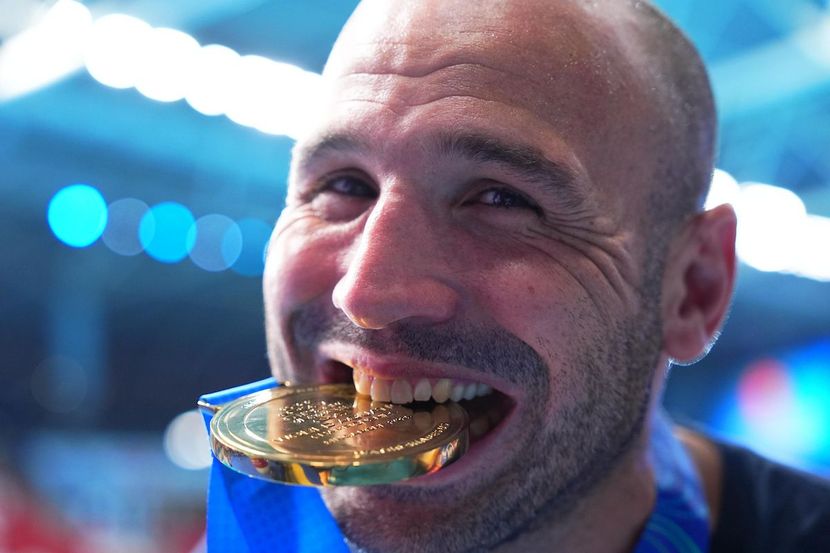
Felipe Perrone is a name chiselled into the water polo framework. The dual world champion, World Cup and European champion bowed out with gold in Singapore last year after a stellar career that spanned more than 30 years. Nowadays he has his hands full working for World Aquatics.
Felipe Perrone is on a mission — he hopes to make water polo a more global, accessible and attractive sport, while helping to unlock the potential we all see in our sport.
Since September last year, Perrone barely had time for his towel to dry out after pulling the plug on his playing career, when he was named as World Aquatics’ High Performance and Development Officer with his focus firmly on contributing to the global development of water polo while supporting improvements at the highest competitive level.
“I feel both privileged and responsible to be in this position. Seeing the commitment within World Aquatics and the passion across the water polo community gives me confidence that we can achieve a lot.
“I also collaborate with athletes, coaches, referees, ROC, the Technical Water Polo Committee and national federations in identifying challenges and developing practical solutions.”
Perrone began his involvement beyond the water with the World Aquatics Athletes' Committee. In 2024, Filip Filipovic and I proposed a water polo scholarship programme to help athletes from developing water polo nations train and compete in European clubs.
“The programme is now in its third year and has been incredibly successful. This season, the programme is supporting 20 athletes from different countries, including, for example, South Africa, Colombia and Singapore, playing for clubs in Greece, Spain, Croatia and France.
“It has been particularly rewarding to see how much these athletes have developed thanks to the opportunities the programme has provided.
“While I was still playing, my involvement was limited, but I started working full-time with World Aquatics in September 2025.”
Scoring Goals asked whether it was a natural progression from a long playing career?
“In many ways, yes. After more than 30 years in water polo, playing in different countries and experiencing different sporting cultures, I believe I can bring a valuable perspective. However, the transition is not easy, and I am very grateful for the support of my colleagues at World Aquatics.”
The position was not just a reward for his hard work in the water, but for his foresight in following his academic career.
“I prepared academically for this transition, with a degree in Business Administration, postgraduate studies in Sports Management and a master's degree in Team Sports High Performance. I know how challenging it is to combine professional sport with education, but I strongly encourage all athletes to invest in their education and prepare for what comes after their sporting careers,” he said.
What unique talents does Perrone bring to the role?
“Probably the combination of my educational background and international playing experience. Having started my career in Brazil and later competed at the highest level in Europe, I have experienced very different realities of our sport. This has helped me understand both the challenges faced by developing nations and the demands of elite competition.
“I also believe the relationships and trust I have built throughout my career can help bring people together.”
Where have you been so far?
“Since September 2025, I have been involved in development activities in Australia, Colombia, Ghana, China, United States of America, Belgium and Portugal, working directly with athletes, coaches and national federations. I have also attended all the age-group competitions, where we organised workshops for almost 700 athletes and coaches.
“It has been a unique experience. What has impressed me most is the passion and commitment of people developing water polo, often with very limited resources.
“Seeing children in Ghana creating goals with stones and sticks just to play; the incredible dedication in China, or the dreams of athletes in Colombia to become professional players... These are experiences I will carry with me for the rest of my life.”
What has been the reaction to your ventures?
“Very positive. We know that a visit alone will not transform water polo in a country, but it can be the starting point for a long-term collaboration and a way to inspire young athletes.”
Perrone remembers the impact such visitations had on him. “Manuel Estiarte visited Brazil in 1994 and Tony Azevedo in 1995, and those experiences had a real impact on my career. They helped me believe that it was possible to reach the highest level of water polo, even without the best physical conditions for the sport.
“I hope I can inspire some of these children in the same way they inspired me.
“What would you like to see changed within the water polo community?
“Water polo is an extraordinary sport, and we have a very strong and passionate community.
“What I would love to see is that same sense of teamwork we experience in the water extending to outside of the pool. We may have different opinions, but I hope we can show that same unity and determination outside of it.
“I think we should also remain more open to evolving our sport. I believe we all share the responsibility to help water polo grow.”
Perrone said there were other programmes on the way.
“We are working on several projects, including the scholarship programme, our first Water Polo Coach Certification Programme, which will be launched soon, and a new Technical Officials’ Educational Programme and Pathway was launched this year.
“We are also developing the Water Polo 4x4, a new discipline that I believe can help traditional water polo grow by making the sport more accessible. Having visited so many countries, I have seen first-hand the challenges of accessing swimming pools, securing pool availability or even having enough players to organise a match.
“At the highest level, we are reviewing competition formats, competition regulations, the referee evaluation system, ranking systems and the international calendar.
“These are important steps, but we, of course, still have a long way to go. What encourages me most is seeing how many people within World Aquatics and the water polo community are committed to moving the sport forward.”
How has your family reacted to this new position and will they see you more often than in the past as a player?
“My family keeps calling me a liar because I said in every interview that after retiring I would spend more time at home, and so far the exact opposite has happened! I'm actually travelling much more than before.
“But as always, they have been incredibly supportive. They can see how happy and motivated I am in this new chapter and how much it means to me to continue working in the sport I love. I am very grateful for that.”
A final thought on the game?
“ I think we should also remain more open to evolving our sport. I believe we all share the responsibility to help water polo grow. Look, for example, at the fantastic work Tilly Kearns (AUS) is doing on social media, Hungarian Vince Vigvári's YouTube videos, or the important role independent media channels play in keeping fans engaged.
“These are great examples of how we can all contribute, in different ways, to the future of water polo,” Perrone said.