Within the world of competitive swimming, much of the conversation gravitates toward the fastest times, the narrowest finishes, and the latest innovations in the sport. These conversations are electric — and if given the chance, I could spend hours discussing the finer points of a breaststroke pullout. But they represent only a fraction of what makes swimming extraordinary.
Part One: A Community That Made Me
What often gets lost in the noise is the global tapestry of athletes, coaches, and communities who have quietly shaped this sport across generations. Athletes from every background and corner of the world come to find their place in the water, producing moments of cultural exchange that are as meaningful as any world record. Many of these stories fade with time — but that doesn't mean they didn't happen, or that they shouldn't be told.
With the 2028 Olympic Games set to open in Los Angeles, there is no better moment to look beyond the traditional powerhouses and uncover the swimming histories that have long gone underrepresented. This series — Hidden Histories of Swimming — will travel across the Americas, shining a light on the pioneers, the firsts, and the communities that have built this sport from the inside out. We begin close to home: with the Caribbean, and with the network of people that shaped my own path to the Olympic pool.
A Family Question That Changed Everything
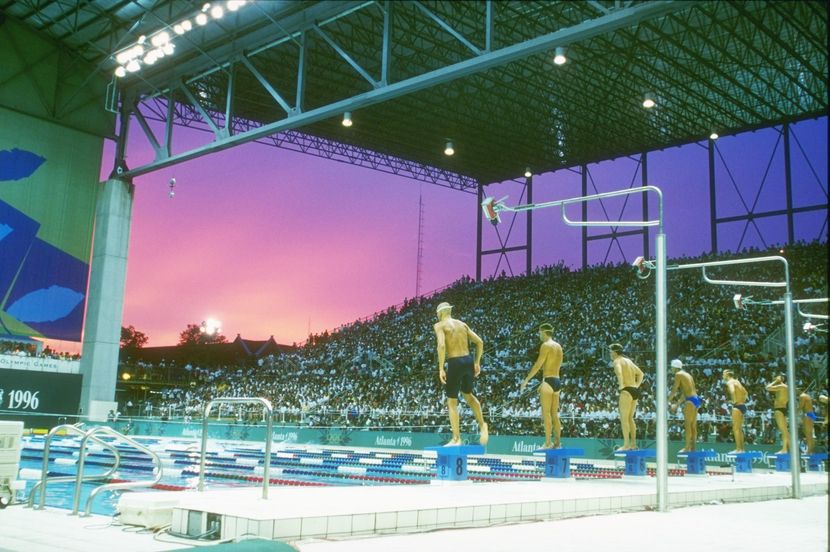
My swimming journey began at age three in Atlanta, the host city of the 1996 Centennial Olympic Games — a coincidence that would turn out to feel less like one as the years went on.
Like many competitive swimmers, the early joy of racing only deepens with time. Weekday lessons become weekend meets; weekend meets become year-round teams, new friendships, and gathering around the television every four years when the Olympics arrive. I still remember watching the 2008 Beijing Games, transfixed as Cullen Jones stepped onto the podium alongside Michael Phelps, Jason Lezak, and Garrett Weber-Gale — four men, one historic relay, one gold medal.
Seeing Cullen on that podium opened something in me. Not just pride, but awareness. Here was a sport that held more diversity than its mainstream narrative often suggested — in the pool, on the coaching deck, and in the stands. At the Beijing Games alone, swimmers from 35 countries across the Americas competed, from the large delegations of the United States, Canada, and Brazil, to the smaller but no less significant contingents from Uruguay, Saint Lucia, and Honduras. Those weren't just statistics. In my household, they sparked a question.
My parents — both Haitian, both watching five young swimmers on their living room floor — looked at the screen and asked: "How come Haiti isn't a part of this?"
It was a fair question, and one with a complicated answer. Haiti had, in fact, sent its first Olympic swimmer, Alain Sergile, to those very 1996 Atlanta Games. But the country had not been represented in the pool since. No woman had ever competed for Haiti at the Olympics in swimming. That changed in 2016, when my eldest sister, Naomy Grand'Pierre, stepped onto the Rio 2016 Olympic stage as Haiti's first female Olympic swimmer — a moment our family had unknowingly been moving toward since Beijing 2008.
Since Rio, Haiti has sent swimmers to every Olympic Games, with Emilie Grand'Pierre and Davidson Vincent in Tokyo. Most recently, Mayah Chouloute and I carried that legacy forward in Paris 2024, and Haiti has now sent swimmers — both men and women — to every Olympic Games since Rio.
None of that happened by accident.
The Community Behind the Career
Looking back, my journey was never built alone. It was shaped by a layered network of individuals and institutions, each playing a distinct role at different stages — from the coaches who first put me in the water, to the national bodies that supported my development, to the pioneers whose stories I would only come to fully appreciate years later.
At the individual level, one of the most formative figures was Coach Tommy Jackson, who led one of Atlanta's most diverse and accomplished swim programs. Among the champions his program produced were two athletes whose achievements deserve far greater recognition. Sabir Muhammad became the first African American to medal at an international swimming competition, claiming a podium finish at the 2000 Short Course World Championships — going on to break multiple American and NCAA records. Curtis Lovejoy, a four-time Paralympic gold medallist, became the first Paralympic athlete to compete across two unrelated sports, cementing his place as one of the greatest Paralympic swimmers in history.
At the institutional level, a broader coalition of leaders worked to open the sport to communities that had long been excluded. Coach Johnnie Means fought directly to desegregate swimming in the American South. Coach Jim Ellis built a championship program in Philadelphia from near-nothing — his story later told in the film Pride. And the Howard University Swim and Dive Team made history as the first HBCU program to compete at the Division I NCAA level, expanding the face of competitive swimming in America.
These weren't footnotes. They were foundations.
What Comes Next
The names and stories above are just the beginning. Across the Caribbean and the broader Americas, there are histories of Olympic swimming that have never received the platform they deserve — tales of firsts, of perseverance, and of athletes who competed not just for medals, but for the right to be seen.
In the chapters ahead, Hidden Histories of Swimming will travel region by region to bring these stories to the surface. We begin with the Caribbean — a region whose contribution to global aquatics is far deeper than most people realize.
In the meantime, we want to hear from you. Who are the swimmers, coaches, or pioneers who inspired your connection to this sport? Share your sources of inspiration — they may just be the subject of a future chapter. Reach out with stories from swimming in the Americas at media@worldaquatics.com.
The water holds more history than we know. It's time to dive in.