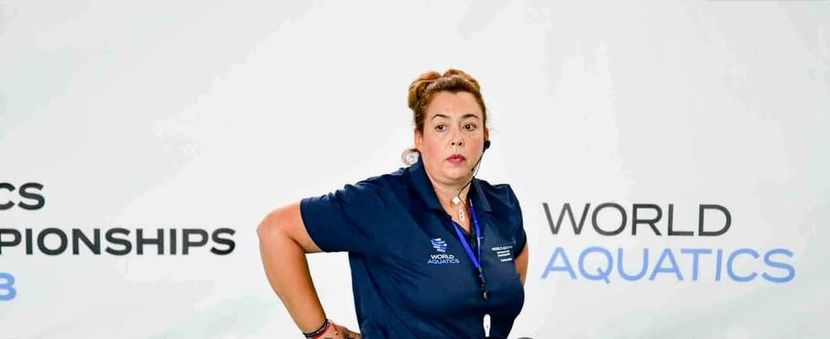
World Aquatics' Women in Water Polo Leadership Programme, in cooperation with Official Match Ball Supplier KAP7, brings together female coaches and technical officials from across the globe to support their professional development. In the final part of a series profiling the participants of this initiative, we speak to Maria Daskalopoulou, a Greek international referee and former player who has spent 13 years building one of the most distinguished officiating careers in water polo, and who sees this programme as the catalyst for the next stage of her journey.
Maria Daskalopoulou's relationship with water polo began, as it does for so many in the sport, in a swimming pool. She started swimming at four-and-a-half years old, and spent the next decade in the water before making a decision at 14 that would change the course of her life. She dropped swimming and picked up the sport that would define the next two decades and, ultimately, the rest of her career.
Her playing career was a long and decorated one, spanning more than 20 years from 1990 to 2012. Along the way she won national championships at club level, claimed World Championship at junior level with the Greek national team, and added two silver medals at European Championships. By the time she retired in 2012 at the age of 35, she had experienced almost everything the sport could offer a player.
What came next, however, was not what she had anticipated. The announcement of a referee school in Greece caught her attention, and she decided to enrol.
“To tell you the truth, I never liked coaching so much,” she admitted. “There was a referee school going on in Greece at that time and I decided to join.”
It proved to be one of the best decisions of her career. She has since officiated at European Championships, the FISU World University Games and the Euro Cup, including a number of finals that she counts among the highlights of her career.
The most memorable came at the 2019 Universiade in Naples, where she took charge of the women's final in a venue packed with several thousand spectators. It was her first experience of refereeing in front of a truly large crowd, and one that has stayed with her.
“We were in a swimming pool full of people, it was like 3,000 to 4,000 people, and for me, it was the first big experience as a referee,” she recalled.
Making the transition from player to official gave Daskalopoulou an entirely new lens through which to understand the sport. The shift was sharper than she had expected.
"When I started refereeing, I felt that I was in a different sport, because it's totally different being a player than being a referee"
“Even small things, like the ordinary fouls – it was so different for me to call something that as a player had felt normal.”
She has also witnessed the sport transform around her over those 13 years, becoming faster and more complex, with rules evolving to keep pace.
Daskalopoulou came to the Women in Water Polo Leadership Programme as someone already committed to growing the referee community in Greece, and she sees the programme as providing the tools to accelerate that work. In her home country, the number of women officiating in the national league has grown to around eight, a shift she describes as encouraging but still far short of what the sport needs.
“We have to become more – we're still so few,” she said.
The programme's early sessions have already made an impression. A profiling exercise at the outset prompted reflection on her own strengths and areas for development, surfacing qualities she knew existed but had never quite examined directly.
“We are going through a procedure where, first, we are starting to find out things about ourselves that we didn't know,” she explained.
"I found out things about me that I maybe knew existed, but I hadn't really put in my mind: this is me, this is what I can do, and this is what I have to work on"
One area she is particularly eager to develop is her digital presence and promoting the sport, telling her story and communicating about her work through social media.
“We live in a period where everything is going on through the internet and this is the way. Social media is a great tool, and we need to use it in the best possible way,” she said.
Above all, she is hoping that the programme will give her greater confidence, both in her day-to-day officiating and in her ability to encourage others. For Daskalopoulou, that development is one she wants to approach with the assurance the programme is helping her to build.
“The more confident you are, the better you are during a game and during your work,” she said simply.
Looking further ahead, she is encouraged by the broader trajectory of women's water polo. The expansion to 12 teams for the women's tournament at the Los Angeles 2028 Olympic Games is, in her view, a milestone that reflects a sport on an upward curve, and one that should be accompanied by a corresponding growth in female representation across all roles.
“I hope that in the ongoing years we have even an equal number of women officials participating – referees, judges – and I hope this also promotes coaches, because so far we don't have so many women coaches, and for sure we don't have coaches in men's teams,” she said.
“This is another thing that maybe this programme will help to achieve. I believe we will go much better. We will improve.”
About the Women in Water Polo Leadership Programme
The Women in Water Polo Leadership Programme is a joint initiative of KAP7 and World Aquatics aimed at increasing the representation and visibility of female professionals in the sport. Through structured education, leadership training, mentorship and international exposure, the programme supports women in developing their skills, advancing their careers and taking on leadership roles within coaching and officiating. It also fosters confidence and professional networks, while helping to inspire future generations of female leaders in Water Polo.
Further information can be found here.