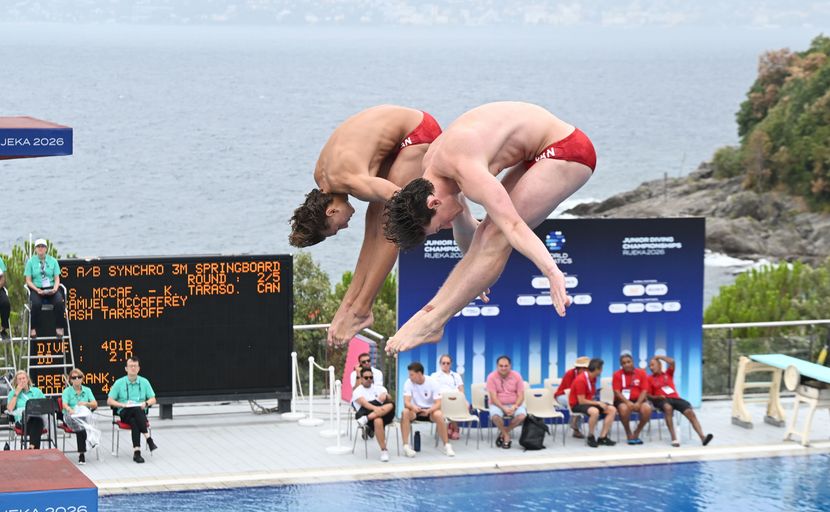
Canada took the first gold of the 2026 World Aquatics Junior Diving World Championships, in boys’ 3m synchro. Soon afterwards, twins Mia and Lia Cueva Lobato went 1-2 for Mexico in the girls’ 1m (age group B) – just five-hundredths of a point shy of a tie.
RIJEKA, Croatia – In an upset over the reigning junior European champions, Canada’s Samuel McCaffrey and Kash Tarasoff took the first gold medal of the 2026 Junior World Championships, in boys’ 3m synchro (age 14-18). The two had only trained together four times before defeating the Russian favourites Ivan Sautin and Matvei Pomoshnikov on Friday by 9.36 points. Germany’s William Ackmann and Finn Awe captured the bronze, 6.03 points behind the silver medallists from Russia.
The boys’ event was interrupted, however, by hard rain in the penultimate round, forcing the last three pairs to wait. Among those forced to wait were Valerii Malieiev and Dmytro Stepanov, of Ukraine, who were in third place at the time. When competition resumed, the Ukrainians remained in third place after round four, but scored zero on their final dive to place 12th overall.
Next, in a fast-moving 1m final for girls aged 14-15, Mexico’s favourite diving twins nearly tied for gold. In the end, Mia Cueva Lobato defeated her sister Lia by 0.05 points for the victory. China’s Chen Xiangling earned the bronze.
Friday’s third final (the mixed team event) was postponed due to an intense thunderstorm.
For details and athletes’ reactions, read on.
Boys’ Synchro 3m
Storm clouds finally broke over the Adriatic Sea at around 13:30 on Friday to put the boys’ 3m synchro event on hold after 14 of the 17 pairs had completed their fourth dives.
At the time, Canada’s McCaffrey and Tarasoff edged Russia’s Ivan Sautin and Matvei Pomoshnikov by six tenths of a point. As mentioned, the Ukrainian pair in third position were among the three duos that had to wait.
When it was over, the Canadians clinched the gold with their last and hardest dive, a forward 2½ with two twists (3.4 DD). Runners-up Sautin (son of the eight-time Olympic medallist, Dmitry Sautin) and Pomoshnikov finished their list with the two hardest dives of the contest (each carrying 3.5 DD), and earned mixed scores on their last one, a reverse 1½ with 3 ½ twists, to take silver. Germany went from fifth place to bronze with a cleaner but easier forward 2½ with one twist (3.0 DD).
Afterwards, the gold medallist from Montreal, McCaffrey, 18, shrugged off the harsh conditions.
"To be honest, I think Kash and I are a very energetic duo"
"For us, the weather was just part of the experience. We tried to turn it into our advantage and kinda play with it."
Since McCaffrey’s partner Tarasoff, 16, trains in Saskatoon, more than 3,000 km away, Tarasoff said, "We did four training sessions together – two in Croatia, two in Canada. We knew [a medal] was possible, but we were definitely surprised that we were standing on the podium."
Silver medallist Sautin, 18, said, "before this competition, I’ve trained in an open pool like three times in my life. Normally, I train indoors in Voronezh," in southwestern Russia. The silver marked Sautin’s first Junior World Championships medal but he had yet to break the news to his father, Dmitry, a five-time Olympian who won his first Olympic medal at Ivan’s age as a member of the Unified team at the 1992 Barcelona Olympics.
The Russians were also a long-distance pair. Pomoshnikov trains in Buzuluk, about 1,000 km from Sautin, and the 2026 junior European champions have only been diving together for three months. As for saving their hardest dives for last – just when the rain and wind set in – Pomoshnikov said, "we don’t regret at all, but if we had a third eye and knew that the conditions will change, we would take difficulty in the first part of the programme. We expected better result but we were confident and we got through it."
The German bronze medallists were also faraway partners. Awe trains in Rostok, on the Baltic Sea, eight hours by car from Ackmann in Aachen. "But we make the best of it," Awe said. "We are very proud of our performance today."
As for the conditions Ackmann called them "horrible," adding that they did their fourth dive without waiting "which ended up costing us a lot of points. But in the last dive, we decided to wait for the conditions to get better which paid out at the end."
Girls’ 1m (ages 14-15)
In the girls’ 1m (ages 14-15) event, scores from the first five dives in prelims carried over into the three-round final.
As it turned out, the top three qualifiers from prelims all made the podium, but not in the same order.
Mexico’s Mia Cueva Lobato ended up taking gold by surpassing both Chen of China and her own twin, Lia (the top qualifier) – edging out her sister by a razor thin 0.05 points.
Silver medallist Lia Cueva Lobato was beaming after the medal ceremony. "YES!" she said. "This is wonderful. We almost tied. Yeaaaaaaaah! In the morning, I was just thinking to enjoy the competition and have fun."
The rough conditions on Friday didn’t faze Lia. "I was a little nervous," she said, "but I don’t much care about the weather. I was trying really hard to concentrate. In the past, we used to train outside."
The twins’ whole family came to Rijeka: their mother, father, brother, and older sister, Suri (who is also competing here). In the final, Mia said, "I could hear them yelling: Do it! Do it! You can do it!" adding that "I’m so excited for the other days. I’m doing 1m, 3m, 3m synchro, platform."
Bronze medallist Chen, 15, didn’t reveal whether she was expecting to win a medal. "This morning," she said, "I wanted to place the best version of myself. It’s okay. I didn’t think about dives, just be the best of myself."
Coming up:
Two finals are scheduled for Saturday: girls’ synchro platform (ages 14-18), followed by the boys’ 3m event (for ages 16-18).