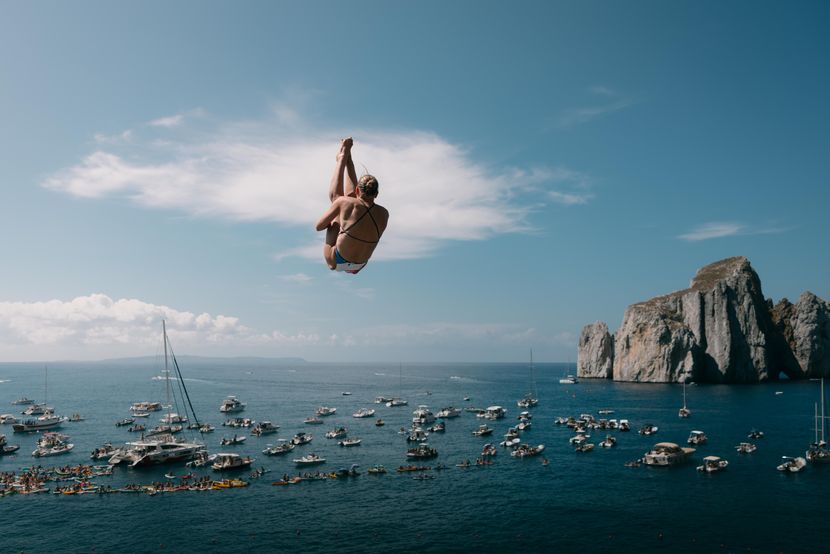
Thirteen years after high diving’s global debut, new research from World Aquatics reveals how elite athletes manage scarce access to full-height platforms, intense dryland training, and high injury risk as they prepare for competition.
A landmark research study commissioned by World Aquatics, published in the International Journal of Sports and Exercise Medicine, sheds light on how the world's top high divers train, prepare for competition, and manage their bodies.
Competing from platforms of 20m for women and 27m for men, elite high divers push the limits of aquatic sport, yet little was previously known about their daily routines. A new survey, which represents 56% of competitors at the 2025 World Aquatics Championships in Singapore, now offers the clearest picture yet.
More Time in the Gym Than the Water
One of the study's most striking findings is that elite high divers spend more hours each week training in the gym, practising skills on dryland equipment, and completing low diving sessions than they do actually diving from competition height. Recovery activities — including stretching, ice baths, massage and physiotherapy — also account for a significant portion of their weekly schedule.
Perhaps most revealing is how many elite athletes lack regular access to a platform at full competition height, with only a few permanent facilities in the world. Two-thirds of female high divers (67%) and 40% of male high divers reported that they either do not practise from competition height on a weekly basis or simply do not have access to such a facility.
Building Confidence Before Competition
When asked what helps them feel ready to compete, both female and male high divers pointed to more diving, from both high and low platforms, as the primary confidence builder in the weeks leading up to an event. This finding has implications for how competition venues are equipped: the study recommends that lower platforms be available alongside full-height structures at all competition sites, giving athletes the opportunity to progressively build into their preparation.
Where It Hurts: Soreness and Injuries
The neck, calves and lower back emerged as the most commonly sore areas after competition for both women and men, a finding consistent with the physical demands of feet-first water entry from extreme heights.
Over the year prior to the survey, 9 female respondents reported 16 injuries, while 15 male respondents reported 24 injuries. For females, injuries were split equally between acute incidents and overuse (8 each, 50% per category), whereas among males, 21 of 24 (88%) were acute and 3 (12%) were due to overuse. The most frequent injury sites also differed: females reported knee and lumbar spine injuries most often, while males mainly experienced neck and shoulder problems.
Notably, 25% of injuries in both groups occurred even when the diver entered the water with correct technique — underlining the inherent physical demands of the sport regardless of execution.
What the Data Tells Us About Injury Risk
Using correlation analysis, the researchers identified several factors associated with injury rates. For female high divers, more hours spent training from competition height were associated with more injuries, whereas more hours in the gym were associated with fewer injuries. For less-experienced divers — defined in the study as those with fewer than 8.5 years of diving experience — a higher volume of high-diving training was strongly associated with increased injury risk. For more experienced athletes, greater gym time appeared to offer a protective effect.
The authors are careful to note that correlation is not causation, and that a larger prospective study would be needed to formally establish risk factors. However, they advocate a pragmatic approach to injury reduction in the meantime, given the small, globally dispersed nature of the high diving community.
Female-Specific Findings
The study also gathered data on issues specific to female high divers. A significant majority, 78%, reported experiencing perineal pain during diving. One in three reported a history of urogenital infections. While none currently use protective swimwear, 67% expressed interest in developing a swimsuit that provides greater protection in the perineal area. The authors call on healthcare providers and officials to assume the challenge of designing improved competition swimwear for female high divers.
Recommendations for Athletes, Officials and Medical Staff
The study makes a series of practical recommendations across three groups.
For athletes, the findings point to the value of a well-rounded strength and conditioning programme, with particular attention to neck strengthening given the consistent appearance of neck soreness and injury across the sport. Less-experienced high divers may benefit from managing their full-height training volume more carefully.
For officials, the priority should be to expand the global network of pools with permanent full-height platforms, while ensuring that every competition venue provides lower platforms for warm-up and preparation dives, as well as recovery facilities, including ice baths, massage, and physiotherapy.
For healthcare professionals, the study highlights the importance of multidisciplinary support teams within national training centres, along with regular medical screening — including cervical spine imaging, psychological support, and nutritional guidance.
A Foundation for Future Research
The study was conducted as a survey during the 2025 World Aquatics Championships and was published in the International Journal of Sports and Exercise Medicine. The authors acknowledge the limitations inherent in survey-based research, including non-response bias and the relatively small overall population of elite high divers worldwide. Nevertheless, with more than half of the entire world championship field represented, they believe the findings offer genuinely new and valuable insight into a sport that continues to grow on the global stage.
The authors call for ongoing, year-round injury and illness registration across the high diving community, as well as prospective research into the specific risk factors identified in this study, to build an evidence base that can inform the sport's long-term development.