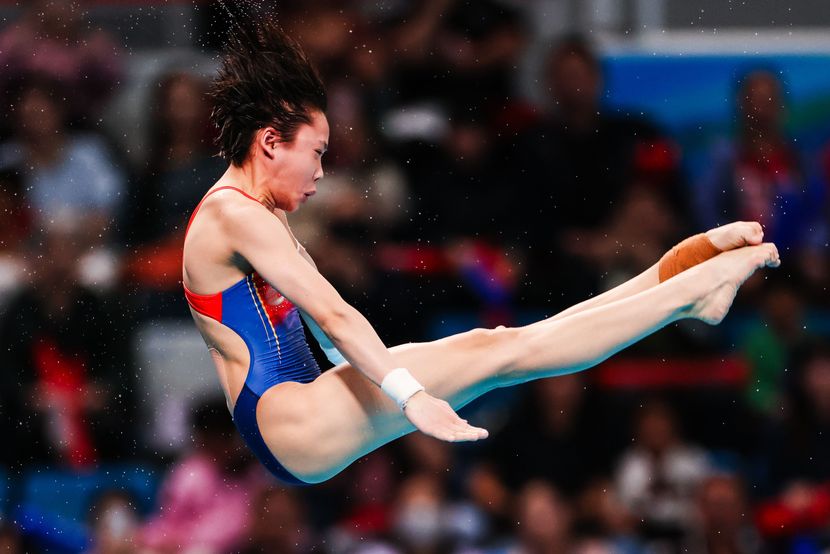
On day two of the 2026 World Aquatics Diving World Cup Super Final, China claimed two more gold medals to remain undefeated through seven (of nine) events.
At Beijing’s water cube on Saturday, Wang Zongyuan, 24, dominated the men’s 3m final to give China its sixth gold medal of the weekend. His teammate Zheng Jiuyuan, 22, claimed silver to replicate their 1-2 finish at last year’s Super Final. Mexico’s Osmar Olvera Ibarra, 21, stormed back after a botched dive in the third round to take bronze, ahead of Jules Bouyer of France who was seeking his first World Cup medal.
In the second final of the day, 15-year-old Jiang Linjing snared China’s seventh gold as she obliterated the field in the women’s 10m platform event, finishing 78.75 points ahead of runner-up Anna Konanykhina, 21, of Russia. Germany’s 2025 World Aquatics Championships runner-up Pauline Pfeif, 23, took the bronze, ahead of the new American star Ellireese Niday who turned 14 in February and was making her Super Final debut.
Here’s a closer look:
Men’s 3m
Going into the last round of the men’s 3m final, Wang already carried a 25.10-point lead over Zheng, but he saved his best for last. The three-time world champion scored a massive 102.60 points on his final dive, an exquisite 109C (forward 4½ with a 3.8 degree of difficulty), to post 544.35 points for the win. Zheng claimed silver, 43.85 points behind his older teammate.
Wang said he was “very happy” to retain his title at home. “Twelve dives in two hours was quite a challenge,” he said, referring to the elimination format which premiered at last year’s Super Final. “From the preliminary to the sem-ifinal, I tried hard to find my rhythm. The best part of my performance today was [that] I was able to quickly reset my mindset and smoothly find the competition rhythm.”
Runner-up Zheng also called new format “intense.”
“Actually,” Zheng said, “I was a bit too excited during the competition, but in the final, I got into the groove and performed at my highest level.” To reach the final, Zheng had to beat the no. 11 seed Nikita Shleikher of Russia in a head-to-head match-up, then finish among the top two in his three-man semi-final. And while Zheng’s final score (500.50) was about five points less than his silver-medal score from 2025, he felt he had improved his control since then.
But perhaps the most exciting plot line involved the no. 4 seed Olvera Ibarra of Mexico. In the third round of the final, the reigning world champion nearly landed on his back on his 207C (a back 3½). The dive scored a mere 46.80 points and dropped the Mexican to last place in the four-man final, 66.25 points behind Wang’s lead. The slip gave hope to Bouyer of France, the no. 7 seed and the lone finalist who had never won a World Cup medal. But Olvera Ibarra rallied back to earn more than 90 points on his last two dives to claim the bronze with 480.50 points.
Olvera Ibarra said afterward that he’d been struggling with injuries before the Super Final. “During the competition,” he said, “I actually felt better than I did in training. I just need to focus more and adjust. My goal was to take the gold, but I'll just keep working harder.”
All the athletes seem to have learned that the new Super Final format requires both consistency and stamina because one error can mean disaster as the field grows smaller.
The men’s individual 3m event began with six head-to-head-matchups. The only upset during that phase was a minor one when No. 7 Bouyer eliminated the No. 6 seed, Nathan Zsombor-Murray of Canada, by 43.50 points. The six remaining divers carried their head-to-head scores into the semi-finals where Wang and Olvera Ibarra advanced easily in one group. Bouyer and Zheng (the reigning 1m world champion), emerged from the other semi-final. In the four-man final, all scores were wiped clean and each diver performed his full list of six dives to determine the winner.
Women’s 10m
As the top seed in the women’s 10m event, China’s Jiang, 15, had no trouble beating the no. 12 seed, Suri Cueva Lobato of Mexico, in their head-to-head meeting, and leading the first semi-final group to advance to the final along with American no. 4 seed Niday, who had ousted Australia’s no. 9 seed, Ellie Cole in her head-to-head match by 10.80 points.
The biggest surprise came on the other side of the draw when the no. 10 seed Konanykhina eliminated the no. 3 seed, Jo Jin Mi, 22, of the Democratic People’s Republic of Korea in their head-to-head meeting by 3.90 points. Then, in the second semi-final group, Konankhina and Pfeif (the no. 11) advanced to the final by bouncing another top-10 seed, the no. 7 Kate Miller of Canada.
With a clean slate in the final, Jiang blazed so far ahead of the field that she could have scored one point on her final dive and still won gold based on her score after the fourth round (335.55). With the pressure off, Jiang lost some sharpness on her final dive: a back 2½ with 1½ twists (a 5253B) that only added 62.40 points to her winning tally of 397.95.
Jiang said afterwards that she was aware of her lead. “I saw the scores during the competition,” she said, “but I knew I still had to focus on doing my best in the remaining dives. I cried after winning the gold because I hadn't done well on my 407C [in the semi-final] and 5253B [in the final]. I did better in training.”
"Winning this title gives me extra motivation for my training going forward"
The battle for silver was closer. Konanykhina surpassed Pfeif on her final dive (a 5253B) to end the day with 319.20 points – just 2.20 points more than Pfeif, the reigning World Championships silver medalist who took bronze.
“It's very important to win the silver medal today,” Konanykhina said. She added that it was her first time competing in the elimination format yet “I am very relaxed, actually”.
Bronze medalist Pfeif said she was grateful to turn things around after placing eighth in 10m synchro on Friday. “Since Montreal [the World Cup in late February], I think I've made a lot of progress physically, and also mentally.”
Notably absent was China’s Cui Jiaxi, who took silver behind Jiang at the Montreal World Cup nine weeks ago at the age of 13. According to China’s head coach Zhou Jihong, Cui was sidelined with a strained shoulder muscle she incurred while training last weekend.
But there was another bright young star in the final who made a lasting impression: Niday, the American, the only diver to compete in a swim cap. Had it not been for a pair of relatively easy sub-par dives in the second and third round (a 305C reverse 2½ with a 2.8 DD that the runner-up Konanykhina also had on her list, and 205B back 2½ with a 2.9 DD which Pfeif also performed), she might have had a shot at the silver.
Still, 14-year-old Niday, said, “I'm the youngest one in our team and I look up to every single one of [these athletes]. They're all amazing.” Niday enjoyed the format, too.“
"It's a new way of diving for sure, but it's so fun to watch and to be in it. It's an amazing opportunity for me"
Next, she said, “My plan is to hopefully dive to the best of my ability and one day represent the US again.”
Coming Up:
The 2026 World Cup Super Final concludes on Sunday with two more head-to-head events. First will be the women’s 3m final featuring China’s No. 1 and No. 2 seeds Chen Yiwen (the reigning world and Olympic champion) and Chen Jia (Chen’s world champion synchro partner), respectively.
The event will close with a fascinating men’s 10m platform showdown that will include all three current world championship medalists: Australia’s two-time world champ Cassiel Rousseau, 25, Ukrainian silver medalist Oleksii Sereda, 20, and bronze medalist Randal Willars Valdez, 24, of Mexico. At the same time, China’s Bai Yuming, 19, and Lian Junjie, 25, will aim to extend China’s winning streak in the ninth and final World Cup event of 2026. Don’t miss it!
Additional reporting by Rachel Li Jia in Beijing