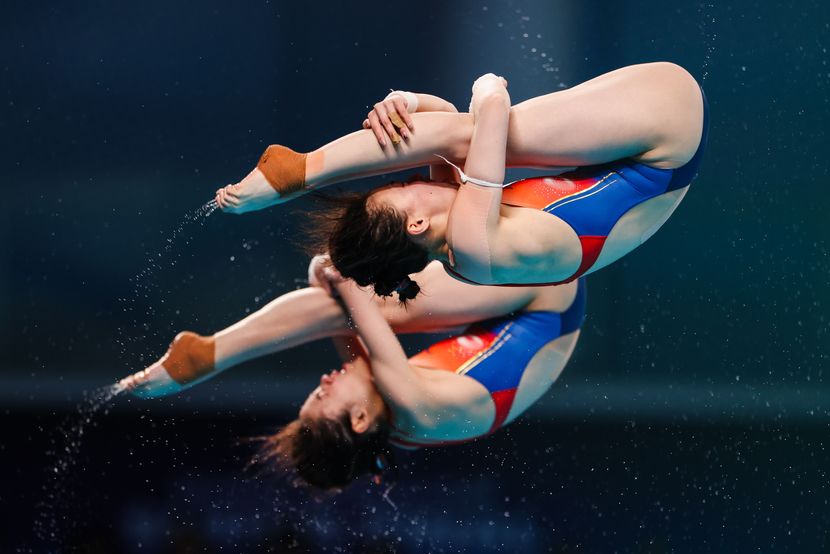
China struck quintuple gold on the first day of the 2026 World Aquatics Diving World Cup Super Final in Beijing.
On Friday, China was so dominant that at least 40 points separated it from the rest of the field in every event except women’s 3m synchro, where China’s winning margin was still a significant 31.11 points. After claiming the first five gold medals for the host nation, four individual events remain.
Here’s how the busy day unfolded in Beijing:
Men’s 3m synchro
The day began with men’s 3m synchro, where the reigning world champions Wang Zongyuan, 24, and Zheng Jiuyuan, 22, led after each round to score 460.68 points en route to Wang’s 24th World Cup victory.
“The chemistry between us is really good,” Wang said. “We encountered some injuries during the year but we always encourage each other.”
🇨🇳 Team China claim first 🥇🥇at the #Diving World Cup Super Final winning both 3m Synchro events!
— World Aquatics (@WorldAquatics) May 1, 2026
Full results https://t.co/hTQjEfPcBm pic.twitter.com/Ym3UnfydR3
The turning point for the rest of the medalists came in the fifth round where the 109C (a forward 4½) tripped up several pairs, including Mexico’s Osmar Olvera Ibarra and Juan Manuel Celaya Hernandez, as Olvera Ibarra entered the water at a 45-degree angle. Their 67.26-point score allowed Great Britain’s Jack Laugher, 31, and Anthony Harding, 25, to advance to second place behind China. Adding intensity to the event, Mexico had saved its hardest dive for last: a triple twisting 2½ with a 3.9 DD. Under pressure, the 2024 Olympic silver medalists scored 90.09 points to pull ahead of Great Britain by 14.37 points and hand the Brits the bronze.
Over the past nine weeks following the World Cup in Canada, runner-up Olvera Ibarra said, “we’ve focused on improving every dive. Today we scored higher than we did in Montreal; that’s what matters.”
Bronze medalist Laugher said competing against China and Mexico “is always very fierce”, but his partner Harding said he and Jack were “a perfect match from the start.” Since the two are targeting the 2028 Los Angeles Olympics, Harding said, “We just need to stay fit and healthy. We don’t dwell on the past, we keep looking forward, and we stay ready.”
Women’s 3m synchro
China’s second gold medal came in women’s 3m synchro from reigning world champions Chen Jia, 21, and Chen Yiwen, 26. They, too, led after each round to finish 31.11 points ahead of runners-up Maddison Keeney, 29, and Alysha Koloi, 24, of Australia. All afternoon, the Aussies had been in a tight race for silver with Great Britain’s Yasmin Harper, 25, and Scarlett Mew Jensen, 25. In the end, the Australians’ fourth dive, 107B (a forward 3½), proved to be pivotal as it earned 72.54 points to clinch the silver. The Brits claimed the second bronze of the day.
Chen Yiwen said after the victory:
"As I get older, I tend to perform more steadily in competitions"
"However, when it comes to training, my form does fluctuate a bit more. A big reason might be that after the [2024 Paris] Olympics ended, I mentally relaxed a lot. Right now, I’m still working hard to get myself into the mindset for the [2028] Los Angeles cycle.”
Silver medalist Keeney said, “I had a good time. I’m really happy with our consistency.”
Third place finisher Mew Jensen credited her relationship with Harper as being key to their bronze. “Our relationship with each other is really strong,” Mew Jensen said. “We took some time…individually and worked on ourselves, and we found that made us stronger when we came back together and it’s shown.” After the Super Final, the pair will prepare for the British Championships with hope of qualifying for the European Championships from July 31-August 6 in Paris, France.
Men’s 10m synchro
In men’s 10m synchro, China’s Yang Zihao, 16, and Zhao Renjie, 15, led after each round to capture gold with 448.68 points despite losing valuable execution points on their hardest dive (a 109C in the penultimate round). Even with the bobble, the teenagers were the only divers to earn more than 90 points for a single dive – and they did it twice – on a 307C (a reverse 3½) and a 5255B (a back 2½ with 2½ twists).
The elder Yang said “I don't think there's been much change” compared to the World Cup in Montreal in February. “I'm still not stable on some dives. But I do feel less anxious than last time.”
Ukraine’s two-time Olympian Olekseii Sereda, 20, and Mark Hrytsenko, 16, placed second in a topsy-turvy race to fill out the rest of the podium. After the fourth round (of six), Mexico, Canada and Ukraine ranked second, third, and fourth, respectively – all within three points of each other. But on the final dive, Ukraine bumped Mexico’s Kevin Berlin Reyes, 25, and Randal Willars Valdez down to bronze-medal position by 1.26 points. Only the medalists cleared 400 points.
Ukrainian runner-up Sereda said, “We did a lot of training, a lot of hard work… and this helped us to get this medal. We’re happy to represent our country and show a good result today.”
Bronze medalist Berlin Reyes said the medal “is why we came here. I’m just happy and excited to compete” with Willars Valdez, who celebrated his 24th birthday one day earlier.
Women’s 10m synchro
In women’s 10m synchro, Chen Yuxi, 20, and Lu Wei, 20, demonstrated China’s dominance once again. The event’s 2025 world champion (Chen) and the event’s 2019 world champion (Lu) tallied 366.12 points for the win. They also captured two scores of 10 on their final dive, a complicated back 2½ with 1½ twists (5253B).
Gold medalist Chen was proudest of the fact that “in the final round, I gradually let go of myself and got my whole mindset back on track. From today's performance, you can see that my overall training level hasn't reached a very peak state yet. This includes things like the consistency.” Since 2026 marks the first time in five years there will be no World Aquatics Championships, Chen said, “my biggest goal for the rest of this year is the Asian Games” in Nagoya, Japan, in late September.
Kim Mi Rae and Jo Jin Mi, 22, took silver for the Democratic People’s Republic of Korea, 44.82 points behind China, and a comfortable 24.18 points ahead of bronze medalists Ellie Cole, 19, and Milly Puckeridge, 21, of Australia.
Kim called North Korea’s performance “okay,” acknowledging that “we made some mistakes and there are still areas that need improvement. We will continue to refine our movements. Our ultimate goal is to win a gold medal at the [2028] Olympics."
Meanwhile, the Aussies had been in seventh place after three (of five) rounds, and squeaked onto the podium on their final dive to finish just 1.08 points ahead of Mexico’s Gabriela Agundez Garcia and Alejandra Estudillo Torres. Afterwards, Cole said she was proud of the bronze. “We’ve been so close to a medal for so long, so to walk away with that medal…we’re excited to see where it takes us in the future.”
Mixed Team
China closed the day with its fifth gold in the mixed team event. However, it competed with a completely new lineup compared to the World Cup in Montreal, so that meant there would be no heroic efforts by 13-year-old Cui Jiaxi and 14-year-old Zhao Renjie on Friday. Instead, it was up to 3m specialists Lin Shan, 24, Liu Chengzan, 16, and 10m experts Bai Yuming, 19, and Lu Wei, 20, to keep China undefeated.
The only shaky moment came in the third round (3m mixed synchro) where Lin and Liu didn’t enter the water vertically on their 205B (back 2½ pike) and scored only 52.50 points. Suddenly, at the midpoint, Mexico was just 2.60 points behind China’s lead, and Russia was only 6.10 points behind Mexico. Canada was just 3.30 points behind Russia, in fourth.
In the 10m portion, however, Australia came out of seventh place to take the bronze, thanks to a pair of 80+ point individual dives by Ellie Cole and two-time individual 10m champion Cassiel Rousseau (who did double duty on 3m as Australia’s only male in Friday’s team event). Mexico hung on to second place, finishing 41.20 points behind China, and 12.05 points ahead of Australia.
Even with the gold medal, Bai was a bit disappointed with his 10m dives, saying, “I didn't do well on my 109C, and then the next dive was a 407 – one less somersault than the 109 – so I struggled a bit to adjust,” adding that he felt more pressure in team events “because I worry that a bad performance from me could hurt the team's overall result.”
Mexico, the silver medalist, made a slight change to its Montreal roster in Beijing, substituting platform diver Alejandra Estudillo Torres, 20, for Gabriela Agundez Garcia, 25. Torres was originally supposed to compete in Montreal, too, but was injured in the individual 10m practice so 3m diver Aranza Vazquez Montano, 23, said, “We were really excited Ali was in the team now. We had a strong team all throughout the year. It is a great environment, honestly. We're all really good friends and a lot of us also grew up together. We just want each other to do well.” Osmar Olvera Ibarra and Randal Willars Valdez also contributed to Friday’s team silver.
The third member of Australia’s bronze-medal team, Maddison Keeney, said, “I'm just lucky to be here. These guys dove amazingly,” referring to Cole and Rousseau. “I didn't have my best performance tonight with my individual [3m] dive; I just did one practice dive in the warm-up. But these guys were amazing. I'm just lucky to have them.”
Next: Head-to-head action begins in the individual events on Saturday, starting with the men’s 3m springboard final where the three-time world champion Wang Zongyuan could face the 2025 world champion Olvera Ibarra. After that, the women’s 10m final will feature China’s 15-year-old favorite, Jiang Linjing, and Jo Jin Mi of the Democratic People’s Republic of Korea.
Additional reporting by Rachel Li Jia in Beijing