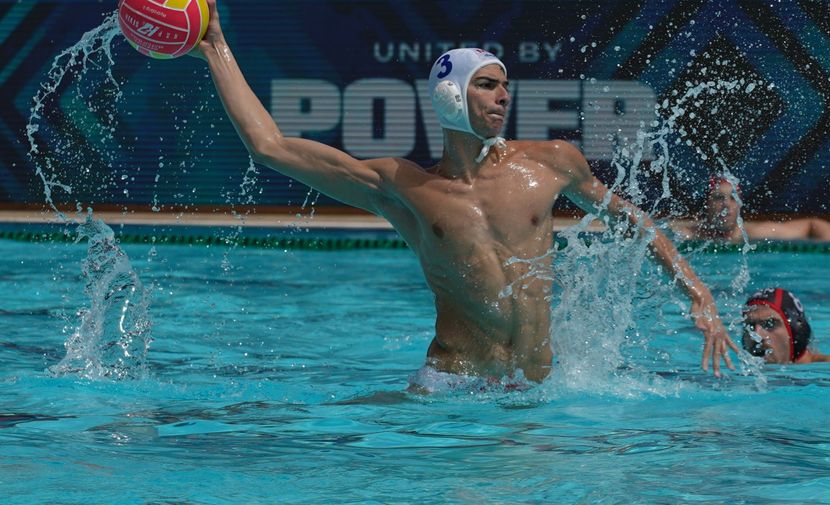
Historic participation levels at the World Aquatics Men’s Water Polo World Cup 2026 Division II tournament underscore the sport’s expansion, as two teams secured their spots for the World Cup Finals in Sydney, Australia.
Overview
Malta has been a hotbed of water polo competition for decades and has hosted many top-flight competitions. Last week witnessed a breakthrough in participation numbers at the elite level with a staggering 23 teams contesting the Division II portion of this year’s World Aquatics World Cup.
It was no mean feat to use two venues to cope with the exhausting schedule, which will be repeated later in the month when the Division II women’s competition is played.
With teams allowed up to 16 athletes and one team providing 11 officials, this was easily the largest single competition that World Aquatics has staged. In the past, junior men have played with up to 24 teams at world championships.
There was an amazing 74 matches played over the two venues in just seven days, a testament to the resilience of the athletes, officials and spectators alike.
There were 14 nations from Europe, four from Asia, three from the Americas, one from Africa and one from Oceania. Of the “missing” nations, Japan was a late withdrawal, and possibly New Zealand was also a major absentee.
This shows the depth of the sport currently because there are also other nations who could have competed at this event.
The expansion from last year’s competition, where 12 teams contested in Istanbul, Turkey, shows we are heading in the right direction. Georgia, Hong Kong China, Slovenia and Poland made their World Cup debuts.
The biggest shock was newcomer Georgia rebounding from a 17-16 day-one loss to Turkiye and then qualifying for Sydney. Georgia has been on the rim of the leading nations in recent years, and this surge warrants a close look at the team ahead of Sydney.
Georgia survived a penalty shootout against Brazil in its second encounter and was always at least six goals ahead of its opponents before the final-day clash with eventual champion Montenegro, which won 19-17. Division I teams will be monitoring vision of Georgia playing very closely.
Singapore is traditionally the South-East Asian Games champion and melding into the wider international scene has had major benefits for the nation. The same can be said for Hong Kong China flexing its muscles at this level.
South Africa is going through a major reshuffle, with youngsters coming through to replace some long-standing players who have retired. By staying with the Division II competition, it bolsters its chances and experience ahead of the biennial World Aquatics Championships.
The previous World League did not attract as many teams, so by splitting the World Cup competition into two divisions, so-called lesser teams have a chance for closer encounters, unless you are unlucky enough to clash with Montenegro or Georgia!
Next year, the two teams dropping from Division I are the United States of America and the Netherlands — two well-credentialed outfits.
TWPC Chair’s Comments
Tamas Molnar, who leads the World Aquatics Technical Water Polo Committee, said the men’s tournaments were an “undoubted success”.
“We are trying to bring the men and women to the same condition, no difference in rules, pool size. Women are developing a lot and we have to support women’s water polo. The point men’s water polo has reached so far is very good.”
Molnar spoke of the competition structure and the points system in Division II that means no matter who turns up, the competition is the same for all. There were more competitive matches, he said. “Because of the current international situation, also there were teams who could not make it to Malta, but to have 23 teams attend was a big success.
“We hope to see the women’s teams provide the same quality in Malta (when the Division II tournament starts on Tuesday, followed by the Division I tournament in Rotterdam, Netherlands on 1-6 May).”
Olympians All
Let’s consider the nature of this competition —nations who have attended the Olympic Games — Montenegro, Australia, France, Romania, Brazil, Canada, Germany, South Africa, Kazakhstan, China and Great Britain — and you see just how good this event is.
In the recent Paris Olympics, Australia, Montenegro, France and Romania were in the programme. In Tokyo 2020, Kazakhstan and South Africa were included. This was not a competition for the faint-hearted.
The Qualified Teams
Montenegro dominated its matches and Georgia learnt from each match to deserve their places in Sydney. Montenegro found itself in Division II with a last-minute meltdown to Croatia in their quarterfinal in Podgorica, Montenegro last year, losing by a single goal. Georgia was competing for the first time.
Montenegro has the all-round game and a blend of tested veterans and youngsters keen to make their mark. Strahinja Gojkovic and Danilo Stupar have just turned 19 and scored 31 goals between team (22-9). Nikola Moskov chimed in with 20 goals in a team where the goals were shared around.
Dusan Matkovic, Balsa Vuckovic, Duro Radovic and Srdan Janovic are such major players giving this team balance and power.
Montenegro scored 82 goals — the best by far — scoring the most on action, from centre forward and second on penalties. Its extra-man goals were insignificant because of the previous examples.
Georgia, by comparison, scored 52 goals and topped the extra-man count with 20, alongside Ukraine. It also scored 23 action goals, three more than second-placed Montenegro, and scored nine from centre forward, where it dominated.
Georgia has a mix of old and young with Valiko Dadvani and Khvicha Jakhaia both scoring 10 goals. Nika Shushiashvili was another high performer, netting seven goals.
Of the two teams heading to the Southern Hemisphere, Montenegro has nine players born this century and Georgia five.
Team Progression
Montenegro was untroubled en route to the final, but had to surpass Romania 14-8 in the quarterfinal, dump France 15-11 in the semifinals and fend off Georgia by two in the final. Georgia lost the first-day opener to Turkiye, needed a shootout win over Brazil 17-5 on day two; bumped off Ukraine 20-9 in the quarters and Germany 19-13 in the semis.
Australia failed to make the semifinals. As the host nation in July, it has automatic access and thus was out to gain more experience in Malta. It was shocked by Germany 14-11 in the quarters — Australia’s only loss — going on to defeat Romania for fifth place in a 16-14 shootout.
France’s Thomas Vernoux was named the best player and equal highest goal-scorer with 36 goals. He shared the goal-scoring with Argentina's Carlos Camnasio. Best goalkeeper went to Raul-Ioan Gavris (ROU) and Gojkovic was named best youngster.
Of the two teams heading to Sydney, Gojkovic was the best shooter with 22 goals, followed by Moskov (20), Dadvani (17) and Vuckovic (16).
Clutch Matches
Day 1: Georgia being pipped by Turkiye 17-16.
Day 2: Canada upsetting France 13-12; Georgia needing a shootout to beat Brazil 17-15.
Day 3: Argentina getting the better of Ukraine 15-14 and China pushing aside Turkiye 16-13.
Day 4: Slovenia slipping past Great Britain 13-10.
Day 5: South Africa knocking off Hong Kong 23-22; Canada downing Turkiye 15-14; Malta 16-15 over Argentina; France defeated NAB 14-13.
Day 6: Malta pleasing the home crowd with a 13-12 victory over Brazil; Canada downing Slovakia 14-12.
Day 7: Six of the seven matches were two-goal differentials with Brazil the closest at 13-12 over Slovakia.
Conclusion
This final day showed how vital this competition is to the development of world water polo. Only by playing these close tournaments can the game progress.
This event should open the eyes of other nations — especially Asia, where it is widely played — and possibly more teams from Europe. It just begs the question, how many teams can a venue cater for?
Another point is that it showcases individuals’ abilities, with the possibility of players earning overseas contracts with top clubs — that, and the chance to play against the best, visit different countries, and compete under the close eye of top-level referees.
For two teams, the reward is a long trip Down Under.