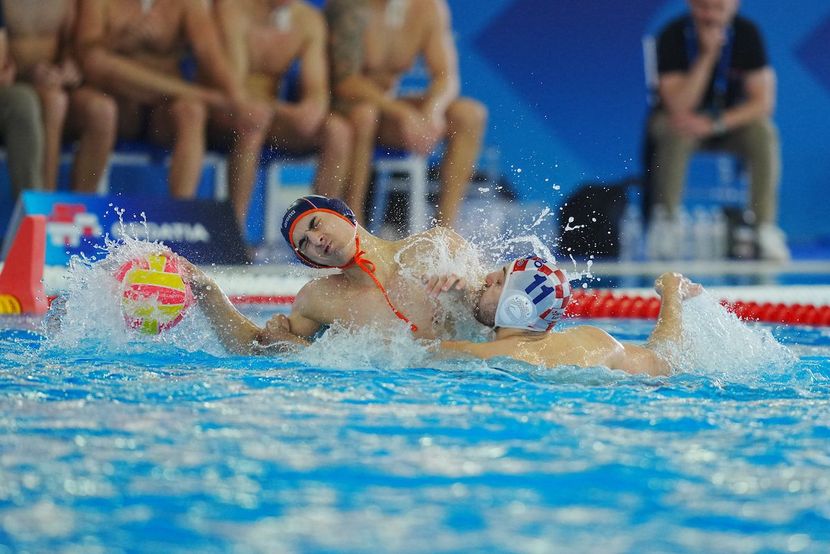
Five teams qualify for the World Aquatics Men’s Water Polo World Cup 2026 Finals following a tournament defined by tactical discipline, standout individual performances and key breakthrough moments.
Overview
Spain maintained its No 1 world ranking, even though it lost to Greece in a penalty shootout in the final match of the Division I tournament. With it, Spain finished atop the points to take out first place in Division I ahead of world No 6 Italy and No 3 Greece.
The round-robin series among the top four was enthralling with Spain and Italy winning on day four; Greece and Spain winning on day five and Greece and Italy on day six. The sole loser in the second half of the tournament was Hungary with three straight losses.
However, while Hungary lost matches with differences of four, six and three, it is still handily placed three months out from the Sydney finals.
The fifth and final place went to Croatia with a crushing 11-6 defeat of triple Olympic champion Serbia, this year’s European champion. Serbia will not make the trip as the sixth position is allotted to the host nation, in this case Australia, who contested the Division II event.
There was nothing between the top four as Spain lost to Italy and Greece; Italy lost to Spain; Greece lost to Hungary and Italy and Hungary beat Greece on day one before losing the last three. This left Spain with seven points, Italy with six and Greece five while Hungary had none.
Bringing in Montenegro and Georgia to the mix, as well as Australia who only lost once in Malta, will prove a most interesting tournament. As the main event of the global year in the absence of Olympic and World Aquatics Championships, reputations will be on the line and the battle for medals will be intense.
Of the preliminary round, the biggest hurdle for Hungary was Netherlands, succeeding in a penalty shootout 16-15. In fact, while Serbia and United States of America were not performing highly, Netherlands was doing its hardest to qualify, losing by four to Serbia, by three to Greece and four to Croatia. However, Netherlands’ real fight began in the second stage, going down to Croatia and Serbia again by four goals before toppling USA for seventh place, winning 12-11.
For consistency and determination, the Dutch were on the ball, but not quite at the level of the more experienced teams.
Italy was another very consistent team, but stumbled against Spain on the penultimate day. With no unbeaten teams, it was a treat to watch this tournament.
Statistics
Spain was third in scoring; fourth in action shots and fourth in extra-man scoring.
Italy was second in scoring; sixth in action shot and first at extra-man scoring (35/70).
Greece was first in scoring (83); third in action shots and second in extra-man attack (34/64).
Hungary was seventh in scoring; second in action shots and eighth in extra-man goals.
Croatia was fourth in overall goals; top of action goals at 24 and fifth on extra man.
World Rankings
Looking at the world rankings after the event, Spain stays on top, second-placed Italy moves up to sixth after missing last year’s World Cup through suspension; Greece holds third spot; sixth-placed Serbia is now fourth; Croatia stays at five; USA remains at seven and Netherlands moves up to 14th. Of the two Division II qualifiers, Montenegro is now eighth and Georgia 17th. Host Australia sits 12th.
Best Players
It was too easy seeing Stylianos Argyropoulos (GRE) taking out the Most-Valuable-Player award with not just his scoring — top scorer with 24 — but with his dominance in the pool and ability to take the hard shots when most needed. He was a threat every time he took a breath.
Others to shine through were Bernat Sanahuja and Alvaro Granados (ESP); Vasilije Martinovic and Nikola Jaksic (SRB) who will be missed in Sydney; Konstantin Kharkov and Tin Brubnjak (CRO) while Vince Vigvari worked hard for luckless Hungary. Ryder Dodd (USA) — who collected best-youngster award — will be another who could have added sparkle in Sydney.
Of the goalkeepers, Mauro Cubranic (CRO) had a 65 stoppage percentage; Unai Aguirre (ESP) flagged 52.2 per cent; Panagiotis Tzortzatos (GRE) 44.7 per cent; Soma Vogel (HUN) 48 per cent; Gianmarco Nicosia (ITA) 48.9 per cent. All five teams generously used their other goalkeepers.
Decisive Plays
Gergely Burian (HUN) off a deep across-the-face pass on extra with five seconds remaining against Greece to win 13-12 on day one.
Adam Nagy (HUN) with a blast from the top right for 11-1, three seconds from the final buzzer to force a shootout against Netherlands on day two. Hungary won 16-15.
Nikolaos Gkillas with a fumbled acceptance of a cross pass, then a shot on the buzzer of three quarters for 11-7 down against Serbia on day two. Argyropoulos scored two late goals to win 16-15.
Pol Daura (ESP) snapping up a rebound to score on the buzzer — VAR taking some time to corroborate it left the hand on time. It was for 10-6 at halftime in the 13-9 win over Hungary.
Konstantinos Kakaris (GRE) levelling at 11-11 with eight seconds remaining to force a shootout against Spain, winning the penalties 4-2 for a 15-13 victory.
Up-And-Comers
World Aquatics was spreading the cash and the best young player from each tournament was awarded $US2000, as were the highest scorers, most valuable players and best goalkeepers.
In Alexandropoulos, the best youngster was Dodd (USA), who has been making a name for himself these past few years. At nearly 20, Dodd was his team’s best scorer with 12 from 29 attempts, only one from the penalty stripe. Jett Taylor, 17, was the youngest player, getting the equivalent of two quarters in two matches.
Brubnjak (CRO) may be 25, but he is new at this level and made a huge impact on his team and the tournament, scoring 12 goals at 48 per cent.
Ante Jerkovic (CRO) is just18 and played three matches for two goals, doing plenty of work around the pool.
Biel Gomila (ESP), 20, was another to impress with hard work even though he took only two shots and scored both.
Dimitrios Chatzis (GRE), 18, is another to watch as he develops. He gained valuable time in all six matches, scoring four times.
Peter Szalai (HUN), 22, gained 44 minutes in three matches and punches above his weight, scoring thrice.
Alessandro Balzarini (ITA), 22, five matches and 74 minutes shows how head coach Alessandro Campagna holds him in high esteem. Netted four.
Kimi Christ (NED), 17, one from one in his 12 minutes of two matches.
Fabio Jukic (NED), 19, took nine shots in three matches, burying one.
Luka Gladovic (SRB,) 19, the fourth-highest player to spend time in the water for his team, scoring eight goals from 21 attempts.
Best Senior Players
For Spain, Sanahuja, Granados and Unai Biel were best; for Italy, Matteo Iocchi Gratta and centre forward Francesco Cassia; for Greece it was Argyropoulos and Efstathios Kalogeropoulos; for Hungary, Vince Vigvari and Gergo Fekete; for Croatia, Kharkov and Loren Fatovic; for Serbia, Martinovic and captain Nikola Jaksic; for Netherlands, Mart van der Weijden and Lars ten Broek; for USA, Ryder Dodd, now truly in senior ranks, and captain Max Irving.
Trends
The shorter pool allowed for breathing space, but generally there were just 30 shots per team. The shorter clock meant quicker passing and faster thought processes. It was noted that there were many players whipping the ball off the hand as soon as it arrived. It seemed that every team either shot or lost the ball within the 18 or 28 seconds.
The use of the cross pass is coming more frequently, as is the use of the deep-left player to receive the ball and shoot. Beating the goalkeeper with the cross pass is tantamount to excellent and prolific scoring
.
Goalkeepers were kept busy and most coaches used both athletes to good effect, because they were of the calibre needed. Also, the older goalkeepers were taking more of a back seat to the youngers guys.
Conclusion
We are still two years from the Olympics and coaches are still experimenting, turning up with new players and now getting used to calling challenges more often, some successfully, proving the worth of VAR.
This is the elite competition in the world and the players treated that as such.
It was such a pity to see Serbia drop so many matches — twice when head coach Uros Stevanovic was in the bleachers on suspension.
The men’s and women’s Finals competition wraps up in five days, with teams getting the one big quarterfinal chance and then the semis and finals, to be played at Sydney Olympic Park Aquatic Centre — scene of the 2000 Sydney Olympic water polo finals and 1995 Women’s World Cup and 1999 Men’s World Cup — on 22-26 July.