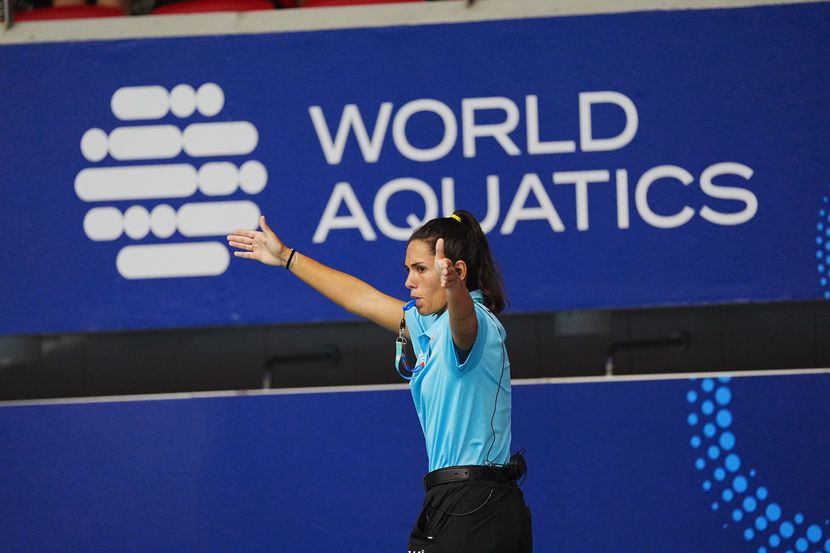
World Aquatics' Women in Water Polo Leadership Programme, in cooperation with Official Match Ball Supplier KAP7, brings together female coaches and technical officials from across the globe to support their professional development. In the second of a series profiling the participants of this initiative, we speak to Marcella Braga, a referee from Brazil whose journey from player to official is opening doors for women in her country.
Marcella Braga did not set out to become a referee. When her playing career ended, coaching seemed the natural next step. For a time she pursued it, but the pressure of a live game, the split-second decisions and the raw adrenaline of officiating ultimately drew her in a different direction. Today, she is one of the few female referees in Brazilian water polo, and she is determined not to be the last.
Water polo came to Braga after she found swimming was not for her, and she enjoyed a career as a competitive player for more than a decade, representing national age-group teams and gaining a personal insight into the challenges faced by women in the sport.
“A lot of male players were already receiving money to play back at that time, and the female team did not,” she recalled. “If you look at the players who played alongside me, a lot of the men are still playing professionally. For the women, I think just one.”
When the demands of a working life made it impossible to sustain both training and a career, Braga made a reluctant choice to stop playing, but she was determined to stay within water polo.
The club she had played for invited her to take a coaching role, and she worked with the women's squad for two years and served as auxiliary coach as the national team, helping them to claim gold at the South American Games.
However, she found refereeing better suited her schedule and skillset.
“Coaching was like being in my comfort zone. Refereeing is its own world entirely. Things happen so quickly, and you need to think and act in one or two seconds. I think it is more my profile. Coaching is good, I also liked it and it was a great opportunity, but I think I prefer refereeing because of the adrenaline.”
The early years featured some challenges, and Braga acknowledged that there were moments which tested her resolve.
“At the start it was very difficult, because the majority of referees are male and I felt that I needed to prove myself as a female referee, that I am capable and I can do this job. I continued pushing forward, continued improving, and today I feel more prepared.”
Braga believes her playing background has proved invaluable in reading the game from the pool deck, helping her to understand the broader context of the match and anticipate what is about to happen.
“Being a referee is not about knowing the rules, like you take a piece of paper, read them and off you go,” she explained.
“You need to understand the game, the whole picture, not just what is happening in the pool. The people in the stands need to understand what is happening too. As a referee, you have a huge responsibility for that.”
Now a World Aquatics Bronze level official, Braga last year officiated at the World Aquatics Championships in Singapore, which marked a significant step in her development.
Braga’s path into the Women in Water Polo Leadership Programme will help her to continue to develop her officiating career.
“I didn’t know that only a few of the women who submitted the form would be chosen. I was so happy I was one of them,” Braga said
“It is so difficult to be a female in water polo because the majority is men – we have more men’s teams, more men’s coaches and a lot of male referees. We are so few. To be together with our peers, to study, understand more and have the opportunity to improve so we can show the way for the next women who come into the sport is an amazing opportunity.”
The programme's early sessions have already made an impression. Alongside the process of getting to know fellow participants from across the world, the group completed a detailed leadership survey that mapped each participant's profile, identifying both strengths and blind spots.
“It was amazing to receive the results, because now we understand our strong points and where we need to improve,” she said.
"For example, I am in the red zone – I am a very direct person. But if I am speaking with someone who is in the green zone, who is more patient and needs more context, I cannot just deliver information directly. I need to try to put more story into my words and understand the other person so I can be closer to them, so people can understand you better and be more open to you.”
Upcoming sessions will explore how artificial intelligence and platforms such as LinkedIn can be used to raise profiles and create opportunities, an area Braga is particularly keen to strengthen through her participation in the programme.
Looking further ahead, Braga wants to progress through the refereeing international pathway and take on more major water polo events.
However, she hopes the success of the programme can extend beyond her own career.
“I want to gain the knowledge and meet more people so I can lead the way for new women joining water polo,” she said. "In my country, we need more people with a vision and the knowledge to grow the sport. I want to bring more women together and help water polo improve in all areas.”
About the Women in Water Polo Leadership Programme
The Women in Water Polo Leadership Programme is a joint initiative of KAP7 and World Aquatics aimed at increasing the representation and visibility of female professionals in the sport. Through structured education, leadership training, mentorship and international exposure, the programme supports women in developing their skills, advancing their careers and taking on leadership roles within coaching and officiating. It also fosters confidence and professional networks, while helping to inspire future generations of female leaders in Water Polo.
Further information can be found here.