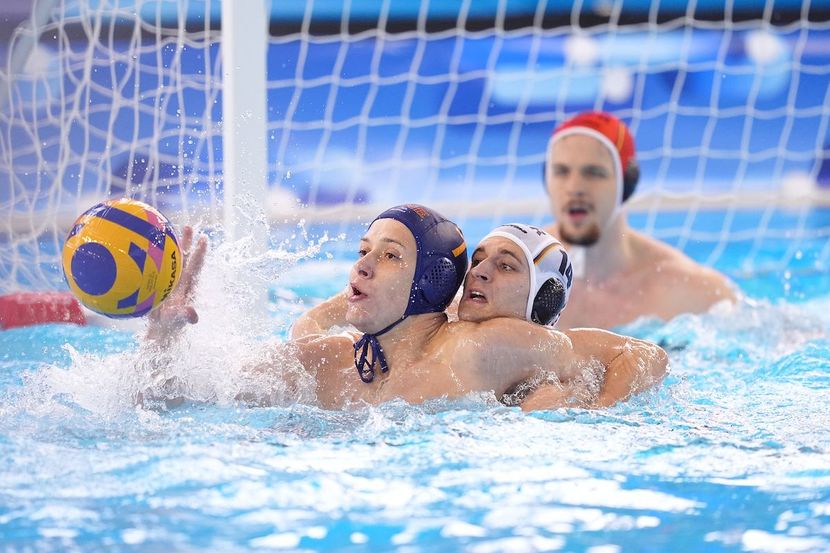
For the first time in the history of the World Cup, a plethora of teams has entered this year’s event and competition will be rife to see who will make the top eight of each of the men’s and women’s finals series to be staged in Sydney, Australia, this July. Competition starts with the men's competitions next week and the women's later in the month and early May.
The World Cup was originally the premier competition for women who could not compete in the Olympic Games.
Once Sydney 2000 came around and women finally made the Olympic stage 100 years after men first competed, the World Cup became a third level for women after the World Championships and was played for every four years.
This meant every four-year cycle there was an Olympic Games, alternating with World Championships and a World Cup slipped in between with a World League filling the “off year”.
World League
The World League was the fourth tier of FINA competition and attracted a vast number of nations who did not play the elite level, like Egypt, Morocco, Algeria, Singapore, Brazil, Puerto Rico, Georgia and the like.
The men’s version started in 2002 in Patras, Greece and ended in controversy when two nations were disqualified, leaving Russia, Spain, Hungary and Greece as the finishers. It continued unabated until 2019 before Covid forced the cancellation of all 2020 fixtures. Strasbourg, France was the final hosting of the World League in 2022 after Tbilisi, Georgia the previous year.
The women’s World League started in Long Beach, USA in 2004 and was staged yearly until 2019, finishing in 2022 after the one year off in 2020. USA women dominated this event with 14 of the 18 crowns.
World Cup
The men’s World Cup surfaced in 1979 and was played in Belgrade and Rijeka in Yugoslavia. It was on a two-year cycle until 1990 in Sydney, Australia, became four-yearly in 2002 until 2018 when Covid-19 intervened. It resurfaced in 2023 in Los Angeles, USA and was last played in 2025 in Podgorica, Montenegro.
The women’s World Cup began in 1979 in Merced, USA as an annual event until 1984 (missing 1982) and then jumped four years until 1988 in Christchurch, New Zealand. Eindhoven, Netherlands hosted in 1989 and two-year cycles followed until 1999 in Winnipeg, Canada. From 2006 until 2018 it was a four-yearly cycle. Long Beach 2023 was the last of this successful competition.
Since 2023, the World Cup merged with the World League and it is now the third tier of competition, played every year. However, 2024 was a truncated year with European, World Championships and Olympic Games creating a log-jam of events in the first half of the year, meaning the World Cup was turfed for that year.
The Women’s World Cup Division II competition is in Malta on 21-26 April while the Division I tournament will be held in Rotterdam, Netherlands on 1-6 May.
2026 World Cup
The 2025 World Cup was split into two divisions with an elite group in Division I and allcomers in Division II. The top two teams of the second tier progressed to the finals series while the bottom two of Division I missed out and drop to the lower division the following year. Host nations get automatic entry to the finals series.
This saw an explosion in countries wishing to enter and this year an incredible 58 teams from 32 countries are competing across the men’s and women’s Division 1 and Division II tournaments.
A key innovation for the 2026 edition is the introduction of the league phase format in Division II, designed to ensure fairness, transparency and increased competitive balance.
Five teams from both the men’s and women’s Division 1 tournaments will advance to the World Aquatics Water Polo World Cup Final, joined by the top two teams from Division II and the host Australia.
These eight teams will then compete for the coveted World Aquatics Water Polo World Cup title in Sydney on 22-26 July at the legendary Sydney Olympic Park Aquatic Centre, where Australia’s women famously won gold at the Sydney 2000 Olympic Games.
Who Is Competing In Men?
Five of the men’s teams from Podgorica last year — champion Spain, Greece, Hungary, Croatia, Netherlands — will be joined by triple Olympic champion Serbia, USA and Italy in the Division I series at Alexandropoulos, Greece on 6-12 April.
In the Division II series in Malta on 7-12 April, an amazing 23 nations have put their hands up — Argentina, Australia, Brazil, Canada, China, France, Georgia, Germany, Great Britain, Hong Kong China, Kazakhstan, Malta, Montenegro, NAB (Russia), Poland, Portugal, Romania, Singapore, Slovakia, Slovenia, South Africa, Turkiye and Ukraine.
Who Is Competing In Women?
In the Division I series in Rotterdam, Netherlands on 1-6 May, seven of last year’s top eight in Chengdu, China — champion Greece, Hungary, Netherlands, Spain, Australia, Italy and Japan — will front alongside USA who failed to qualify last year.
In Division II in Malta on 21-26 April, 15 nations will compete in two venues — Argentina, Brazil, Canada, China, Croatia, Germany, Great Britain Kazakhstan, Malta, NAB (Russia), Portugal, Singapore, Slovakia, South Africa and Turkiye.
The Champions
Hungary is the undisputed champion when it comes to men’s crowns with four while five countries have won twice — Serbia, Spain, USA, USSR and Yugoslavia. There are four other winners.
In total medals, Hungary has 11, Spain seven while Italy and Yugoslavia have six apiece.
Netherlands has an incredible eight women’s crowns with USA claiming five and Australia three. There are three other single winners in Canada, Greece and Hungary.
In total medals, Netherlands has 14, Australia and USA 11 each and Hungary six.