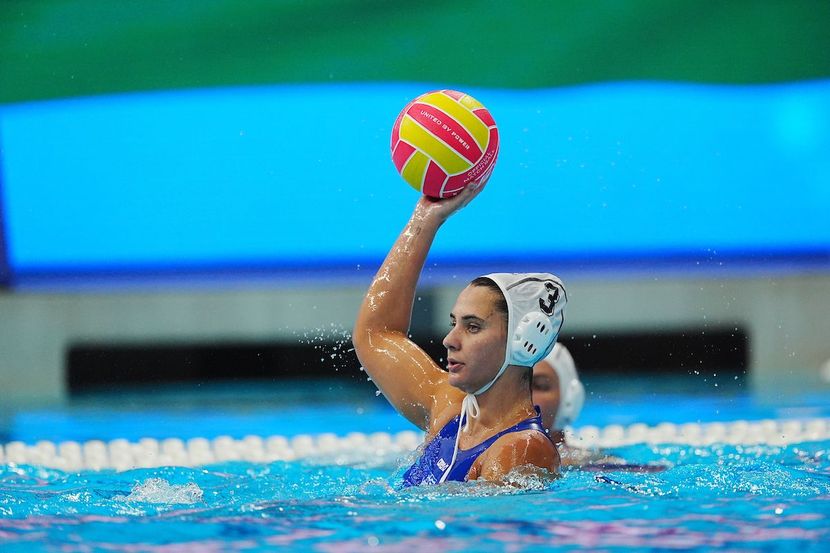
The 2026 Women's European Water Polo Championship will take place from January 26 to February 5, 2026, in Funchal — on the island of Madeira — in Portugal — the first time the country has played host to the event.
Overview
Netherlands took out Spain with a last-gasp goal from Bente Rogge two years ago. Perhaps it could be Spain’s time this year considering it won the Olympic crown in Paris in 2024 and toppled United States of America for bronze in Singapore during last year’s World Aquatic Championships.
Spain relinquished the crown to Netherlands after successive victories in 2020-22. It has been in the podium for five of the last six editions.
Greece, however, may lay the greatest claim to what happens in Funchal having beaten Hungary in both last year’s World Aquatics World Cup and World Championships finals. Greece was third last time out at the Europeans and silver medallist in 2022, so is due a break, having lost four previous finals — 2010, 2012, 2018 and 2022.
Where does that leave Hungary, forever knocking on the door, having lost seven of 10 major world events.
At European level, Hungary has made the final on 11 occasions, winning just the three times — 1991, 2001 and 2016.
Netherlands has a proud record at Olympics (two titles), World Cup (eight) and World Championships (2) with the Europeans yielding six crowns, including four of the first five.
Five-time champion Italy is not far from the action with its best recent showings being bronze medals in 2016 and 2022. Titles came in the glory years of 1995, 1997 and 1999, 2003 and 2012.
Competition
Sixteen teams have qualified for the championships, and they will be divided into four groups of four.
Group A: France, Germany, Greece and Slovakia.
Group B: Hungary, Portugal, Romania, Spain.
Group C: Croatia, Italy, Serbia, Turkiye.
Group D: Great Britain, Israel, Netherlands, Switzerland.
Each group includes two teams that finished in the top eight at the previous edition in Eindhoven 2024, and two nations that successfully navigated the qualification tournaments in the summer.
In Funchal, the teams will compete in a round-robin format within their groups, with the top two from each pool progressing to the second group stage. Groups A and C will combine to form Group E, while Groups B and D will form Group F, and all the results from the first stage will carry over to the second phase, where the teams will face new opponents.
The second group-stage winners and runners-up will progress to the 1st-4th semifinals, while the third-and fourth-placed teams will contest the fifth-eighth semifinals.
Elsewhere, the sides that finish third and fourth in group stage I will form two new pools (G and H) of four, before crossover classification games decide the ninth-16th rankings.
Qualifications
The top three teams will qualify for the 2027 World Aquatics Championships in Budapest, Hungary and the top eight for the 2028 European Championships.
Conclusion
As with World Aquatics events in recent years, organisers have tried to do away with large-scoring matches by introducing the two-tier system. This gives some protection for the top nations while the so-called lesser nations have to work harder to surpass the hurdle to mix it with the top nations.
Come 5 February, will we see a sixth nation become European champion or will one of the former champions add to the trophy cabinet?