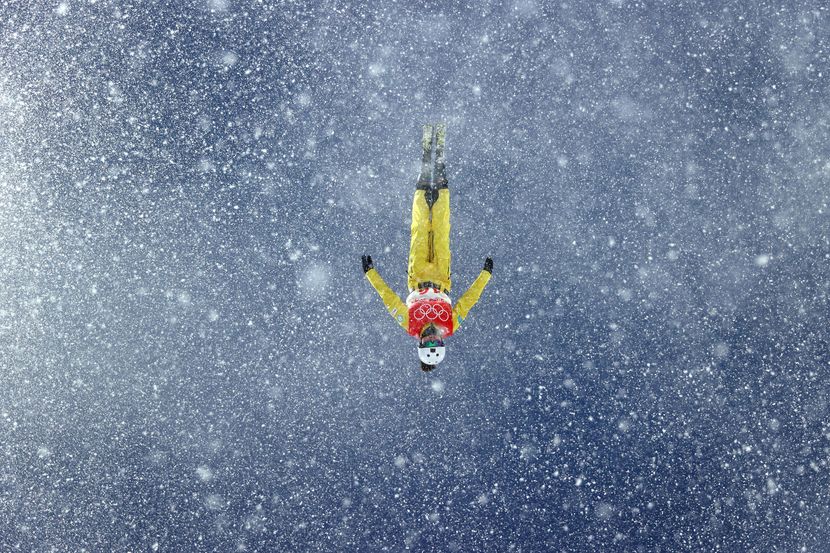
High diving fans can watch the world’s best athletes flipping and spinning this February – except it won’t be on water. It will be on snow, at the 2026 Winter Olympics in Italy. Commentator Trace Worthington explains.
While high diving is on its winter hiatus, fans may want to tune in to the Milano-Cortina Winter Olympics from February 17-21 to see its off-season cousin, freestyle aerials, taking place in the Italian Alps.
Aerials skiing and high diving have a lot in common. Both sports feature flips and spins. Both sports require landing on one’s feet. Both scoring systems discard the high and low scores and multiply by the degree of difficulty. Both sports also have cryptic codes to describe their maneuvers. (In high diving, it’s alphanumerical, like 5181B; in aerials, it’s all about the “full,” “double-full,” or “triple full.”)
To learn what else fans can appreciate, we contacted one man who has spent decades at the nexus of both sports: Trace Worthington, a cliff diving commentator, and a two-time Olympian and 1995 world champion in freestyle aerials.
But first, it’s important to know how aerials works. Instead of plunging from 20m and 27m platforms like high divers, in freestyle aerials, athletes ski down to a 4.1m tall jump that shoots them into the sky where they flip up to three times (maximum, per the rules) and twist as much as they want before landing 14-15 meters below.
Given the gymnastic basis for both sports, are you surprised that more aerial skiers don’t go into high diving?
“No, I’m not. There’s probably not an aggressive approach to recruitment. The divers who have taken over the Red Bull circuit, especially the Canadians, come from traditional diving backgrounds: Molly Carlson, Simone Leathead, also [Switzerland’s] Morgane Herculano, and from Italy Elisa Cosetti, Andrea Barnaba. All those guys have traditional diving backgrounds.”
Isn't high diving more lucrative than aerials, though?
“It depends. [In 2025, World Aquatics awarded $8,000 US for a World Cup victory and $20,000 US for a world championship title.] Red Bull had four events last year and next year there's six. You’d probably have to win every single event in order to make decent money. I think [five-time world champion] Rhi [Iffland] does well. Gary [Hunt] probably does okay. Molly [Carlson]'s the one that's killing it. She was just named Forbes’ 30 Under 30 [sports] business people. Look at her following!” (reportedly more than 7 million from YouTube, TikTok and Instagram)
At the 2002 Salt Lake City Winter Olympics, the aerials gold medalist, Ales Valenta, borrowed divers’ arm positions to help him perform a trick that no one else had ever landed in competition: three flips with five twists on snow. Interestingly, his coach was a 2-time Olympic diving medalist, Vladimir Aleynik of the Soviet Union (1976 bronze and 1980 silver on 10m). What other similarities exist between high diving and aerials?
“You have to keep the core of your body tight. You need a really powerful takeoff. You have to be patient with it, and if you’re square when leaving the platform or the jump, it sets the tone for whatever trick or dive you're doing. Also, spotting is very similar in aerials and high diving. Between flips, you have to get a visual to know where you are, how high you are, and how much room you have left to work with. You've got to pick a spot – typically, down in the water or on the snow.”
What are some less-obvious differences between the two sports?
“The approach and the apex. In high diving, your takeoff is initiated by catapulting off that platform as high as you possibly can. Say it’s two, three, four feet – about as high as you can jump off the ground. The rest is down. The highest point of the dive (or apex), is maybe the first flip. You’re dropping after your first flip.
In aerials, you’re hitting the big jump at 40 to 45 miles per hour, and when you go off the 72- degree kicker you’re almost upside down, looking at the sky, so you’re taking an upward trajectory before you initiate your first move. If you’re doing a triple backflip, you’re still rising into that second flip so the apex is typically in that second flip before you drop. But in aerials, you’re also traveling out [horizontally, to clear the flat knoll between the jump and the landing], so you have to factor that in.
Also, aerials skiers have so much added weight: boots, skis, bindings, a uniform, helmet, gloves. To move all that mass around is far different than high diving where you have a Speedo and your bare feet. High divers can maneuver a lot more freely. I think aerials skiers would love the freedom of high diving like, ‘Oh, I don't have to swing that around.’
At the same time, high divers might think it’s nice that, in aerials, the speed and the kicker catapult you upward. They’d be like, ‘I'm just going for a ride; Wow, this is fun! This is like flying!’”
What Can Aerials Skiers Learn From High Divers?
“Aerialists could learn the quick twisting technique from divers, for sure. The hardest trick in aerials now is three flips with five twists, but the sport is moving in the direction of [performing] thee flips and six twists, so athletes are going to need a whole new level of twisting technique and core strength and agility just to survive that jump.
To be able to spin that fast, high divers have so much discipline in training. It takes an insane amount of strength. I don’t know any aerialists who are as strong as [Romania’s 2023 high diving world champion] Constantin Popovici. That dude’s a machine! He snowboards a bit, but if he knew how to ski well, I think he’d be really good in aerials because he’s small and he’s quick and he’s got an insane amount of discipline to make his twisting faster.”
Which Other High Divers Could be Great in Aerials Skiing?
“I think [Britain’s 2024 world champion] Aidan Heslop would do well because of his twisting technique. The way he brings his arms in, how he twists, and how he spots reminds me of an aerials skier. The separation of his twisting and the separation of his spotting is very pronounced to me. But he’s also a taller dude, which isn’t great for aerials. [Heslop is 1.85m (6-feet) compared to Popovici at 1.70m (5-foot-7).] And Rhiannan, with her trampoline background, would be the best on the women’s side, hands down.”
Final Thoughts?
“Both are very daredevil sports within their [skiing and diving] culture[s]. The mutual respect is huge. They all know and understand acrobatic elements – it’s the other stuff that freaks them out about each other’s sports.
When they had a high diving facility in Park City, Utah, aerial skiers would say, ‘Dude, 90 feet above water, that’s so high! That’s insane! Whoa!’
Then, when high divers look at aerials, they’re like, ‘Dude, they’re coming in at like 45 miles an hour, snow’s kicking in their eyes. To control just getting off the jump and not have your skis shoot off to the side or your knees buckle? Are you kidding me?’ That’s the stuff they appreciate when they see aerials.
So it’s more fear than acrobatic stuff. They both know what to do.”