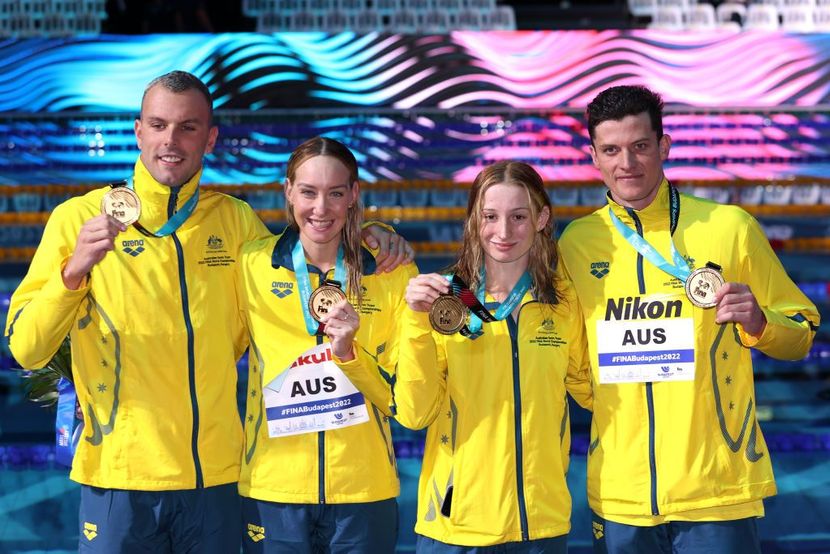
The Aussies have Zac Stubblety-Cook, Kaylee McKeown, and Mollie O’Callaghan ready to defend their World titles from last year while Olympic champions Kyle Chalmers, Emma McKeon and Ariarne Titmus look poised to return to the top of the podium after a small break in 2022.
It was in 2018 when Swimming Australia first adjusted its selection trials to be six weeks ahead of the major international meet of the year in preparation for a home Commonwealth Games. Later that year, they took the same approach to the Pan Pacific Championships in Japan, where the team saw a fair amount of success, including winning all three women’s relays over the Americans in the Olympic city.
Since 2018, the Australians have kept their selection Trials roughly six weeks out, following the American system that has been beneficial for decades after a disappointing showing at the 2012 and 2016 Olympics. In 2019, the Australians won four of the eight relays on the World Championships schedule, while in 2021 at the Olympics, the team won a total of 21 medals, including nine golds - the country's most ever in the pool in one Games.
It is safe to say the Australians have found a system that works, and its team for the 2023 World Championships is poised to keep that tradition going. After nine golds and 21 medals at the Olympics in Tokyo, the team won six golds and 17 total medals at the World Championships.
Here are Australia’s best chances for gold medals at the World Championships in Fukuoka.
Ariarne Titmus and the Race of the Century
One of the most intriguing races ahead of this summer’s World Championships is the women’s 400m freestyle where Australia’s Ariarne Titmus finds herself as one of the co-favorites alongside the likes of Canada’s Summer McIntosh and USA’s Katie Ledecky.
Titmus stunned the world in 2019 when she took down Ledecky at the World Championships and repeated that feat in front of the entire world at the 2020 Olympics two years later. Titmus broke Ledecky’s world record last year in the 400m but did not race her at the World Championships, electing instead to focus on the Commonwealth Games in late July.
This summer’s 400m freestyle will be the first time Ledecky and Titmus have shared the pool since Tokyo and they have a new challenger on the blocks who has swum faster than both of them. Last year, Ledecky and Titmus both beat McIntosh head to head at the Worlds and Commonwealth Games, respectively. But this year, McIntosh, age 16, broke Titmus’s world record in April and has added even more intrigue to the race that seems to get bigger and bigger every day.
While McIntosh swam a 3:56 in April in the 400m freestyle, Titmus has managed a 3:58 at the Australian Trials last week in Melbourne as she will be one of the co-favourites to retain her World title from 2019.
Titmus will also play a big role alongside teammate Mollie O’Callaghan in the 200m freestyle as they will challenge the oldest women’s long course world record on the books - Federica Pellegrini’s 1:52.98 from 2009.
In the last 14 years, Titmus has gotten closer than anybody with her 1:53.09 from the 2021 Olympic Trials and will certainly take a stab at that in July. Last year, she had the fastest split ever with a 1:52.82 at the Commonwealth Games on the end of Australia’s 4x200m freestyle relay and has the third fastest time in the world after O’Callaghan (1:53.83) and McIntosh (1:53.91). Titmus is the reigning Olympic champion in the 200m but has shown some vulnerability in getting beat by O’Callaghan this year, however, Titmus could perhaps be aiming to peak in July at the World Championships, as she had swum quicker at Trials last year than she did at the Commonwealth Games.
In the 800m freestyle, Titmus was 8:15.88 in winning ahead of Lani Pallister (8:20.56). However, the 800m freestyle is Katie Ledecky’s best event, having not been beaten internationally in over a decade. Titmus has been able to beat Ledecky head-to-head in both the 200m and 400m freestyle but has not been able to extend that speed to the 800m as she won silver at the 2020 Olympics and bronze at the 2019 Worlds. If Titmus is to somehow beat Ledecky over 16 lengths of the pool, then she will have to swim under 8:10 to be close, something that she or anyone else has ever done.
Kaylee McKeown and the Pursuit to be the Best Backstroker in the World
One of the most anticipated matchups of the meet will be in the women’s 100m and 200m backstroke finals with double world record holder Kaylee McKeown at the forefront against the likes of (potentially) USA’s Regan Smith and Canada’s Kylie Masse.
McKeown took down Smith’s world record in the 200m backstroke in March of this year to add to her 100m record set in the lead-up to the Tokyo Olympics two years ago. Smith has yet to qualify for the American team but has been on fire this year, setting up a huge showdown between the defending 200m World champ in McKeown and the defending 100m World champ in Smith.
McKeown has also qualified to swim the 200m IM as she won the silver medal last year in Budapest. However, she scratched the 100m back at the World Championships last year to focus on the 200m IM, and the year before at the Olympics, she scratched the 200m IM to focus on the 100m back. The world still has yet to see McKeown race all six rounds of both events at a major meet. She is capable of beating the best in the world in both events, but it would be a very difficult double, with the 100m back semifinals falling on the same session as the 200m IM final. If she scratches one for the other, one would think she would stay in the 100m backstroke where she holds the world record and is the Olympic champion.
The intriguing part is it may take a world record to win both the Olympic backstroke distances as both McKeown and Smith have had career years in 2023. Smith has been 57.9 in the 100m back and 2:04.7 in the 200m, while McKeown has been as quick as 57.5 to nearly miss her own world record, and 2:03.1 in the 200m to set the global mark.
Smith won last year’s World title in the 100m back without McKeown in the field, while McKeown won last year’s World title in the 200m back without Smith in the field. Putting them both in the same field will be a welcome sight to those wanting to see great racing and they are expected to deliver.
Kyle Chalmers and his Redemption Tour
Another intriguing race matchup will be between Kyle Chalmers and Romania’s David Popovici in the 100m freestyle as well as rising star Pan Zhanle of China. Chalmers did not race the 100m freestyle last year at the World Championships where the Romanian Popovici set the world aflame with his 47.1 in the semifinals.
Chalmers raced in Budapest where he split 46.6, 46.8, and 46.9 across three different relays for the Australians, while only racing the 100m butterfly individually. After taking most of the summer off from the 100m freestyle individual, Chalmers returned in the fall with three wins at the World Cup circuit and capped off the year with a gold medal at the World Short Course Championships in the event in front of a home crowd in Melbourne.
Chalmers is a racer and seems unafraid of a challenge. This year, he will likely line up alongside the fastest man ever in the 100m freestyle in Popovici, who has been 47.61 this year compared to the 47.44 by Chalmers at the World Trials in Melbourne. Both of their strengths lie in the second 50, as they are both known for their finishing kick. They haven’t raced head-to-head long course since the Olympics two years ago when Popovici was the inexperienced kid and Chalmers was going for a back-to-back gold medal, before ultimately getting the silver.
Chalmers will be hungry to get back to the top of the podium and with the way his 2022 finished, he will definitely be reinvigorated to do so in the long course venue.
Emma McKeon and Mollie O’Callaghan and the Legacy of Australian Sprinters
Two years ago, Emma McKeon was perhaps the best swimmer in the world. At the Olympics in Tokyo, McKeon won both the 50m and 100m freestyle, as well as the 4x100m freestyle and medley relay gold medals, along with a bronze in the 100m butterfly, 4x200m freestyle, and the mixed medley relay. It was an astonishing seven-medal haul that saw her as the first Australian to achieve such a feat in one Olympics.
McKeon did not race at last year’s World Championships but will be back this year racing a full line-up. McKeon will be one of the gold medal favourites in the 50m and 100m freestyle as well as a co-favourite in the 100m butterfly. McKeon’s biggest challenger will come in her teammate Mollie O’Callaghan, who won the 100m freestyle gold medal in McKeon’s stead.
Australia has a rich history in the women’s 100m freestyle, as McKeon and O’Callaghan added their names to the long line of champions down under in the blue ribbon event that includes Jodie Henry (2004) and Dawn Fraser (1956-1964) as well as World champions Libby Lenton (2007) and Cate (2013) and Bronte Campbell (2015).
O’Callaghan, who comes from the same training pool as Ariarne Titmus, has the number one time in the world at the moment in the 100m freestyle with a 52.48, with McKeon sitting third at 52.52 behind Hong Kong’s Siobhan Haughey (52.50). O’Callaghan beat McKeon head to head last year at the Commonwealth Games and ended 2022 with the fastest time in the world in long course, while McKeon closed the year as the World Short Course champion in the 100m freestyle.
O’Callaghan has had the upper hand over McKeon in the 100m freestyle since the Olympics and has been able to step up on the big stage, but they haven’t met on as big of a stage as the World Championships.
O’Callaghan will also be in the 200m freestyle where she has the fastest time in the world this year over Canada’s McIntosh and Australia’s Titmus. Last year at the World Championships, O’Callaghan was out-raced by China’s Yang Junxuan in the 200m freestyle final before winning the 100m final two days later. O’Callaghan was the star of the Australian women’s team last year when she won six medals, including a gold in the 4x100m freestyle without McKeon to boost the lineup.
The freestyle depth in Australia is immense and O’Callaghan is leading that charge, and continuing the legacy of those before her. If she can take down both Titmus and McKeon respectively in the individual events, it would certainly cement her status as a superstar down under and create a lot of buzz ahead of the 2024 Olympics in Paris.
Sam Short and the Rise to the Top of the Distance Ranks
Another swimmer that has gathered a lot of momentum towards the Paris Olympics has been 19-year-old Sam Short, who looks to be the next distance star for Australia.
Short has the fastest time in the world this year in the 400m (3:42.46) and 800m freestyle (7:40.39) and also put up an impressive 14:46 in the 1500m freestyle final in Melbourne. The Australians have a rich history in the men’s distance freestyle races - most notably producing champions Ian Thorpe, Grant Hackett, Kieren Perkins, Murray Rose, Mack Horton, and most recently last year’s World champion in the 400m - Elijah Winnington.
Short has had the upper hand over Winnington thus far in 2023 in the 400m freestyle, leading the world rankings with his swim from April as that time would have won silver at last year’s Worlds behind Winnington. Short made his Worlds debut last year in 2022, placing ninth in the 800m and 14th in the 1500m freestyle, so having the target on his back in both the 400m and 800m will certainly be a different experience than Budapest last year.
If Short is able to start the meet in the 400m freestyle with a podium finish, then that could spell good things for him for the rest of the week, it is just a matter of doing it on the day of the 400m. Last year Winnington won the 400m freestyle with a 3:41 as he inched closer to the 3:40.07 world record that has stood since 2009 by Paul Biedermann and before that, Ian Thorpe’s 3:40.08 was the global standard since 2002.
The 3:40 barrier has never been broken, even when it was expected Thorpe would do so at the 2001 Worlds in Fukuoka - and perhaps this is the year it finally gets broken after two decades of thinking it would be happening soon. And who better to break it than an Aussie? If Short can break through with gold in Fukuoka, it would certainly turn him into one of the faces of Swimming Australia ahead of the Olympics with its rich history in the men’s distance races.
Zac Stubblety-Cook and the Pursuit of Breaststroke Immortality
Zac Stubblety-Cook made history in 2021 when he became the first Australian male breaststroke champion since 1964 when he won the 200m breaststroke at the Tokyo Olympics. Now he returns to Japan with his name attached to the world record and the target on his back as the defending champion in the 200m.
Stubblety-Cook will certainly have his hands full come the 200m breaststroke final in Fukuoka as the Japanese will have two guys vying for the gold medal - former world record holder Ippei Watanabe and current national record holder Shoma Sato. Both Sato and Watanabe had high hopes going into a home Olympics in 2021 as Watanabe was the Worlds bronze medalist in 2019 while Sato was pushing the pace on the world record in early 2021. However, Watanabe was third at Olympic Trials and Sato did not make the Tokyo final, so there is a revenge arc at play with them. Stubblety-Cook is currently ranked fourth in the world for 2023 at 2:07.86 and will certainly need to be much quicker come Fukuoka as it is looking to take a 2:06 to make the podium.
Stubblety-Cook holds the world record at 2:05.95 and won last year’s World title at 2:07.07. The key for anyone wanting to beat Stubblety-Cook head-to-head is to press the pace on the first 100 as he has the fastest back half among anyone in the entire world, but if the gap is too much on the first 100, then perhaps it could deter him. However, Stubblety-Cook has run people down time after time, also winning last year’s Commonwealth Games crown to cap a superb year. Stubblety-Cook has already won every 200m breaststroke race there is to win, it is just a matter now of how long he can stay on top.
Cameron McEvoy and the Comeback Story of the Year
One of the wild cards to Australia’s team has been the return of sprint superstar Cameron McEvoy, who blasted a 21.27 in the heats of the 50m freestyle at age 29. McEvoy currently leads the world rankings without a month to go until the championships, which would certainly be a big story if he can continue that momentum all the way to the 50m freestyle final in Fukuoka.
McEvoy was the best 100m freestyler in the world in 2014 before he finished with silver at the 2015 Worlds in the event and eventually a disappointing seventh place in 2016. A year later at the 2017 Worlds, he missed the 100m free podium by 0.03 and wasn’t quite the swimmer he once was in the years after.
McEvoy took an extended break after competing in his third Olympics in 2021, and “got deep into rock climbing” in his time away from the pool, which helped him get reinvigorated to be one of the best sprinters in the world again. Long story short, McEvoy is back and again a gold medal favorite for Fukuoka. The crutch against McEvoy in the past was that he couldn’t get it done in the big moment, so if he can win the big one this summer, it will certainly change the narrative around his career and be a feel-good story for the ages.
The Dolphins Headed to Fukuoka