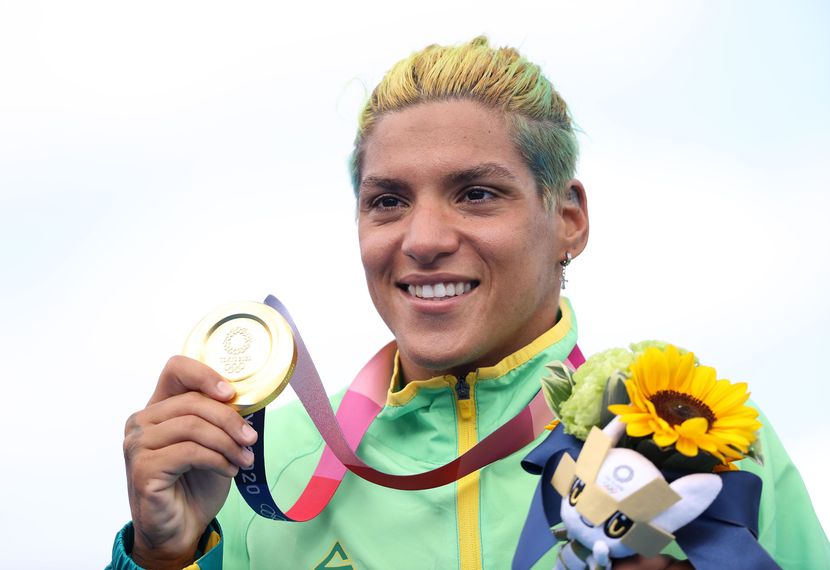
Ana Marcela Cunha of Brazil decisively won her first Olympic medal winning the Women's Olympic Marathon 10km race by out touching Sharon van Rouwendaal (NED) by .7 seconds. The five-time world champion Cunha earned her first Olympic medal at 29 years of age. Her previous best result was a fifth place at the Olympic Games Beijing 2008, when she was 16 years old.
This victory was surely her personal redemption for a 10th place finished at the 2016 Rio Olympics, the last edition held in her home country.
Cunha is the second Brazilian to win an Olympic gold medal in a swimming event and the second from her nation to medal in the Olympic Marathon 10km. Her teammate Poliana Okimoto stood on the podium at the Rio Olympic Games following her bronze medal finish on Copacabana Beach. The nation's previous Olympic swimming gold was won by Cesar Cielo in the men's 50m freestyle at the 2008 Beijing Olympic Games.
Marcela was lauded by FINA as the female open water swimmer of the year a total of six times including 2017, 2018 and 2019. In the Olympic Marathon 10km distance Cunha has claimed three medals at previous world championships, but none of those were gold like today's highest honour of her career. Previously Cunha's highest finish in the Olympic distance was silver at the 2013 FINA World Championships in Barcelona.
It was a silver medal in Tokyo for Sharon van Rouwendaal (NED) who was the defending Olympic champion from Rio 2016. Although the 27-year-old Dutch swimmer hoped to be the first to claim multiple and back to back Olympic gold medals in marathon swimming, she adds another Olympic medal to the impressive trophy case of her country. The Netherlands is a small country with a strong resume including her own and Ferry Weertman (NED) Olympic gold medals. Dutch swimmer and cancer survivor Maarten van der Weijden was the first Olympic champion in the men's Marathon 10km in the 2008 Beijing Olympic Games, the first edition of the event.
SILVER: SHARON VAN ROUWENDAAL
In 2016 van Rouwendaal won the first Olympic gold medal for her country in swimming as none were earned for the Netherlands in the 50m pool during the Rio Olympic Games. In Tokyo van Rouwendaal finished 16th in the women's 200m backstroke on July 30th but two other Olympic silver medals were won by breaststroke ace Arno Kamminga (NED) in the 100m and 200m races. She becomes the second swimmer to earn multiple Olympic medals in Marathon swimming following Thomas Lurz (GER) who was the bronze medallist in the 2008 Beijing Olympic Games and was awarded the silver medal at the 2012 London Olympics.
BRONZE: KAREENA LEE
Kareena Lee, 27 years old from Noosa, Australia also collected her first Olympic medal. The Australian qualified for the Olympic final with a 7th place in the 2019 FINA World Championships. Her finish in Yeosu, Korea two summers ago were vast improvements to the 19th place finish in the 2017 Budapest World Championships swum in Lake Balaton, Hungary and her 20th place in Kazan at the 2015 World Championships. Lee is the first swimmer from Australia to collect an Olympic medal in Marathon Swimming.
An early start for the women's in the fourth edition of the Olympic Marathon 10km Wednesday August 4 at Odaiba Marine Park in Tokyo, Japan. Twenty-five women from 23 different countries entered the 29.3 C water at 6:30; an early start to avoid higher water and air temps. Only the USA and Germany had the advantage of two swimmers each, based on their top 10 finish at the 2019 FINA World Championships in Yeosu, Korea.
A new course map was in place for these Olympics. In the London during the 2012 Olympics the Marathon swimming course was configured for six laps swum in the flat water of Hyde Park's Serpentine. Although the body of water in Odaiba Marine Park is beautiful and seemingly unlimited, the 10km course consists of seven laps, sometimes referred to as loops, each 1.43km. The available footprint for the course, at the same site of the already completed Olympic triathlon is smaller due to the fact that Tokyo 2020 marked off an area that has been screened off to keep out larger particles and marine life might be unhealthy or distracting for the athletes.
QUOTES
Gold
Ana Marcela Cunha (BRA):
On what winning gold means to her:
“It means four Olympic cycles, a lot of years working. It’s my third Olympic Games. In 2008 I had no chance, in 2012 I didn’t qualify and Rio 2016 was not the result we (coach and her) expected.
“We arrived here wanting, as much as you can, this medal and around 10 days ago, I said to my coach to win this race will be very difficult for my opponents because I want it so hard, so much and I'm really well prepared.”
On what it took to win gold:
“Well, we had to be cool or ‘cold’ as Europeans (are). We are Latin people; we are hot, we are emotional people, so I had to be very cold mentally in the race to be focused and I had to win it myself. I knew I was prepared for that."
On who inspired her on the journey to gold:
“Especially my family, they always believed in me and supported me in
this journey. We are dreaming the same dream (with her coach). This medal means a lot to me. I will keep this medal in a special place and I have a plan to develop
a foundation that will support the future dreams of swimmers. I think this medal will show new generations that swimming, and especially marathons, will allow many others to dream. I could speak for hours about this medal but our time is short. I am thankful for the support of the Brazilian government and for many other sponsors, supporting me for so many years. Of course I must thank my club and my family.
“I was able to give 100% of my skills and talent today. In other competitions I often said I could have done better, but I won't say this today. I am exhausted from the race. I am proud that it has been 13 years since my first Olympics. Never until today could I say that I was an Olympic champion, but today I can say that I am the Olympic champion.
On her hair style:
“My hair is my signature. It is my tradition to get a haircut or a new hairstyle or a new hair colour before a race.
On her future plans after this success:
“I am very happy in training for open water swimming. I am active and training with passion. That love will allow me to continue. Paris is just three years away. My mental preparation is as important as my physical training. My body and my mind are always connected and the most important is that I have always believed in myself.”
Silver
Sharon van Rouwendaal (NED):
On how much the silver medal means to her:
“Really a lot. I think I did the best race possible. I was one of the favourites here and that’s really, really hard in open water because everybody's looking at you, and every round I couldn't come up a little bit more in the front.
“I had to be smart and I didn't want to swim in front because as the favourite, people would maybe pull me back, so I tried to stay second and third, and then saw Ana and I thought ‘it's better to let her (stay) in front, then maybe I can come back’. But it got really hard. I couldn’t do better, if I would be in the front I would have been pulled back. This is the best I could do today.”
On the race’s strategy:
“I had a different tactic due to warm water. I needed a new plan for today's race as i didn't train that much in warm water.
“Just five years ago i was mostly a pool swimmer. I knew that I was one of the favorites in today's race. It was tough at the end of the race, especially due to the warm water
conditions, but today's plan was a smart plan for me. The silver feels a little like gold because I am the first woman to earn two medals, achieving what Thomas Lurz (GER) did in the men's marathon.
On her changes in training:
“Just after 2016, i was still training in France but after seven years with the same programme I made a difficult decision to change coaches and move to Germany. That was a really good decision for me. Immediately I began to appreciate the changes in my body and how I could race differently.”
Bronze
Kareena Lee (AUS):
On winning the bronze medal:
“I don't really think that I've processed how it feels, it's just incredible. It was the goal going in to come out with a medal and doing this at my first Olympics is unbelievable.
On the water conditions and her preparation for the race:
“A fish jumped out of the water and hit me on my chest, I didn't know what it was at first, and I was like ‘woah’. I have watched them jump out before but I didn't think one would actually hit me during a race.
"So I've been training in a pool that was 31 degrees and the last couple of weeks leading in I went to Darwin which has a similar air temperature to here back in Australia so that's how I prepared.”
On the race strategy:
“My race strategy was to race up the front but not in the lead, but close enough to keep an eye on others and to conserve energy for the last lap. The race pace was picking up in the second lap and that was unexpected. My plan was to pick up the pace with 2km left in the race. I saw Ana Marcela was going a little wider and I followed her. My position was good enough to stay in the race for a medal but unfortunately not enough to overtake her.
“I am so happy for Australia....it's not just my medal, but it’s for the whole team and I am very thankful for their support.”
On her route to Tokyo:
“I missed qualifying for the 2016 Olympic team and it was my goal to get onto the 2020 team. I changed coaches to swim with John Rogers, a five-time Olympic coach and
he worked with me on my speed. I am thankful that Australia sent me to many world cup events to gain experience. I have done a lot more pool training after my 7th place finish at the World Championships in 2019 in Korea. In the 10km race at Yeosu I was only a second outside of the medals and I knew that I needed morespeed to get my hand on the touchpad first.
“That speed paid off today. I was calm and relaxed and i was back a little further than usual but i was ready to move. I was hurting so much but I knew that everyone else was hurting too. It's an honour to sit here with these girls today.”