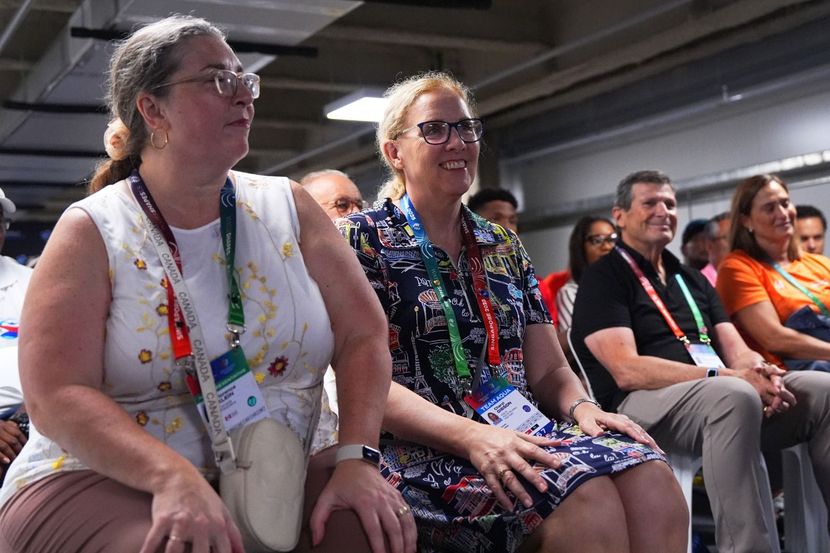
On 29 October 2026, World Aquatics hosted four online information sessions for National Federations (NFs), presenting updates on its development programmes, upcoming opportunities and key timelines for 2027.
World Aquatics Updates National Federations on 2027 Development
On 29 October 2026, World Aquatics hosted four online information sessions for National Federations (NFs), presenting updates on its development programmes, upcoming opportunities and key timelines for 2027.
To accommodate different languages and time zones, two sessions were held in English, one in French and one in Spanish. Across the four sessions, 211 participants representing more than 120 National Federations took part, demonstrating strong engagement from the global aquatic sports community.
The sessions covered a wide range of development initiatives, including Athletes' Scholarship Programmes, Coaches' and Officials' Development Programmes, World Aquatics' e-learning platform CORAL, the World Aquatics Support Programme, the Sustainability Programme and Discover Water.
Supporting the development of athletes and sports professionals
World Aquatics highlighted that 153 athletes currently benefit from scholarship programmes. National Federations were reminded that applications for the 2027–2028 scholarship programmes will open from 15 to 30 April 2027.
Updates were also provided on coaching and officials' education, including international and national coaching certification courses, continuous professional development opportunities through CORAL, annual officials' examinations and bronze, silver and gold certification pathways.
Sustainability and Discover Water Programme
World Aquatics also provided an update on its Sustainability Programme, highlighting that 41 Member Federations have signed the AQUA Sustainability Declaration.
By signing the declaration, National Federations can benefit from global credibility and alignment with sustainability commitments as well as access to guidance, support with knowledge sharing possibilities.
The Discover Water Programme has also made positive progress in 2026, with 12 trainings delivered, and 40 Country Leads and 127 local educators trained. The programme continues to expand its reach, supporting Member Federations in developing aquatic participation, physical literacy and water safety in their countries.
2026 AQUASP Final Reporting
Particular attention was given to the World Aquatics Support Programme. In 2026, 180 National Federations received funding through the programme, supporting their organisational capacity and aquatic sports development.
All participating Federations are requested to submit their reports for 2026 through GMS by 23 November 2026.
The report will document project implementation, results and impact, progress against objectives, Key Performance Indicators (KPIs), alignment with national strategies and financial expenditure, supported by relevant documentation.
Support Programme: New funding opportunities for 2027–2028
With the successful delivery of the 2026 programme, it is also time to prepare for next year's opportunities. The session provided Member Federations with information to support their planning and preparation for the coming years. Eligible National Federations will be able to receive USD 50,000 over two years (2027–2028).
To qualify, NFs must meet four criteria: participation in one of the last two major World Aquatics events (Singapore 2025 and/or Beijing 2026), submission of the NF survey (which closed on 10 September), attendance at the World Aquatics Extraordinary Congress on 25 November 2026, and completion of previous AQUASP editions.
Applications will be open from 15 December 2026 to 28 February 2027 through GMS.
The National Member Federation Survey: Tiering Framework
The National Member Federation Survey assesses the strengths, capabilities and development needs of National Member Federations (NFs) across five key pillars: governance, administration, development, competition management and international representation.
Based on their results, NFs are grouped into four development tiers: Emerging, Developing, Established and Advanced.
Survey responses are measured against defined minimum requirements and expected practices, using a scoring method for each pillar.
To read the results, tiers should be interpreted individually for each pillar, rather than as an overall ranking. These recommendations can be used to identify development priorities and guide resource allocation.
Looking ahead to Beijing 2026 and 2027
World Aquatics also presented upcoming development activities at the World Aquatics Swimming Championships – Beijing 2026, including Aquatics Integrity Unit activities, educational workshops and regional National Federation meetings scheduled between 1 and 6 December.
The next Development information sessions for National Federations are scheduled as follows:
· 1 December at 17h30 local time in the venue: for National Federations from Oceania, Asia and Africa.
· 2 December at 17h30 local time in the venue: for National Federations from Europe and the Americas.
The sessions delivered by World Aquatics generated valuable questions and feedback from participating Federations. The presentation has been shared with NFs, while session recordings are available on CORAL.
The next online session will take place before the release of the new World Aquatics Scholarships Programme guidelines in April 2027.
World Aquatics continues to offer learning and development opportunities, with upcoming webinars on CORAL in November including:
- 17 November: Understanding Insurance: key insurance covers, with Thomas Guesde. You can register here.
Through these initiatives, World Aquatics continues to strengthen its collaboration with National Federations and support the sustainable development of aquatic sports worldwide.