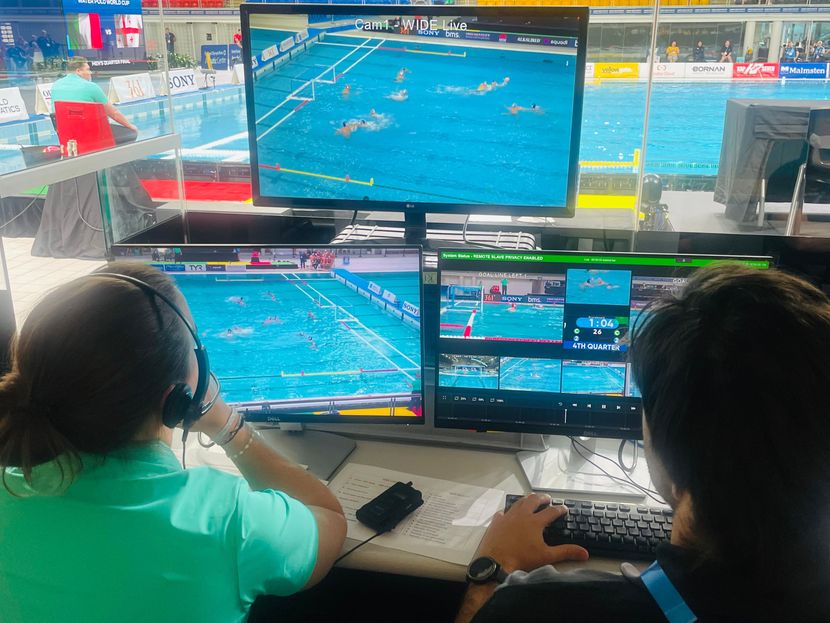
When the Video Assist Referee (VAR) was initially introduced to water polo, it was met with concerns over its impact to the flow of the match. However, since it was officially adopted by World Aquatics in time for the World Aquatics Championships 2019 in Gwangju, South Korea, it has evolved to be an integral part of the water polo landscape.
When VAR was first introduced to international water polo matches, its only real protocol was to determine goal/no goal, and despite early scepticism, it was seen as a valuable tool to prove whether shots had crossed the line or not.
As the technology evolved, Olympic referee Dion Willis (RSA), Chair of World Aquatics water polo’s Referees’ and Officials’ Committee (ROC), said further testing was done in the interim and additional protocols introduced for the Tokyo Olympic Games in 2021.
“VAR continues to advance with access to sports broadcasting camera footage from their underwater cameras, which has now been included in the VAR protocol.
“This footage assists the match referees when making crucial decisions, especially with possible violent action situations taking place below the surface,” Willis said.
Like water polo, football began to adopt widely the use of VAR technology in elite leagues around the world in the past decade. As well as the goal-no goal ruling, VAR is used in top-tier football to aid referees’ decision-making in awarding or overturning penalties, red cards and checking for mistaken identity for yellow or red-card offences.
Operating under the philosophy of "minimal interference, maximum benefit", the football VAR system seeks to provide a way for "clear and obvious errors" and "serious, missed incidents" to be corrected.
It is the same in water polo.
There have been long stoppages in matches but the current protocol turnaround time to make a VAR decision is not more than three minutes, and not to review a single situation too , otherwise go with the official’s original on-field decision.
“For example, you can make an on-field decision of aggressive play and issue a red card and then, post-VAR review based on the footage available, upgrade your decision to violent action after your review,” Willis said.
A coach’s challenge has been a real paradigm shift for most referees to contend with, particularly when you or your colleague overturns your on-field decision, like awarding, or not awarding, a penalty, for example.
“Bearing in mind your original on-field decision is made in a split second. Now you have the opportunity to review your decision from multiple angles and in slow motion.
“To be honest, more than 85 per cent of referees’ original decisions are correct, so give credit where it’s due and coaches are cautious to challenge unless they believe they are 100 per cent correct,” Willis said.
A coach has one opportunity to make a challenge and if successful has an additional opportunity, so they need to be confident when doing so.
Some VAR decisions actually take place in the background without stopping or pausing the match as both referees, match delegate and VAR referee are all in constant contact during play.
Many times, goal/no goal situations are reviewed while play is continuing, as well as other protocol situations, like possible aggressive play, illegal entries or even corner throws are being reviewed by the VAR referee during the match.
The match can be stopped due to technical issues or errors and in some instances taken back to the time this incident occurred. When this happens all goals, exclusion fouls and timeouts are erased with the exception of all red or yellow cards being issued by the match referees.
“I don’t believe that the coach’s challenge has created any animosity between referees and coaches when overturning a decision. It’s become part of the game and I believe we need to embrace technology to give the game the credibility and transparency it deserves.
“The majority of coach challenge requests are penalty/no penalty challenges based on current stats and protocol guidelines followed by possible aggressive play situations that may have been missed during play, of which the majority (90 per cent plus) are inconclusive based on the available evidence.
“What we must always remember is that the final decision based on the available evidence belongs to the match referees. VAR is exactly what it means — “Video Assist Referee”.“At the Tokyo Olympics, we had two dedicated VAR referees who were both valuable assets to the match referees based on their experience and vast knowledge of the game.”
Willis said more needs to be done on training referees in the VAR protocols.
On the question of how ROC makes daily appointments, Willis said: “Where possible, we appoint the VAR referees based on previous VAR experience and level of communication skill as minimum requirements.
“What’s critical is the VAR referee needs to perform a proactive role and not reactive to the match referees’ requests.
“For example: On a possible goal/no goal situation, the match must continue and the VAR referee needs to check immediately and inform the match referees of the outcome, so they know if necessary to stop the match at the appropriate moment, or to continue with play, and not the match referees having to ask the question,” he said.
“In the event it is a goal and the match has continued, it’s then important for the VAR referee to know the cap number of the goal scorer and the match time on the clock so as to speed up the process at the restart.
“Referees need to focus on the play in front of them and not on a situation in the previous attack or transition. Teamwork and collaboration is essential to ensure the best possible outcome,” Willis said.
Editor’s Note: We will explore how the World Aquatics Referees’ and Officials’ Committee (ROC) operates in a forthcoming column.