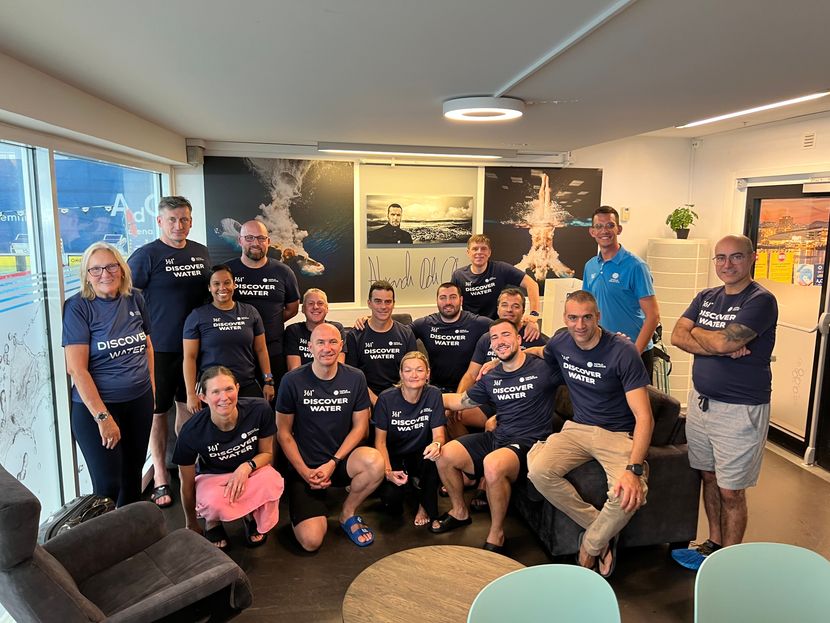
Fourteen Country Leads from across Europe came together in Bergen, Norway, from 21-26 September for World Aquatics' Discover Water training designed to support National Federations with implementing the programme within their national contexts.
Launched in 2024, World Aquatics’ Discover Water is a global programme that aims to make aquatics more accessible and safer for all. Although it is focused on children aged 6 to 12 to develop essential water safety skills and knowledge, it covers much more.
The programme helps children develop physical literacy, water safety skills and a positive, lifelong relationship with water. Through a child-centred, playful and inclusive approach, the programme supports children to build confidence, competence and enjoyment in and around water, while developing the foundations for safe and lifelong participation in aquatic activities.
Discover Water ensures traditional swimming lessons are complimented with growing confidence, motivation, and building healthy life skills for the future.
Organised in cooperation with the Norwegian Swimming Federation, the European Country Leads Training combined practical delivery, programme development, peer learning and implementation planning.
Cato Bratbakk, President of the Norwegian Swimming Federation, said:
“We are proud to have the opportunity to host an event organised by World Aquatics, and we believe these past six days in Norway have brought opportunities for professional discussions, inspiration, and knowledge sharing with our regional colleagues.”
From theory to practice
Throughout the six days, Country Leads worked with the Discover Water guidebook, playbook and activity cards, exploring the principles of physical literacy, inclusion and activity adaptation. Together, these elements support a child-centred approach that helps children develop the skills, knowledge, confidence and behaviours to participate safely and positively in aquatic environments.
Participants then put those principles into practice, preparing and delivering activities with local school children from Bergen, observing colleagues, assessing sessions, and providing feedback.
Safety and participant wellbeing were also central themes to the training. Sessions covered water safety, site assessment and risk identification, emergency action plans, safeguarding and child integrity, medical screening and parental consent.
An open-water session delivered with the Norwegian Society for Sea Rescue gave participants an opportunity to experience real-life scenarios designed to equip them with greater understanding of risk assessment, life jackets and buoyancy aids, water familiarisation, buddy rescue and basic lifesaving techniques.
Learning across borders
Throughout the training, participants were able to share their experiences, ensuring the group could learn from each other in an interactive and collaborative way.
Aleksandar Samardzija of Slovenia highlighted the knowledge he gained during the training and the value of learning from colleagues across Europe. He said the discussions gave him the opportunity to reflect on his own work and his federation’s approach
"it's also improving the federation as a whole, and me as a person, in my work."
For Giorgi Marsagishvili of Georgia, learning from colleagues, who represented other National Federations, provided different perspectives to support his work on developing new approaches to youth swimming, praising in particular “the chance to know many international coaches and learn from them, learn from their situations, and learn the situations of what's happening in their federations."
The focus on physical literacy linked closely to work already underway in the participants’ countries.
Erika Meeker of Sweden connected the training with her federation’s work to revise its Learn to Swim curriculum, while Luis Coutinho of Portugal highlighted how the four dimensions of physical literacy could support programmes being developed in his country.
"All the insights that we have when we leave this training will be very useful to try to input and to upgrade the problems that we already have underway in Portugal”,
From Training to Implementation
A central theme of the course was the importance of Discover Water’s global framework, while ensuring it is tailored to individual needs.
Country Leads analysed their existing learn-to-swim curricula against the Discover Water approach and considered how the framework could improve and complement existing national systems.
Luana dos Santos Held of Germany highlighted the value of reflecting, analysing and monitoring as part of developing a sustainable long-term approach to developing programmes.
"One of our big goals as German Swimming Federation is to have all kids from the primary school being able to swim until 23 years old"
Bergen provides a local example
The training was supported by strong local partnerships coordinated by the Norwegian Swimming Federation. This involved Bergen Municipality, AdO arena and local swimming clubs Arna svømme- og livredningskliubb, Bergen Vest Svømmeklubb, Bergens Svømme Club, Åstveit svømmeklubb and Svømmeklubben Delfana. TYR provided equipment and caps, that were distributed to children who participated in the activities.
The partnerships enabled the training to combine classroom learning with practical sessions involving children and demonstrated to Country Leads how local stakeholders can work together to create sustainable learn-to-swim opportunities.
The Svøm Bergen model delivers 90 swimming lessons reaching around 3,000 children per week. It is important for children to feel safe and competent in and around water, and working together in this way is a practical example of how National Federations and local stakeholders can coordinate to support the wider community.
Preparing for the next steps
The Bergen training concluded with Country Leads outlining the next steps for putting their learning into practice within their National Federations.
The training was an important step in building the capacity required to implement Discover Water across Europe.
Since its launch in 2024, Discover Water has made a considerable impact and has expanded around the world. More than 60 countries have already been trained through the continental courses held across Africa, Asia and the Americas.
By combining a common global framework with national experience and local adaptation, World Aquatics is supporting Discover Water Country Leads to help them move from learning to implementation and support National Federations with the development of sustainable approaches for water safety.