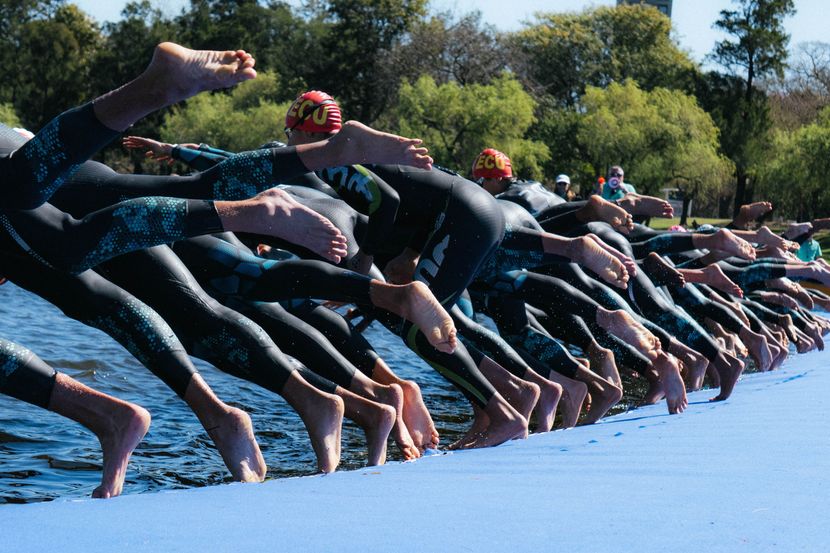
The best and brightest junior talent from around the world took the spotlight at the recently concluded World Aquatics Junior Open Water Swimming Championships 2026 in Santa Fe, Argentina. Here we take a look at some of the best storylines to have emerged from the event.
Alongside the individual successes of the meet, there was a collective success for the sport - as Santa Fe welcomed a record high number of athletes.
273 competitors representing 39 National Federations took part across four days of competition, evidencing how open water is not only a budding sport amongst the junior ranks, but one with real depth and pedigree.
The figures underline the sport’s continued growth at all levels, building on the 219 and 264 athletes that competed in 2022 and 2024, respectively.
Of the participating nations, Italy were the largest team with 13 athletes in total, while Chinese Taipei had travelled the furthest distance of any nation.
Former Olympic Champion and Vice Chair of the World Aquatics Open Water Swimming Technical Committee, Ferry Weertman, said of the sport’s growth: “Record numbers on the entry list this year shows just how much depth is coming through at junior level.
“History tells us a number of the athletes racing in Santa Fe will go on to compete on the biggest stages in our sport.”
Open Water Family Roots Run Deep
One of the standout storylines away from the racing was the remarkable number of family connections competing at the event.
One such case was the Hansen family, who had three siblings competing as part of Team USA.
Karrington Hansen, Brinkleigh Hansen and Sawyer Hansen were part of their nation’s 11-strong contingent, and took home six medals between them.
For Karrington and Sawyer, these marked their first international medals, while Brinkleigh returned to the World Junior podium having won gold and silver at the 2024 event.
Siblings Alex Siegel and Will Siegel of Long Island Aquatic Club also raced for Team USA, and took home three medals between them (one individual, two relay).
Elsewhere, similar stories emerged for the Australian and Japanese contingents.
Olivia Galea’s bronze made history as Australia’s first Junior Open Water Swimming Championships medal, and follows brother Matthew’s bronze from the Commonwealth Games (800m Freestyle) earlier this season.
Her teammate, William Thorpe, is now one of three Thorpe brothers to have competed at this event - following in the footsteps of siblings of Robert and Samuel who raced at the 2022 and 2024 editions.
Sachika Kajimoto of Japan, younger sister of Ichika Kajimoto, reminded everyone of her family’s reputation for sprint strength, winning joint-bronze in the Women’s 3km Knockout Sprint event.
Ichika is reigning champion in that event from the 2025 World Aquatics Championships, while for Sachika, her finish in Santa Fe marked her first international podium and Japan’s only medal of the competition.
Rise of Solo-Effort Racing
Solo-effort racing is a tactic that continues to grow within the sport, and was firmly on display in Santa Fe.
A traditionally less common tactic in open water, depriving the leader of the respite that comes with swimming in a pack - much like a peloton in cycling - athletes like Moesha Johnson are adopting this approach more and more: taking command of races by building an early lead and forcing the rest of the field to race on their terms.
Ludovica Terlizzi, winner of the Girls 10km, was the first to race in this courageous fashion on day one of competition, touching home almost 90 seconds ahead of the silver medallist.
The theme continued with Russian athletes Kseniia Misharina (gold in Girls 7.5km) and Alan Nosov (gold in Boys 5km) electing to take their respective races on in the same way.
The final, and arguably the best example of this racing-style, came from fellow Russian athlete Kira Guseva in the Girls 5km.
Guseva blew the field apart during the first lap and eventually touched home 1:24.6 ahead of the rest of the field.
This inherently brave style of racing continues to challenge the tactics audiences have come to expect, and is likely to be adopted more frequently at events as the sport continues to evolve.
A Win for Ovalles is a Win for Argentina
Perhaps the most heart-warming result of the meet came in the form of Sofia Ovalles’ bronze medal in the Girls 5km.
The 14-year-old Argentinian had the support of a nation behind her as she powered home towards what would be her nation's only medal of the competition.
The hosts had some stellar performances, with multiple top 15 results and a sixth-place finish from Mateo Mayer in the Boys 7.5km.
But it was Ovalles’ result that received the biggest celebration of all, which she said after the race felt ”like a dream”.
Russia Top Overall Team Standings
Russia topped the team standings after what was a week of superb performances from their team.
They took home four gold and three silver medals, accumulating 205 points which narrowly beat out Hungary for the top spot (196 points).
Third place went to Team USA, who earned 167 points from their results. The team from Italy finished just outside the top three with 120 points, while Australia rounded out the top five teams with 91 points.