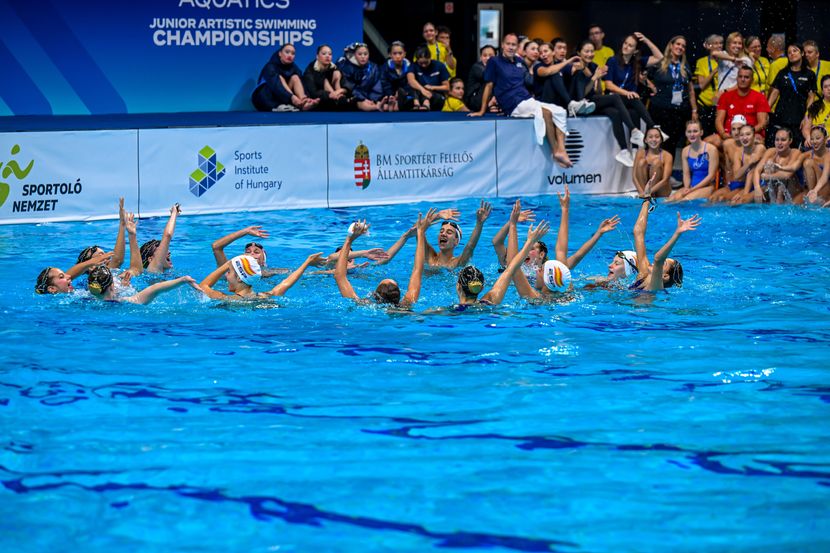
History-making world champion Giorgio Minisini (ITA) departed Budapest ‘excited’ by the ‘fierce battles’ emerging within his sport after witnessing the next generation of artistic swimmers star during the 2026 World Aquatics Junior Championships.
Minisini, who became a pioneering multiple World as well as European gold medallist during a transformational time for male athletes in the sport, has taken on a series of ambassadorial and coaching roles since retiring from the sport in 2024.
The 30-year-old Italian was invited to Budapest as a World Aquatics ambassador and conducted masterclass clinics as well as a medal ceremony presentation during the showcase event in Hungary’s iconic Duna Arena.
Minisini also had the chance to showcase a new concept he has been working on which he hopes will help the sport further evolve and entertain.
“I had so much fun,” says the former artistic swimmer. “There were so many moments I enjoyed, like working on some details around the new Artistic Impression scoring system for Male Solos, with experts from the Technical Artistic Swimming Committee (TASC).
“I also had the great opportunity to get my newly developed format on the big stage during the Gala; the Acrobatic Showdown, where two teams at a time get in the water, performing three acrobatic movements to the same music.
“I’ve been working on it for over two years and I’ve loved how the athletes and the audiences reacted to it!”
Russia won nine of the 11 disciplines at Budapest 2026, with Spain, China, Kazakhstan, Belarus and Japan the other nations claiming top-three finishes during the five-day competition.
“I think this new generation of swimmers have a very nice balance between technicality and artistical sensibility,” Minisini told World Aquatics. “The new scoring system is surely giving them the opportunity to level up their skills, but on the artistic note the judges are giving more and more value to well-built and well swam choreographies.”
Anna-Mariia Fomicheva (RUS) was the most decorated athlete, claiming four gold medals as well as a bronze, with team-mate Aleksandra Zavialova (RUS) matching her tally of golds.
Each were part of Russia’s triple crown winning team event victors, while also collecting additional respective duet and solo successes. They were push close though in many of these events by Spain, who after impressing at recent Olympic Games, as well as World and European Championships, now have new emerging talents who are likely to be pushing for places among their nation’s senior stars come LA 2028.
“On the women side, here also most of the competition was between the Russians and the Spanish team,” remarked Minisini.
“They differentiate themselves on the style; highly technical and chorographical the first, impactful on the performance second) and that gives a lot of unpredictability to the competition.”
Zakhar Tromimov (RUS) claimed the most gold medals among male athletes, with victory in both individual disciplines, together with the Mixed Duet Technical title alongside Alina Rumiantseva (RUS).
For obvious reasons Minisini continues to keep a close eye on developments within the men’s side of the sport and he played a key role in the men’s masterclass gathering which took place in Spain in late 2024.
“On the men's side, I think that the battle is getting really fierce. We've seen a great young talent called Eneko (Sanchez, winner of five medals) from Spain emerging, but also a majestic performer as Zakhar (Trominov) from Russia.
“That said, I was really impressed by the French guys though: both Maceo (Vanhee-Dedieu) and Nolan (Fontbonne)performed in a great and professional way, and I can't wait to see more of then swimming. The Japanese man (Aitaka Heizo) also did a great job, as well as the Kazakh (Viktor Druzin).
“Of great interest has been the first-ever medal for team Belarus (in the Team Acrobatic Final).”
Minisini was in-line to become the first-ever male to compete in Artistic Swimming at an Olympic Games with rules adjusted to allow participation through the Team competition.
However, he was ultimately not included in the final selections, as those charged with making the decision felt the scoring system for male athletes made including them in a team discipline ultimately too much of a risk at the time.
The sport has progressed since and there is genuine hope that athletes such as Dennis Gonzalez (ESP) could make a landmark appearance come LA 2028 and with that in mind, many nations are now choosing to field male athletes in junior events.
Minisini is clearly pleased by the move, but feels further adaptations and considerations would assist with the development of male inclusion in the traditionally all-female team disciplines.
“I was delighted with the inclusion of two men in many (team) routines,” he told World Aquatics.
“We've seen Maceo and Nolan in the French tech team; we've seen two highly talented boys in the free team of China; we've also seen two very charismatic men in the Acrobatic routine of team Italy.
“This last example gives me some reflections to propose though; Filippo (Pelati) and Gabriele (Minak) swam on a routine that was designed originally for eight women and I'm quite sure that if we start to include men in the team events with specifically designed choreographies. we could finally harness their maximum potential.
Minisini continues; “I'm really eager to see the moment where every mixed team will swim an actual mixed choreography. That's the next step our sport needs: and for this, maybe the new Acrobatic Showdown format could help!”