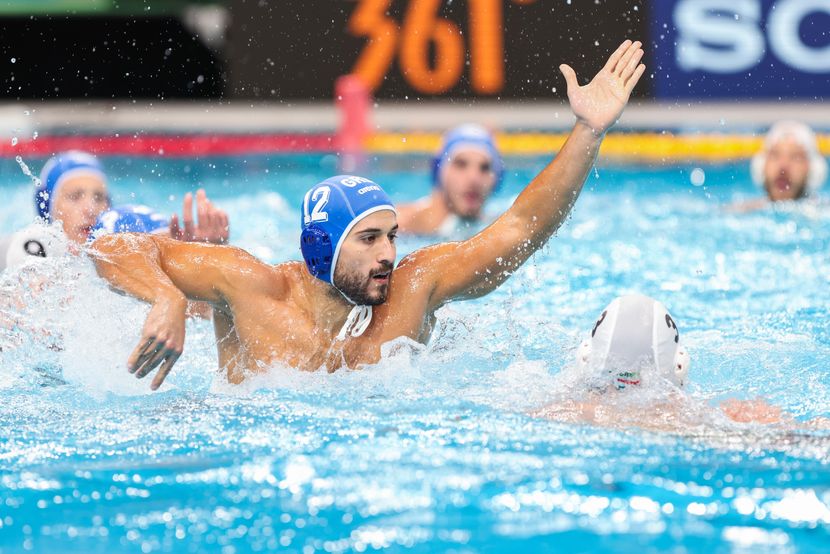
The final phase of the World Aquatics World Cup in Sydney offered high-level matches in an exceptional environment at the iconic Sydney Olympic Park Aquatic Centre in the city.
FINA Bureau Liaison Kryiakis Giannopoulos has analysed the state of men’s water polo following the success World Aquatics World Cup finals in Sydney, Australia.
The four-time Olympian with 428 international caps — his country’s second highest — Giannopoulos has the credentials to expound on how the sport is evolving.
His diagnosis follows and it can probably be replicated for the women’s side of the competition.
Roster Renewals
In the middle of the new Olympic cycle, many national teams underwent significant roster renewals. The average age of the top eight men’s teams was: Australia 27.9, Hungary 27.2, Italy 26.8, Georgia 26.7, Spain 26.2, Greece 26.0, Montenegro 24.7 and Croatia 20.4 years. Despite this significant renewal, the organisation maintained a high technical level and presented a greater competitive balance, with more friendly matches and smaller final score differences.
Key Trends
The comparative analysis of the World Cup Sydney 2026 and the Singapore 2025 World Championship highlighted four key trends:
• More goals (+15.3%) with a slight increase in final attempts (+4.5%), indicating significantly higher offensive effectiveness.
• Greater contribution from the forward line (+180%) and clear redistribution of offensive production. Notable is the impressive increase in goals from free kicks after fouls at six metres (+250%), while goals in the counter-attacks (+367%), from penalties (+31.6%) and from numerical advantage (+16.3%) also increased, alongside a parallel reduction in goals from free kicks (−35.0%).
• Fewer fouls in the box (−5.6%), more in the penalty area (+7.9%) and almost unchanged total fouls (−1.9%), data consistent with a more "physical game" at two metres, without an increase in total fouls.
• Goals with an extra player and penalties exceeded action goals (14.6 against 13.7 goals per game) for the first time, indicating the ever-increasing importance of the extra player. (Action goals = all goals, excluding fix on five and penalty goals.)
“This study provides quantitative data for the gradual assessment of the impact of the new regulations on modern football. The analysis of the upcoming major international competitions will show with greater certainty where the new reality of the sport is heading,” Giannopoulos said.
Stats Tell A Story
Looking at some of the statistics, combining the Division I tournament and the Sydney finals of the World Cup:
Men:
• The top two scorers were Stylianos Argyropoulos (GRE) with 33 and Bernat Sanahuja (ESP) with 30.
• Extra-Player goals: Argyropoulos with 11
• Action goals: Sanahuja with seven.
• Outside shots: Argyropoulos with four.
• Counter-attack goals: Argyropoulos and Unai Biel (ESP) with three each.
• Penalty goals: Argyropoulos converted 12, four ahead of his nearest rival, Jacopo Alesiani (ITA).
• Centre goals: Lorenzo Bruni (ITA) and Dimitrios Nikolaidis (GRE) with three each.
• Leading sprinters: Alesiani with 19, well ahead of Maro Susic (CRO) on nine.
Women:
• The top three scorers were Kata Hajdu (HUN) with 25 goals, followed by Emily Ausmus (USA) with 23 and Ryann Neushul (USA) with 19.
• Extra-player goals: Hajdu with 11.
• Action goals: Ausmus with 10, followed by Hajdu, Abby Andrews (AUS) and Sienna Hearn (AUS) with nine apiece.
• Centre forward was dominated by Paula Camus (ESP) with eight goals, three ahead of her rivals.
• Outside shots: Krisztina Garda (HUN) and Elena Ruiz (ESP) with four each.
• Counter-attack goal: Ausmus with four; Vanda Valyi (HUN) and Jenna Flynn (USA) scored three each.
• Penalty goals: Lola Moolhuijzen (NED) and Alice Williams (AUS) converted six each.
• Leading sprinters: Valyi with 20 and Nona Perez (ESP) two behind.