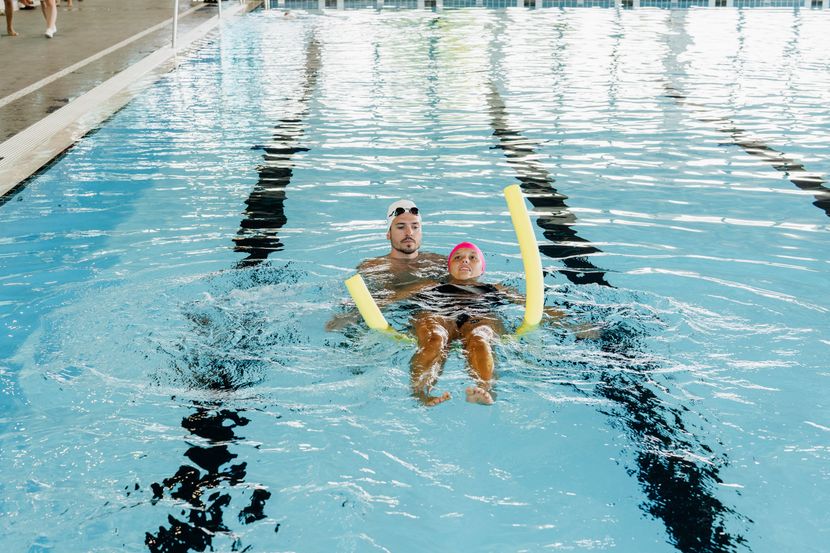
Around the world from Italy to Grenada to Australia, World Aquatics' Global Partner Myrtha Pools is working with governments, federations and communities worldwide to preserve, renovate and build the aquatic facilities where swimming journeys and water safety begin.
The World Health Organization estimates that learning to swim can reduce the risk of drowning among children by up to 88%. Yet around the world, communities face a growing infrastructure crisis: municipal pools built between the 1960s and 1980s are reaching the end of their operational life, particularly across Europe and Australia, while many under-served communities still lack adequate aquatic facilities. Every pool that closes removes one of the most effective environments for teaching life-saving skills.
As Global Partner of World Aquatics since 2009 and supplier to six Olympic Games, Myrtha Pools is working to change that – work that sits squarely alongside World Aquatics' own drowning prevention efforts through initiatives such as Discover Water and Pools for All.
In Italy, Olympic artistic swimmer Giorgio Minisini joined young athletes at the Aquamore Ghedi Centre ahead of World Drowning Prevention Day on 25 July.
“I have always believed that water is an extraordinary tool for inclusion. Learning to swim isn't just about practising a sport: it is a skill that can save lives,” Minisini said.
"I’m proud to support Myrtha Pools’ initiative because investing in modern, safe and accessible public facilities means giving more people the opportunity to gain confidence in the water while contributing concretely to drowning prevention"
In Australia, where hundreds of aquatic centres are approaching the end of their design life, Myrtha partners with Royal Life Saving Australia to renovate and build resilient facilities, from transforming the seasonal George Town pool in Tasmania into a year-round centre, to refurbishing remote community hubs in Wadeye and Katherine in the Northern Territory.
In France, temporary competition pools from Paris 2024 are being converted into permanent public aquatic centres in communities that historically lacked access to swimming.
“The legacy of the Paris 2024 Games is not limited to medals; it is a tangible social legacy. The conversion of temporary Olympic pools into permanent public aquatic centres in local communities lacking aquatic facilities - such as Sevran, Bagnolet and, more broadly, Seine-Saint-Denis - has helped tackle inequalities in access to swimming pools and, consequently, to learn-to-swim programmes. This success was made possible thanks to the technology of our partner, Myrtha Pools. Their unique expertise in designing swimming pools for communities has enabled the creation of cutting-edge facilities dedicated to swimming education,” said Laurent Ciubini, General Director of the French Swimming Federation.
A similar legacy model is at work in Japan, where seven schools now feature pools from Tokyo 2020, and in the United States, where V3 Sports in North Minneapolis has turned a Myrtha pool built for the US Olympic Trials into a thriving community hub.
“At the core of our programming is accessibility and relationship-building through water. We are proud to offer Family Water Safety Workshops, which go beyond traditional instruction. These highly impactful experiences give families the opportunity to learn about water safety in a supportive environment, explore their own swim stories, and build confidence together in and around the pool,” said Molly Belk, V3 Sports Program Manager.
In the Caribbean, Myrtha contributed to World Aquatics' Pools for All initiative by helping build Grenada's first national 25-metre pool.
“When you live on an island, learning to swim is essential," said Veda Bruno-Victor, General Secretary of the Grenada Olympic Committee.
“We have dreamed for many years of having dedicated learn-to-swim facilities across our country. Thanks to the commitment of World Aquatics, Myrtha Pools and the Grenada Olympic Committee, that dream is finally becoming reality. This is the first step towards giving future generations the opportunity to learn life-saving skills.”
In Colombia, Myrtha's long-standing partnership with the Colombian Swimming Federation has helped train more than 8,000 professionals and provide free swimming lessons to over 10,300 children.
“We think it's essential for everyone to have the opportunity to learn to swim in public pools. Water safety is fundamental for public health and for children's social development,” said Andrés Erazo, the Federation's Technical and Project Director.
From Europe and Australia to the Americas and the Caribbean, Myrtha Pools continues to show that investment in aquatic infrastructure is an investment in safer, healthier and more inclusive communities, ensuring every community has the opportunity to learn to swim, stay safe in the water and benefit from facilities designed to last for generations.