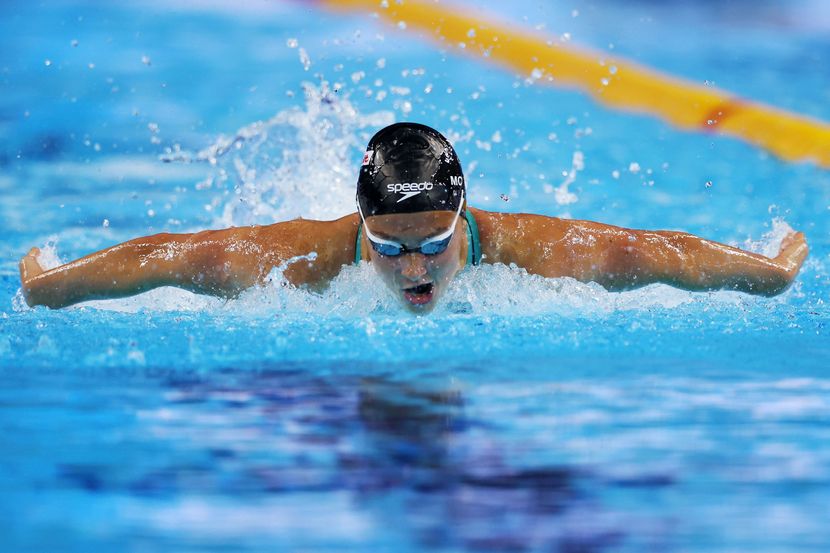
Canada’s McIntosh broke the oldest standing world record on Sunday night on the first night of the 2026 Canadian Swimming Trials.
It took 17 years but it finally happened. The women’s 200m butterfly record that was once thought to be unbreakable was finally broken Sunday night in Montreal at the hands of 19-year-old Summer McIntosh of Canada.
When China’s Liu Zige initially broke that world record in October 2009, McIntosh was only three years old. Now at age 19, McIntosh, who owns three Olympic gold medals and is the winner of eight World titles, has perhaps the greatest achievement in her career, lowering Liu’s 2:01.81 to 2:01.65.
“As soon as I dove in, I felt absolutely incredible,” McIntosh told the CBC on Sunday night. “The crowd got my adrenaline going.”
McIntosh was out in 58.21, just off of Liu’s 58.08. The difference was on the third 50m, where McIntosh split 31.52 to Liu’s 32.12, before the Canadian came home in 31.92 to set her seventh career long course world record in four different individual events.
She also holds the global marks in the 200m and 400m IM and the 400m freestyle, joining a short list of swimmers to hold four individual long course world records at once, which includes the likes of Michael Phelps and Sarah Sjostrom.
“As you can see by emotions, this means the absolute world,” McIntosh said poolside moments after her race. “Growing up, this is the one world record that I thought I would never break.”
For many, no one thought this world record would get broken.
In the year 2009, in which 66 world records were broken in long course meters, the most for any calendar year, Liu’s 2:01.81 from the China National Games was perhaps the most impressive. At the time, she took nearly two seconds off Jessicah Schipper’s 2:03.41 from that year’s World Aquatics Championships in Rome, and two seconds off her own best time to that point in 2:03.90 from the same race in the Italian capital.
Over the next few years, as the swimsuit regulations were changed, the winners of the 200m butterfly at the Olympics and World Championships all came in around the 2:04/2:05 range. It would take 12 years before anyone saw a 2:03 on the board, which came at the hands of China’s Zhang Yufei at the Tokyo Olympics in 2021.
We didn’t know it at the time, but a new era of swimming was starting that year.
McIntosh made her Olympic debut as a 14-year-old in Tokyo, when she raced to fourth in the 400m freestyle, and was an emerging talent in the lead-up to the 2022 World Aquatics Championships, which served as her true international breakthrough. There, she won gold medals in the 200m butterfly and 400m IM and announced herself as a star in the sport, following in the footsteps of her mother, Jill, who raced at the 1984 Los Angeles Olympics.
In 2023, she broke world records in the 400m freestyle and 400m IM, taking down names like Ariarne Titmus and Katinka Hosszu from the record books. At just 16-years-old, she was in 2023’s “race of the century” and was Canada’s female athlete of the year. She was a household name. Any time she got behind the blocks, fans tuned in. She was must-see TV.
While she saw the most success from the scoreboard in the 400m IM, she was inching closer to that vaunted 200m butterfly world record.
When McIntosh swam 2:03.03 in the 200m butterfly at the Paris Olympics in 2024, it was the first time that Liu’s mark looked vulnerable. It was, at the time, the second fastest swim in history, and her first swim inside 2:04. 2:01 still seemed so far out there, but it was within reach.
A summer later, after she relocated briefly to the south of France to train with coach Fred Vergnoux, her 2:02.26 at the Canadian Trials in June 2025 turned heads. In the same meet in which she broke three world records, and had the second fastest time in two others, it was the 200m butterfly that she left being the most excited about. She was the first to ever go 2:02, and had a real shot at Liu’s record.
Seven weeks later, she went 2:01.99 at the World Championships. But the reaction wasn’t delight, it was frustration.
After she was ahead of Liu’s pace for 150 meters last summer in Singapore, McIntosh admitted it was the last 15 meters that were the difference.
So on Sunday night in front of a Canadian crowd in Montreal, in the same pool in which her mother broke the Canadian record in 1985, she once again turned ahead of world record pace at the 150m wall, and the crowd knew what to do.
“The crowd was always loud throughout the whole race but I could tell over the last 50 that I must be close to world record pace based on how loud the crowd was,” McIntosh said.
Knowing something special was about to happen, the crowd roared every step of the way. At long last, 2:01.81 had been ousted, 2:01.65 the new standard, as she shared a hug with her new coach Bob Bowman poolside.
“This is probably, in my opinion, one of the hardest world records on the books,” McIntosh told the CBC. “That’s always been a big goal of mine. I remember a long time ago, one of my old coaches said one day this would be mine, and to now break it is very surreal.”
McIntosh broke the last remaining world record from 2009 on the women’s side and added to her already cemented legacy as one of the greatest to ever do it. Sjostrom’s 50m butterfly from 2014 now stands as the oldest global mark in long course meters.