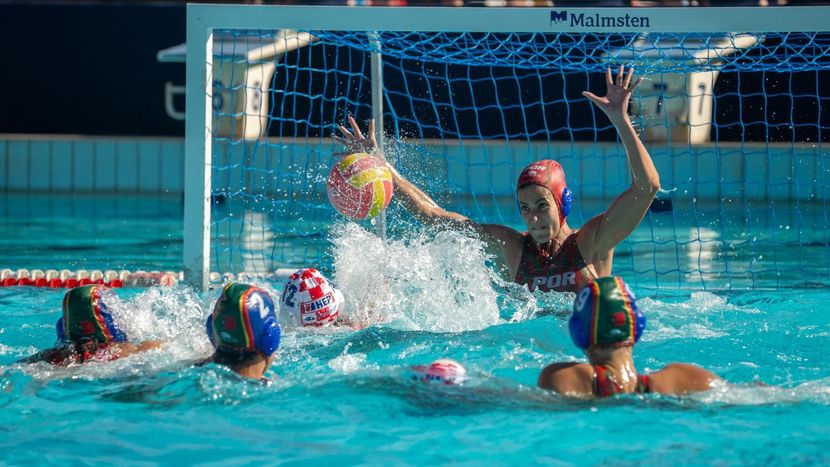
With 15 teams at the World Aquatics Women’s Water Polo World Cup 2026 Division II tournament in Malta, a host of new nations is expanding the network while two teams secured their spots for the World Cup Finals in Sydney, Australia.
Overview
Malta has been kept busy in recent weeks, hosting both the men’s and women’s divisions — 23 men’s and 15 women’s teams — with a staggering 108 matches over two venues — Tal-Qroqq and Cotonera. The Maltese federation is to be acknowledged and congratulated.
With this expansion of the game, the idea to split the tournament into two divisions has been a revelation and allowed lesser nations the chance to compete against higher-ranked nations.
The tournament provided some wide margins in many matches with only three going to penalty shootout, but the real thriller was at the sharp end of the tournament where Russia and China clashed in the final, having already qualified for the Finals.
It came down to the last second with Russia calling a timeout with four seconds remaining with the player moving several metres upfield and then unleashing a missile that breached the Chinese defence, spectacularly gliding into goal on the buzzer for the 18-17 victory.
It marked the return of Russia to the world scene, not having competed at this level since
2021 when it competed as the Russian Olympic Committee at Tokyo 2020. It has missed four World Aquatic Championships since last competing and finishing fifth in Gwangju, South Korea. It also missed the 2023 and 2025 World Cups, having claimed silver at Surgut, Russia in 2018. Russia also forfeited the chance to play the final World League Super Finals (2022) after winning bronze in 2021.
Russia’s best women proved equal to the task under Sergey Markoch — who won bronze medals as a player at the 1988 and 1992 Olympic Games — easing through every match by huge margins until facing China.
In December 2024, there were just 28 matches played between 16 teams, so the larger number of matches allowed more competition, sending a message to other nations for next year.
There were newcomers to the competition — Argentina, Malta and Slovakia — while Germany competed as a combined nation for the first time in World Cups.
Highlights
Watching Russia crush all the opposition until the final day was one highlight, but what I liked most was the cross-passing utilised by so many teams to beat the goalkeepers. The precision of these passes was excellent and proved the march women are making at this level.
The enthusiasm showed by the women and preparation that many teams made beforehand brought out the best in the players and for many it was at a new international venue.
Medallists All
We noted with the men’s competition that three teams have had success at this level in the past including Canada who won the crown in 1981 — the third edition. It twice has claimed bronze (2002 and 2006). Canada missed the last two editions and was sixth in 2018. China was a bronze medallist in 2010 and finished eighth last year with a shock loss to Japan. In 2014 it was fourth. Russia won silver medals in 2018 and 1997 when it lost to Netherlands.
Of the other teams, South Africa was eighth in 2018; Singapore finished eighth behind South Africa in 2014; Kazakhstan was eighth in 2002 and 2006; Brazil was eighth in 1991; and West Germany was sixth in 1989. Croatia, Great Britain, Portugal and Turkiye were attending their second World Cups.
The Qualified Teams
Russia, as earlier stated, was a class above, beating Argentina 33-11, Germany 26-4, South Africa 27-5, Brazil 22-5, third-ranked Canada 24-6 and China 18-17.
China, coached by Spanish supremo and 1996 Olympic champion Miki Oca, downed Turkiye 17-6, Argentina 21-5, Germany 14-1, Turkiye 18-5, fourth-ranked Croatia 23-11 and had the one-goal loss in the final.
Both teams will feel that they firmly belong in the top eight in the world and will provide stiff opposition to whomever qualify from the Rotterdam assignment starting this weekend.
Lower-Team Progression
Of the lower-ranked teams, Canada had four narrower-shaped wins before being clobbered by Russia and Croatia arrived with larger margins until the Chinese clash.
Brazil and Turkiye were the next best with Brazil having three one-goal victories and Turkiye having two big wins and two losses against China before the loss to Brazil.
Awards
The best-player award went to Russia’s Bella Markoch who was the pivot of the team and constant scorer. Best goalkeeper went to China’s Shen Yineng and the highest scorer and best young player was Croatia’s Ria Glas, taking out both awards.
Statistics
In the goal-scoring ladder, Glas topped all 131 scorers with 26 goals with team-mate Iva Rozic grabbing 25. Olga Lupingogina (RUS) netted 24, Markoch and Elena Borg (MLT) 23, Yan Siya (CHN) 22 and Katy Cutler (GBR) 20.
Maria Santos (POR) and Bennett Bugelli (MLT) made 52 saves; Darja Heinbichner (GER) 51; Shen 47 and Madeline Brown (GBR) 46. Coaches used their second goalkeepers extensively, spreading around the love.
Other statistics show that Yan made nine extra-player goals and scored most goals from the top at six; Lupinogina made most action shots at 11 and most counter goals at six; Borg was best from the penalty line at 10 from 10 and most successful sprinter with 17 wins; Toula Falvey (GBR) scored four more goals than the others with 12 from centre forward.
For all its big scores, Russia converted only 50.4 of its shots (127 in total) to China’s 63.7 (91). Russia won the actions goals (28); Brazil won penalty goals (eight); Canada won centre-forward goals (nine); Malta won outside goals 13; China won extra-player goals (21) and counter-attack goals (five) with Russia (five), although this last statistic is subjective and could have been much higher.
Clutch Matches
Day 1: Portugal winning penalty shootout against Great Britain 13-10 with a 3-0 shootout. Brazil nudging out Malta 11-10.
Day 2: Malta taking Slovakia 13-11 in penalty shootout after the match was tied at 10-10.
Day 3: Canada over Portugal 15-10.
Day 4: Being quarterfinals, one would think it would be close. However, Canada’s 14-9 win over Great Britain was the closest.
Day 5: South Africa pipped Singapore 12-11 in the 13-16 semifinals; Brazil ousted Great Britain 14-13 in the 5-8 semifinals; and Malta edged Argentina 9-7 in the 9-12 semifinals.
Day 6: On crunch day, the final was the closest; Brazil toppled Turkiye 12-11 for fifth place; Argentina needed a 16-14 shootout win after being tied at 11-11; and South Africa secured 13th classification with a 14-13 margin over Slovakia.
Conclusion
With a climactic conclusion to the tournament finishing on the highest-possible note, it proved the worthiness of this competition. It proved how vital an inclusive tournament for nations outside the top six can be and the hope is for more teams to enter in coming years. Women’s water is gaining in momentum and the effort put into these teams is immense and enthusiastically rewarded.