Coaches and staff reflect on how the programme is helping young athletes to adapt, improve and grow through elite training environments and international experience
The World Aquatics Scholarship Programme has been opening doors since its launch in 2014, providing vital financial and technical support to help aquatics athletes from around the world fulfil their potential. Targeted at athletes who face challenges in accessing high-performance training locally, the programme places the majority of scholarship holders at Training Centres and Water Polo clubs that cooperate with World Aquatics.
The water polo scholarship programme that has been running since 2024 is already proving its value. By placing players in established European clubs, the programme is both raising individual standards and creating meaningful connections between clubs and national teams. Athletes gain daily exposure to higher-intensity training and different tactical approaches, while coaches and teams benefit from the exchange of knowledge and playing styles.
Brazilian player Ana Carolina Neves is one of those athletes currently living that experience, training with Unió Esportiva d'Horta in Spain.
Since arriving, her progression has been clear. For UE Horta Technical Director and Olympic silver medallist in water polo, Xavi Garcia, what stands out most is how quickly she has adapted - not just in the water, but in every aspect of the transition.
“Since joining the Scholarship Programme, Carol has shown a very fast adaptation,” he explains.
“It is important to remember that these are very young athletes who are leaving their country for the first time - they face many changes at once… and that is not always easy.”
Garcia points to both her sporting and personal growth. “From a sporting perspective, she has adapted quickly to a more demanding training environment, improving her intensity and learning new tactical concepts. On a personal level, she has shown great maturity, is very receptive to feedback, eager to learn and has integrated very well into the team dynamic.”
That step up is something Neves herself immediately felt.
“Training with UE Horta has been having a big impact on my development, both in and out of the water,”
she says. “Here, I found a more competitive and demanding environment, which has helped me improve in many aspects and also taught me how to deal better with challenges and adapt to new situations.”
One of the biggest differences has been the intensity of daily work.
“I think the main difference I noticed is the intensity and seriousness of the training sessions, which are much higher than in Brazil,” she explains. “This experience has been very positive for me and for my development.”
Alongside these benefits, the experience is also shaping her mindset. The advice that has stayed with her most is powerful: trust the process.
“To trust the process and the adaptation, even when results don't come immediately, and to train harder than you play,” she says. “You need to push yourself more in training than in games, because that's how you truly improve.”
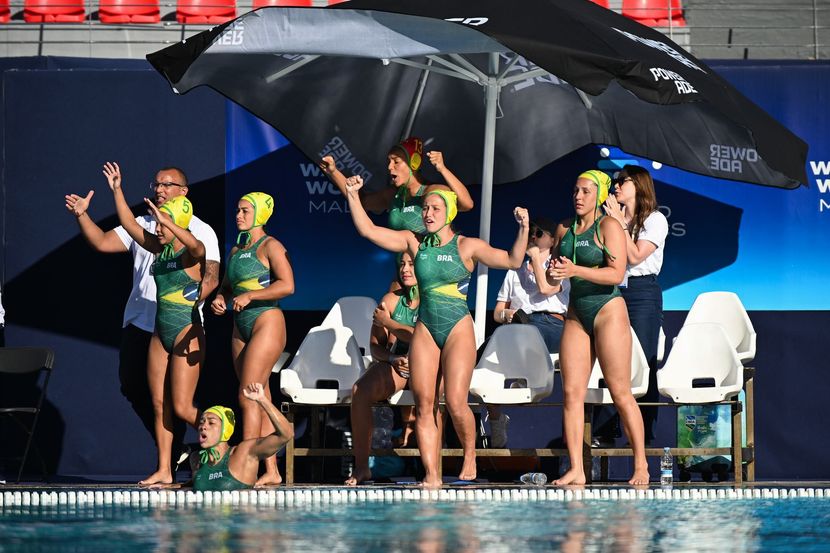
The benefits of the programme extend beyond the individual too. For the Brazilian national team, training camps and joint sessions with Spanish water polo clubs have become a key part of their preparation for major competitions - most recently in the build-up to the World Aquatics Women's Water Polo World Cup Division 2 in Malta (21-26 April), with sessions held at CN Rubí, UE Horta and CN Catalunya throughout April.
“These joint training sessions are extremely valuable for us,” says team manager Cristina Callou. “They allow our team to compete and train in a high-level environment. Facing strong Spanish teams helps us increase our intensity, improve tactical awareness and better simulate the level of competition we will encounter.”
At every level - national team, club and individual - the impact of the World Aquatics Scholarship programme is evident. It is not just about performance in the moment, but about building more complete athletes and creating stronger links across the sport.
As Callou puts it:
“Experiencing different playing styles and environments is key for their growth at the international level.”
And for players like Neves, that growth is already well underway.