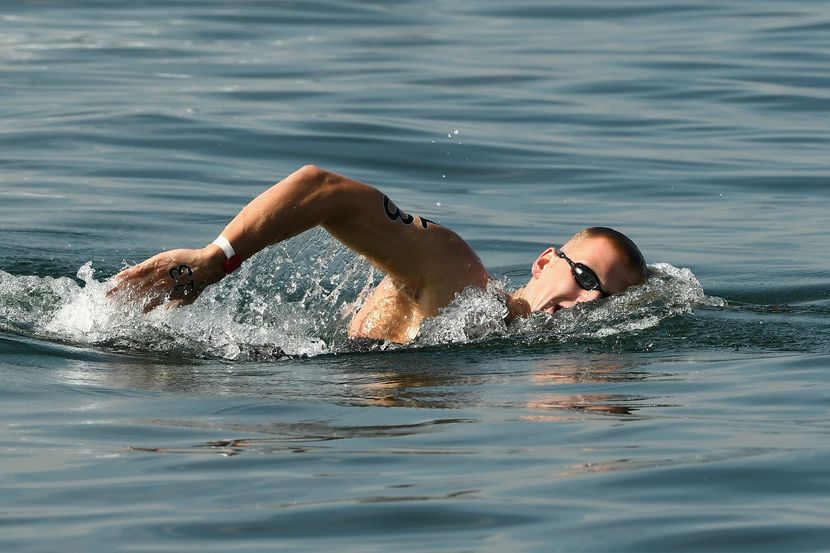
World Aquatics sat down on the eve of the World Aquatics Open Water Swimming World Cup – Ibiza 2026 with Ferry Weertman as the Rio 2016 Olympic champion reflected on race dynamics, the evolution of professionalism, and why the future of the sport – from knockout sprints to the Los Angeles 2028 Games – has never looked more compelling.
Seated on the starting deck in Ibiza, during the final training session in the harbour water at the Santa Eularia des Riu, Ferry Weertman watches the course take shape. The Rio 2016 Olympic Games gold medallist and now Vice Chair of the World Aquatics Open Water Swimming Technical Committee remains deeply embedded in the sport he once ruled.
As athletes prepared to dive into one of the strongest World Cup fields assembled, Weertman offers insight shaped by experience at the very highest level.
Q&A with Ferry Weertman
With such a strong and deep field here in Ibiza, what new challenges does that present to the athletes? Who does it favour?
“With a field like this, positioning at the start becomes very important. If you’re too far back early on, it takes a lot of energy to move forward. But at the same time, this is one of the strongest fields we’ve seen—most of the top-ranked athletes in the world are here—so it’s easier said than done to be at the front.
It’s still a 10km race, so you can’t afford to spend everything in the opening stages. But we know there are swimmers who are very strong from the front and can control the race. I think we’ll see that again here.”
In a large, competitive pack like this, does being a front-runner give you an advantage?
“I think it does, especially now. The races are getting faster and faster, and the field stretches out more. The longer the line becomes, the harder it is to move up. So if you can establish yourself near the front early, that’s definitely an advantage.”
For those who aren’t natural front-runners, where should they position themselves?
If you’re not leading, you want to be somewhere around the front third of the pack—maybe around 30th or 40th position, depending on the size and pace of the field. Any further back, and it becomes very difficult to move forward later.
That said, everyone is fighting for those positions, so it’s never easy. But once you’re in a good spot, you don’t have to work as hard to stay there—you benefit from the draft, from swimming in someone else’s water.”
Looking at the Ibiza course, how do wind and current factor into the race?
“Today there’s a headwind, which will slow things down, especially for those at the front. But there’s also some current on the back section, which might balance things out a bit.
A headwind makes it harder for the leaders because they take the full force of it, but it can also create chop, which makes navigation more difficult. It becomes harder to swim straight, and that adds another tactical element. Conditions seem to be calming compared to earlier, but I still expect some wind, which will make the race more interesting.”
You raced against many of today’s top athletes. What stands out about competitors like Kristóf Rasovszky?
“He’s been a standout since 2017, when he really broke through. Even early in his career, you could see he was someone to watch.
"What makes him dangerous is that he’s unpredictable. He doesn’t follow one set race plan—you never quite know what he’s going to do. Sometimes he goes out hard and leads from the front, sometimes he builds into the race. That unpredictability makes him a very tough competitor.”
And what about Marc-Antoine Olivier?
“I’ve raced him for many years—we both came through around the same time. He’s a very consistent swimmer. He’s not always the one driving the pace at the front, but he’s excellent at holding position, reading the race, and reacting when it matters.
He always seems to find himself in contention at the right moment, and that’s a real strength.”
As a fan of the sport now, which swimmers do you most enjoy watching?
“I really appreciate the stroke of Florian Wellbrock—he’s shown in both the pool and open water just how strong and versatile he is.
And Gregorio Paltrinieri is someone I’ve admired for a long time. I remember watching him at the Olympics back in 2012, and he’s had such a long, successful career across both disciplines. That’s impressive to see.”
What about the next generation—who or what stands out to you?
“There’s a lot of emerging talent, especially on the women’s side. The United States, in particular, has brought through some very strong young swimmers who are already performing at a high level.
But it’s not just one country—there are many strong teams here. It will be interesting to see who steps up this season.”
The Dutch have had such a proud and rich history in swimming, both open water and in the pool. What are you seeing there today?
“There was a period with less focus on developing juniors, but now that’s changing. There’s a renewed effort to build a strong long-distance programme, both in the pool and open water.
It’s growing again, and I expect we’ll see more Dutch swimmers coming through in the next few years.”
How does it feel being here now in an official role, rather than as an athlete?
I’d be lying if I said I wasn’t a little bit jealous. Being here, at a venue like this, right before a race—you feel that excitement. You know you’re in great shape, and you’re ready to test yourself against the best.
I don’t miss the early mornings or the hard training behind the scenes, but I do miss that feeling of racing.”
You’ve seen the sport evolve significantly. What stands out in terms of professionalism today?
“It’s grown a lot. When I started, teams might travel with one coach. Now you see multiple coaches, physios, sometimes even doctors.
Athletes are much more focused on every detail—nutrition, training, recovery. That raises the level of performance, but it also raises expectations.
At the same time, the events themselves have improved. The presentation, the venues—it all looks and feels like a top-level international sport. That’s a big step forward.”
What role do new formats like the 3km Knockout Sprint play in that evolution?
“I still believe the 10km is the core of open water—it’s the purest form of the sport. But the knockout format is exciting. It’s easier to follow, more dynamic, and very engaging for viewers.
I think it has a place alongside the 10km, not instead of it. Ideally, we keep both.”
Looking ahead to the Los Angeles 2028 Olympic Games, what are your expectations for Belmont Shores?
“I think we’ll see colder water there, which could mean wetsuit races—something we haven’t had at the Olympics before. That alone would be a new dynamic.
And being in the sea always adds unpredictability—waves, currents, changing conditions. That’s what makes open water so unique.
It’s also an iconic setting. California has such a strong water culture, and I think it’s a fantastic stage to showcase the sport. Hopefully, it brings even more attention and excitement to open water swimming.”