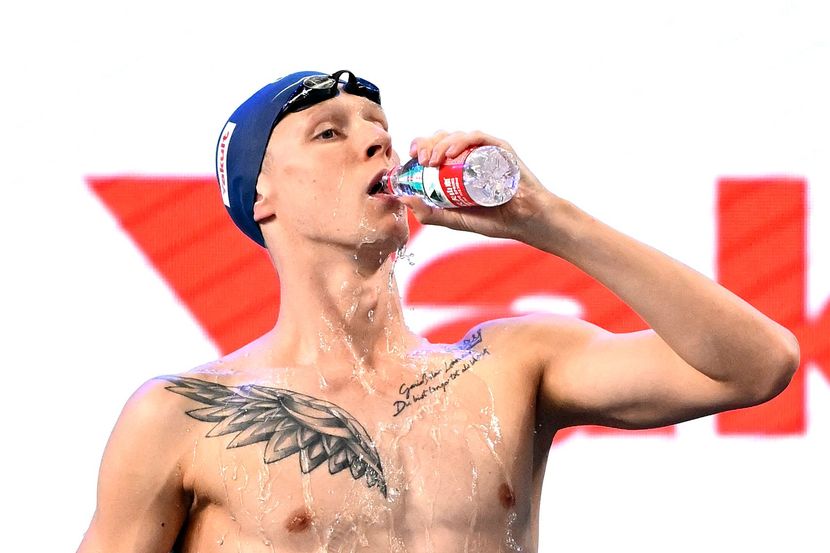
We’ve spoken with leading nutrition expert Andrew Shepherd, Performance Nutrition Lead at Loughborough University, who has shared his best tips & insight to help swimmers take command of their own nutrition strategy.
Nutrition can often be perceived as a complicated topic; ‘Which foods are best? When is the right time to fuel? For swimmers in particular, understanding how best to approach fuelling for such a high-volume sport is crucial, as well as understanding how it impacts your recovery, training, and performance.
Balance
The fundamentals of good nutrition starts with balance. Shepherd explains that a strong foundation is key, and is the first place he would start when advising or working with any new athlete.
“We would always look to establish that foundation and begin with balance; making sure that we've got those good components of carbohydrates, fats, and proteins,” he began. “When we look at the fundamentals of nutrition, I would always anchor to those principles.”
The impact of nutrition is far-reaching, affecting things like energy levels, athletic performance and immunity. It also impacts potentially lesser known areas such as cognitive function, sleep and susceptibility to injury.
Shepherd warns that athletes can often become overly invested in the granular detail, rather than focussing on good basics first. “It's easy to get into advanced nutrition and worry about dotting the i's and crossing the t's - the idea of putting the icing on the cake before we've actually made it.
“From an athletic performance or well-being perspective, trying to have those good components of vitamins, minerals and nutrients so that your immune system is in a really good place is key.”
Carbs Are King
For swimmers in particular, one macronutrient wears the crown: carbohydrates. “Generally, most swimming is going to be carbohydrate dependent. Carbs are king when it comes to getting from A to B.
“When we add in [additional] training, we add in more carbohydrates. And as a result, fuelling pre, during, and post-training is where we then focus our attention on getting the most from that stimulus.”
Carbohydrates feed your brain as well as your body, as Shepherd explains: “Your brain uses carbohydrate as its primary fuel, so it [impacts] your ability to stay alert, have learning opportunities - particularly in a training environment where you're trying to learn and refine technical, tactical skills.”
Being mindful of where you are in the season, or any given training week, is also important when it comes to carbohydrate intake - and fuelling in general. “I think our experience says that most people underestimate the amount of carbohydrate they need for hard work.
“We often see a mistake where people are feeling great on a Monday morning and by Saturday morning, they're surviving,” he said. “It’s important to fuel each session as it comes, and if you are still struggling by the end of the week, you may need to introduce more carbohydrates or look at a carbohydrate option during training.”
Adjust for Training and Racing
Knowing how to fuel pre, during and post-training can be one of the biggest daily challenges that swimmers face. And when it comes to competition, understanding how your body’s needs change throughout the season is crucial in being able to adapt appropriately.
“Essentially, we would describe it as ‘do more, fuel more’. It's that idea of fuelling appropriately for the work you're doing. So, the more you do, the higher the intensity and volume, the more you need to fuel.
“I think sometimes where we make a misstep in swimming is we take total time and task, instead of thinking about intensity and duration.”
He elaborates, explaining: “You might do a two-and-a-half-hour technical, tactical session, where you're working on really acute, specific drills. Versus doing a 90-minute session, where you're working at 50 metre sprints or faster and going all out. That latter needs as much, if not more [fuel] than the longer one.”
Shepherd adds that varying your intake based on your training week should be considered and encouraged, instead of defaulting to eating similar types and amounts of food every day.
“The other piece is just understanding where you are in the season. If you're doing lots of volume across the week, or you're doing lots of intensity, then carbohydrates play a big part. But when you're tapering, we often see the polarity isn't good enough.
“People tend to eat very similarly everyday - Monday might be a light, recovery day and Tuesday you might be going race pace. And yet, people will eat the same thing, whereas Monday should be a low day, and Tuesday should be a very high day.”
One watch-out he advised was not forgetting to re-increase your fuelling post-taper and during competition. “We often see people train and fuel really well during hard work. They taper, have a slight reduction, but then they forget when they start racing to go back to how it was during hard training again.
“You’re doing double warm ups, double swim downs, double racing, heats, semis, finals - the volume goes up through the roof.”
Hydration
Hydrating properly and regularly is key for any athlete; without it your body is going to suffer in more ways than one. Shepherd explains that for swimmers in particular, dehydration is often more common than it would be for land-based athletes - so it’s especially important to be diligent.
“We talk a lot about food, but we shouldn’t forget hydration. Anytime you become dehydrated, you're going to give up both cognitive and physical performance. Swimming is a little trickier in terms of hydration than maybe some land-based sports; lack of access to water bottles and [the fact that] you don't see your sweat. ”
As well as being a cause of fatigue and poor performance, dehydration can also induce cramps and hinder your body’s ability to remove toxins via urine.
Shepherd shared a simple trick that may help swimmers who find themselves struggling to hydrate properly: “Drinking water on poolside can be a challenge, because it can feel like you're drinking the pool water, so flavouring your water can be really helpful.”
Consistency, Consistency, Consistency
As with most things in sport, consistency and repetition are key to getting the most out of the effort you’re putting in.
Although nutrition may feel complex at times, taking a holistic approach that’s built on good habits, balance and that - most importantly - is achievable within your daily lifestyle, can help you achieve a successful nutrition plan that aligns with your goals.