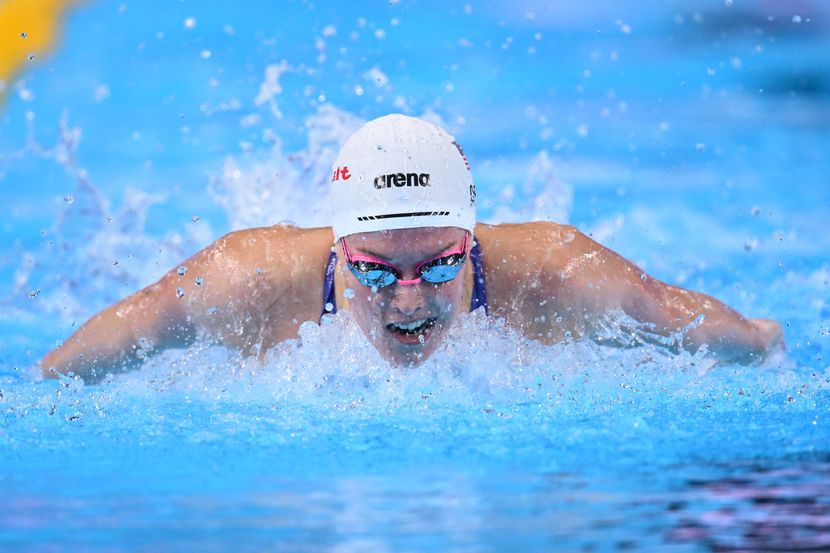
The University of Virginia won its sixth straight NCAA Division 1 Women’s Swimming and Diving title on Saturday night in Atlanta, the first school to achieve such a streak
When University of Virginia head coach Todd DeSorbo jumped into the diving pool at the McAuley Aquatic Center in Atlanta to celebrate its sixth straight NCAA title, it felt more special than the previous five. In becoming the first women’s swimming and diving program to achieve such a feat, it was the first without generational talents Kate Douglass and the Walsh sisters, who committed to the program before the streak even started. The ability to constantly reload on talent and stay on top is unprecedented.
“The first one, obviously, was fantastic,” DeSorbo told reporters Saturday night. “It’s the first time you ever win. And I think the second one is really cool because you start a streak. But this one is, to me, the most meaningful, just because we tried to take the approach that it’s a blank slate this year, that we haven’t won any. We’re starting all over and just start a new streak in a little bit of a different way where depth really will carry us through.”
Greatness in any sport is hard to sustain, as noted last year when the team won its fifth straight. Two schools, both coached by the late Richard Quick, have won five national titles in a row - Texas (1984 - 1988) and Stanford (1992 - 1996). Texas’ streak ended in 1989 when Quick took the Stanford job, while Quick’s second five-year winning streak with the Cardinal was ended in 1997 by the man who replaced him at Texas, fellow Hall of Famer Mark Schubert while at the University of Southern California.
The impressive part in Virginia’s six-year run: all six teams have won by 70 or more points, with the 2026 team scoring more than the previous five with 589, despite not having a superstar quite like Douglass or Gretchen Walsh. Another impressive factoid: Virginia would have still won the 2026 team title without its 200 relay points, becoming the fourth school to win all five relays at the same NCAA meet.
“To me, this one’s the most meaningful, because one, it’s historic, right? Nobody’s ever done it, and not to mention they did it in historic fashion,” DeSorbo told reporters Saturday night. “I know other teams have scored more overall, but it’s been a long time. But for us, you know, as good as our teams have been in the past, and as good of athletes that we had in the past, it’s really impressive that we scored more points than we’ve ever scored.”
Whatever superlative you want to use, this Virginia team fits it. Junior Claire Curzan led the team with wins in the 100 and 200 backstroke, both in meet records, while sophomore rising star Anna Moesch won the 200 freestyle in the third fastest performance in history. Both are set to return in 2027.
“Going into the year, there was a lot of discourse about, ‘Virginia is good, but can they continue to be this dominant?” Curzan said. “And I think this year, by and above, we’ve exceeded everyone’s expectations, including our own. And the Walsh’s are awesome. They’re the best duo in NCAA history, potentially even long-course history. To think that this team collectively can achieve even more than that, I think it’s really, really special. We’ve worked so hard this year, we knew that there was a target on our back, and to kind of see that dream realized is awesome.”
Freshman phenom Sara Curtis also finished runner-up in the 50 freestyle and was a member of four of the five winning relay teams. Olympians Katie Grimes, Aimee Canny, and Emma Weber each picked up All-America status as well.
Virginia closed the meet with the only NCAA record of the championships with a 3:05.26 in the 400 freestyle relay with the team of Curzan, Moesch, and Curtiss, along with freshman Madi Mintenko.
With Canny and Weber swimming in their final NCAA championships, the team will reload next year with World Junior champions Jana Pavalic and Smilte Plytnykaite.
Virginia isn’t showing signs of slowing down, and even though Stanford won more individual events with Torri Huske winning three and Lucy Bell winning two, and even though California is quietly building a powerhouse with freshmen Claire Weinstein and Teagan O’Dell, Virginia is still the standard of excellence, and is going to be as long as DeSorbo is in charge.
“I don’t really have a lot to do with it anymore, which is fantastic,” DeSorbo said of the winning culture that started in 2020. “The team just brings them in. Every year, the seniors don’t want to be that senior class that doesn’t win it. The freshmen don’t want to be that freshman class that’s the first one. And so it just kind of builds and builds and builds. And I think, particularly the first-years, the reason they came was to be a part of that. They’re excited about it. They want that. They’re excited about having that pressure and that expectation and perform well with that.”
With its sixth straight win on Saturday night in the same facility that hosted swimming at the 1996 Olympics, Virginia women’s swimming became just the sixth program in all sports to win six straight NCAA titles.
When DeSorbo started in Charlottesville in the fall of 2017, the team had never been higher than fifth. Now in 2026, the team sits third all-time in women’s swimming and diving with the most national championships, with a chance to match Texas’ seven all-time titles next season.
Elsewhere
The aforementioned Huske was the swimmer of the championships by virtue of winning all three of her individual events, becoming the second fastest performer in the 50 and 100 freestyle, in addition to winning her first ever 100 butterfly in her final NCAAs.
Much of the conversations around the meet centered around the new format which eliminated the consolation finals, much to the chagrin of the fans and swimmers in attendance, in addition to a new event lineup that shuffled around many of the events to be on different days than years past.
This year also marked the first time since 2007 that no individual NCAA record was broken at the women’s championships, despite valiant efforts from Huske, Curzan, and Moesch. The racing delivered as always, however.
Claire Weinstein won her first career title in the 500 freestyle, and went toe to toe with fellow World Championship team member Jillian Cox in the 1650.
Weinstein’s former club teammate Bella Sims won the 400 IM in her first year at the University of Michigan, her third career individual title in a third different event, while former World Junior champ Eneli Jefimova made her NCAA debut for NC State in winning the 100 breaststroke.
Campbell Stoll won her first career title in the 200 butterfly for the University of Texas.
Virginia won the meet with 589 points, ahead of Stanford (380.5) for its second straight top two finish and its 24th overall. Texas was third with 376.5 while California was fourth at 303.
The men’s meet will continue this week in Atlanta, with the 1650, and the 200 medley and 800 freestyle relays beginning Wednesday morning. Bob Bowman’s University of Texas team is the favorite to win back to back titles over the likes of Arizona State, Florida, and Indiana.