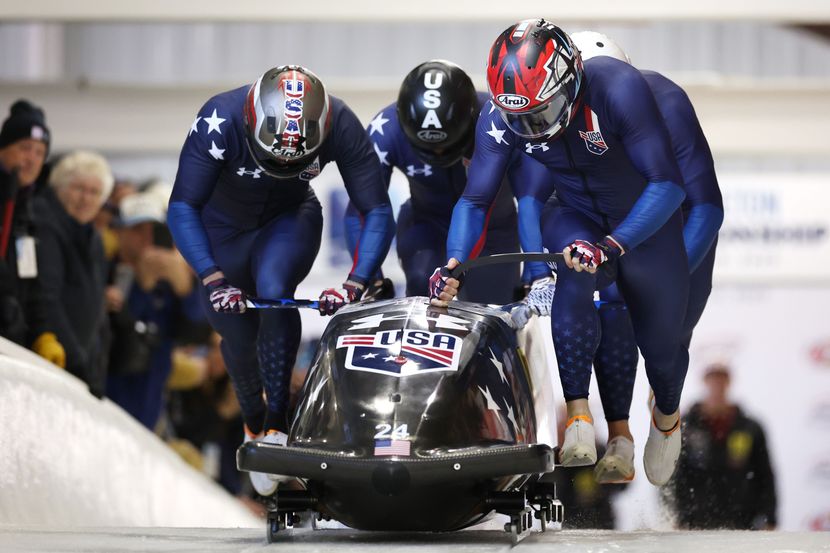
In an improbable shift, American Carsten Vissering has transitioned from breaststroker to a likely Olympic bobsledder. What? Why? How?
Carsten Vissering was one of the top collegiate swimmers in the US, but he knew that after placing second in the 100-yard breaststroke at the 2019 NCAA championships, he had more to give. At the end of his career at the University of Southern California, he had become “obsessed with weightlifting.”
So when he read an article about how an Olympic bobsledder trains, Vissering went, “‘Wait! This guy’s life is that he gets to jump, sprint, back squat – and that’s his sport?’ That’s really what drew me into [bobsled]. It had nothing to do with the actual sport. It was these training qualities.
“That’s everything I want to do right now,” he recalled thinking. “How do I get into this?”
The US team had a series of physical tests, known as a recruiting combine. Vissering completed them virtually and demonstrated the requisite strength, speed, and size to be invited to an in-person rookie camp in upstate New York where he would learn to push a sled.
The camp was held at Lake Placid, home of the 1932 and 1980 Winter Olympic Games, where there was an “ice house” with a short push track similar to a real bobsled start ramp. At the end of the week, the rookies who had that fastest start times were invited to a National Push Championship.
Reality Check
Vissering had no idea how far he could go in bobsled, so he consulted with a former national team member who had written his PhD dissertation on bobsled starts and push-athlete talent identification.
“He was super-polite,” Vissering said, “but he told me: ‘I want to be realistic with you. Coming from swimming, it’s going to be really hard. I don’t know if you’ll even make national push champs, or the national team.’” Often, bobsledders come from track and field (like Olympic hurdler Lolo Jones and sprinter Lauren Williams) or American football (like Herschel Walker).
Not only did Vissering have zero track and field experience, but the bobsled team didn’t even have spiked shoes to fit his size-15 feet on the ice. So he borrowed the largest pair he could find, a teammate’s 13.5s – which is the EU equivalent of squishing a pair of size 49.5 feet into a size 48.
Given the small odds of making the team, Vissering had taken a job at Ernst & Young in Los Angeles that year “because I had zero expectations for bobsled, but I had 100 percent expectations that my parents were going to kick me off their health insurance,” he said. [In the US, citizens have to purchase their own health insurance after age 26.]
Making It
But then, defying conventional wisdom, the 6-foot-5 Vissering made the cut for the national push champs (in the too-small shoes) and performed well enough to compete for the US.
It was the season after the 2022 Winter Olympics and, in hindsight, he said his timing, “was very fortunate, because the team was far less competitive than it is now.”
And on December 18, 2022, the 2013 junior world championship relay bronze medalist who used to swim for the same club as Katie Ledecky near Washington, D.C., made his World Cup debut in a bobsled and placed 12th. His second race was the 2023 World Championships in St Moritz, Switzerland, where his four-man sled placed 18th.
Now in his fourth season on the US team, the 28-year-old Vissering is 37 lbs. heavier than he was as a swimmer and has become a fixture in the USA 2 sled – pushing the hollow and heavy four-man sled on the left side, right behind his driver, Kris Horn, a former decathlete from the University of Massachusetts-Amherst. Last year, his sled placed seventh at the world championships. This season, his crew has already scored four top-8 finishes. Barring injury, Vissering should make the US Olympic bobsled team for 2026 Milano-Cortina.
The Reaction
Vissering’s USC coach, Dave Salo, always thought his swimmer might end up as a tight end in pro football – not curled up in a bobsled – but either way, Salo said, “I’m glad he stayed in the athletic world, because he’s such a tremendous, tremendous athlete. He was the model of intensity in the weight room.”
Everyone knew it.
“I was colloquially named the lifter who swam,” Vissering explained, adding that “I was always known for wanting to do cliff jumping or adventurous things so, for a lot of people, it didn’t shock them. I think people found it was consistent with my personality.”
Swimming Assets
In his new athletic realm, Vissering said two key things he learned as a swimmer have become pivotal in bobsled. One, he said, is “hyper-centralized focus. You have to turn into a hyper-focused mental kamikaze, block everything out except the moment to push down this icy hill, see the wall at the end of it that turns, and still go all out – not think, ‘Oh my God, a scary wall. Are we gonna crash?’ That is one of the No. 1 things that swimming has helped me with: that hyper-focused flow state mindset. In my opinion, that’s separates the best. A lot of people come to the sport who, on paper, should be beasts – but sometimes something doesn't click on the hill.”
Another important transferable skill, he said, was “inter-sled dynamics. Often your best friends can be your biggest competitors. You have to be able to compartmentalize work relationships, stay amicable. Right now we have two sleds qualified for the Olympics and I’m sitting in a spot that, if I hold it, I should go to the Games. Multiple people want to knock me off my spot. People I’m joking around with, you know?”
Bobsled Tough
At the same time, bobsledding has given him a fresh perspective on the simplicity of swimming.
“In swimming, everything is so nice, no crazy variables,” Vissering said during an interview from Austria. “Here, it’s snowing sideways, it’s minus-5, minus-10, we’re lifting on a squat rack in a freezing garage with our boots and jackets on. Even on those days, I’ve had great races. It really toughens you up. I wish I had that in swimming because there were so many things I’d complain about, little things, like: I don’t feel good in this taper, or my pacing’s off or, like, the food. Sometimes at a hotel, you’d get a little bit of pasta and there’s no protein. In swimming, it’s like, ‘Oh man!’ Looking back, Wow, I was such a baby about that."
Now, Vissering doesn’t even wince at having to heave a 462 lb. sled on and off a truck five times during a single practice to transport it back to the start.
The Crash Factor
Another difference? In swimming, he said, “No one’s going to crash right before you and throw you off mentally.”
Personally, Vissering has flipped five times in his short bobsled career – all but once during training. “You can feel a crash coming,” he said. “You feel a little bit of weightlessness. You’re like, ‘Oh, that’s not good.’ Then it’s just scraping. It’s the loudest noise ever. We wear a Kevlar shirt [for protection] but when you’re upside down, half your body will be on the ice while the sled’s still going about 70 miles per hour [or 112 kph] You feel like your arm’s on a stove. Most of the time, it’s not catastrophic; you’re usually going to walk away with an ice burn.”
His most recent crash, however, sent Vissering to the emergency room and could have derailed his entire 2026 Olympic bid – or worse.
On January 10, in St. Moritz, Switzerland, in the first heat of the two-man event, Vissering’s sled flipped while going 99 kph on a tricky turn early in the race. He slid down half of the course on his left side, clinging to the sled.
“I received a pretty bad friction burn on my back,” he wrote from Switzerland a day later, “but the doctor believes I should be healthy by the Games and sprinting by next week.”
What’s Next?
During Vissering's athletic transformation, in April 2025, World Aquatics announced that 50m swimming sprints would be included in the 2028 Los Angeles Olympics. “So funny, the amount of people who blew up my phone,” Vissering said.
“If the Tokyo Olympics had a 50 breast, I think I would have stuck it out and done Trials. At this point, I’m more invested in bobsled. I’ve gotten better every year. Our program’s developing. As a push athlete, I get everything that swimming would satisfy me with.”
So on February 21-22, when Vissering will be sitting knees-to-chin in a metal sled, vying for Olympic gold by barreling down the 16 curves of the Cortina Sliding Centre track in Italy, his old university swim coach, Dave Salo, will be on the pool deck prepping his new team (Arizona State) for the Big 12 conference championships with one eye on the TV.
“Oh, I will watch,” Salo said. “I will! He’s a great kid. I’m so excited for him. And for 2028, I think he’s got a really good shot for the 50m breaststroke.”
Olympic Team Naming for Milano-Cortina 2026
The US Olympic bobsled team is slated to be named on Monday, 19 January. You can find the latest news on Team USA's bobsled naming here.