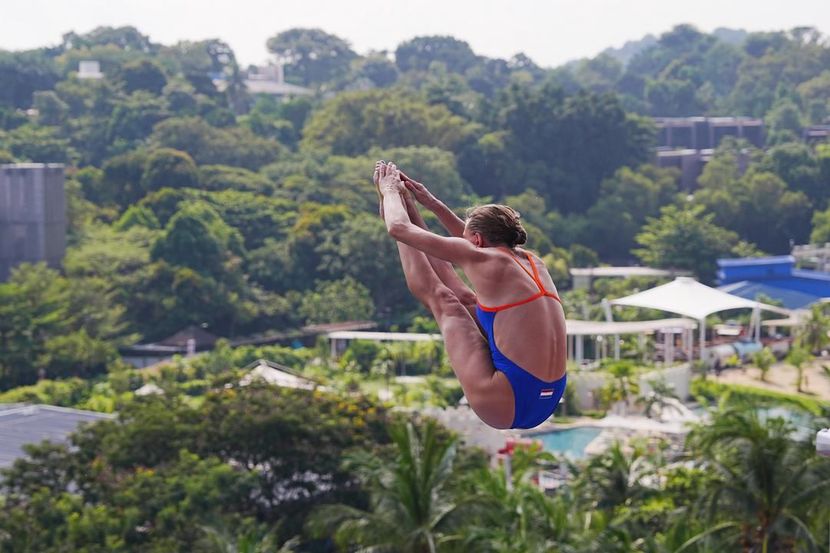
The People’s Republic of China won four more gold medals at the Montreal World Cup on Sunday to complete a sweep of all nine titles.
Not only did China remain undefeated all weekend at the 2026 World Aquatics Diving World Cup in Montreal, but China also claimed all four silver medals in the individual events, too, which meant that no one on its team finished worse than second.
On Sunday, however, some of those silver medals could have landed in foreign hands. Also, four athletes under the age of 16 landed at the top of the podium.
To find out who led the youth brigade, who rallied back from flawed dives, and what the athletes had to saying, keep reading.
Women’s 3m synchro
Synchro 3m world champions Chen Yiwen, 26, and Chen Jia, 21, captured China’s sixth gold medal in Montreal on Sunday morning, less than 24 hours after finishing 1-2 in the women’s individual 3m event. The pair finished 26.52 points ahead of runners up Alysha Koloi, 24, and Maddison Keeney, 29, of Australia. Fifteen-year-old twins Lia Cueva Lobato and Mia Cueva Lobato took the bronze for Mexico, 1.26 points behind the Aussies. Only the top-three pairs surpassed 300 points after all five rounds of diving.
After Saturday night’s individual event, neither Chen nor Chen had trouble recovering. In fact, Chen Yiwen said she’d been falling asleep “early” in Canada, which meant around 11pm – as opposed to after midnight back home.
Even though the Chens have been a pair for less than a year, Chen Yiwen said:
"We just go for it. We dive well together because we practice a lot and we have the same goal"
The Australian runners-up were happy with silver and amazed by the twins in third place.
“On the rise? I think they've risen,” Keeney said of Lia and Mia Cueva Lobato. “They were medalists at last year's World Championships and other World Cups, so they're already a force to be reckoned with. They’re great competitors and they’re really cute. It’s really nice having them.”
When Koloi was their age, she wasn’t even diving. She was a gymnast. “I only transitioned when I was, like, 15, 16. That was late,” she said, adding that the twins “are really nice little girls – and they're beautiful humans; that's always most important to me.”
Asked whether they plan to compete at the Junior World Championships in August in Croatia even though they’ve already pocketed a senior World Championship medal, the Cueva Lobatos said that they still have to qualify at their nationals. If they make the cut as expected, it would be their first Junior World Championships. (They weren’t eligible for the last ones, held in 2024, because they had only turned 13 that year.)
Either way, they have a long future. Ten years from now, Lia said she imagined herself having two Olympic medals – specifically “gold medals in synchro with my twin sister. And [to be] so happy in my life. This is our dream.”
Men’s 10m synchro
The youth force made another statement in the men’s 10m synchro event when China’s Yang Zhihao, 16, and Zhao Renjie, 14, obliterated the field to win gold ahead of Mexican runners-up Randal Willars Valdez, 23, and Kevin Berlin Reyes, 24, who were nearly 10 years their seniors.
Yang and Zhao scored with 469.23 points, but neither had any idea what their winning margin was. Yang guessed “20 or 30 points.” In truth, it was 68.82.
For the first three rounds, every single one of the 11 judges awarded China 9 points or more – and two of them awarded 10s in the third and fourth rounds.
Bronze medalist Euan McCabe, 20, of Great Britain said of the 14- and 16-year-old winners, “I just think they are a different level of human being.”
McCabe’s synchro partner, Ben Cutmore, 22, agreed. “They're just absolutely spectacular. In China, it's like they literally have backups for backups for backups.
"Their diving is always impeccable, and they're very inspiring to watch and to compete against because it always sets the standard"
The Brits were doubly surprised to share the podium because Cutmore caught a stomach ailment on the plane and had to quarantine in Canada.
“I was locked in my room for 48 hours,” he explained. “I only came back to training on Thursday, so we came into this hoping that we would be in the top eight so that we could be in the Super Final. But we came away with [bronze]. It’s a bit surreal.”
Women’s 10m
Even before the first dive of the women’s 10m final, it was clear that, once again, youth would be a dominant theme because the top three qualifiers were just 13, 14, and 15 years old.
In the end, the day belonged to Jiang Linjing, 15, who had already amassed 341.70 points after four rounds and still would have made the podium if she had skipped the final dive. Instead, Jiang reached 428.10 points to beat her 13-year-old teammate, Cui Jiaxi by 57.70 points.
“I exceeded my standards,” Jiang said, and to celebrate, she said she would like “to take a break for one day from the 10-meter platform.”
But the substory was how her teammate Cui dug herself out of eighth place to take silver after botching an inward 3½ in the second round.
The problem, Cui said, was that “when I started that dive, I was a little bit offset and then I rotated too much in the air.” It hadn’t gone well in training and she was nervous, but Jiang told her not to think about it.
Jo Jin Mi, 21, of the Democratic People’s Republic of Korea placed third, but Jo was in second place behind Jiang for most of the contest.
“I trained a lot to get bigger success, but today, unfortunately, I got bronze medal,” Jo said. “When I came to this World Cup, I was not so fluently exercised. I had many limitations to my training for a long time. I had a waist ache in my back, for example. But if I have another opportunity, then I will try all the best.”
Sarah Jodoin di Maria, 26, of Italy, placed a distant fourth. Also of note: 14-year-old American Ellireese Niday placed fifth despite a 2-point penalty on her final dive (an armstand back double with 1½ twists) because she put her feet down and re-started the armstand. Niday had been the third-highest qualifier (behind only Jiang and Cui).
Men’s 3m
The World Cup closed with the men’s 3m final, which was expected to be a battle between reigning world champion Osmar Olvera Ibarra, 21, of Mexico and three-time world champion Wang Zongyuan, 24 – but it didn’t play out that way. Wang led after all six rounds to clinch China’s ninth and final gold medal in Montreal. Four of his six dives scored more than 90 points, including his final dive, a forward 4½ which contributed 98.80 points to his 540.35-point total.
Zheng Jiuyuan, 21, of China made a notable comeback after falling to sixth place on his reverse 3½ in round three to take silver.
Meanwhile, Luis Filipe Uribe Bermudez, 24, of Colombia was locked into second place since the second round until Zheng nailed his dive with the highest DD overtake Uribe by nearly 10 points.
Olvera Ibarra placed fourth, 20.15 points behind Uribe.
Wang, the gold medalist, said his final score wasn’t a personal best but rather, “all the points I got pretty much reflects the performance I usually have.”
Zheng said the problem with his 307C in round three was “the dive has always been a little bit of a challenge for me. I was just being too rapid. Too quick on the dive, and on the takeoff as well. And a little bit stressed as well. So the walk on the springboard was a little bit off. I made my best effort to try to recover what the mistake. I really did the best I can.”
Uribe, meanwhile, was all smiles. When he woke up on Sunday, he said, “I feel today [will be] a good day. It's showtime! So you saw that. I’m so happy we Colombians are back with this medal. This medal is not mine, but is [for] all Colombian people.”
Next
Athletes who qualified for the World Aquatics Diving World Cup Super Final (based on results from Montreal) will compete in Beijing, China, 1-3 May.