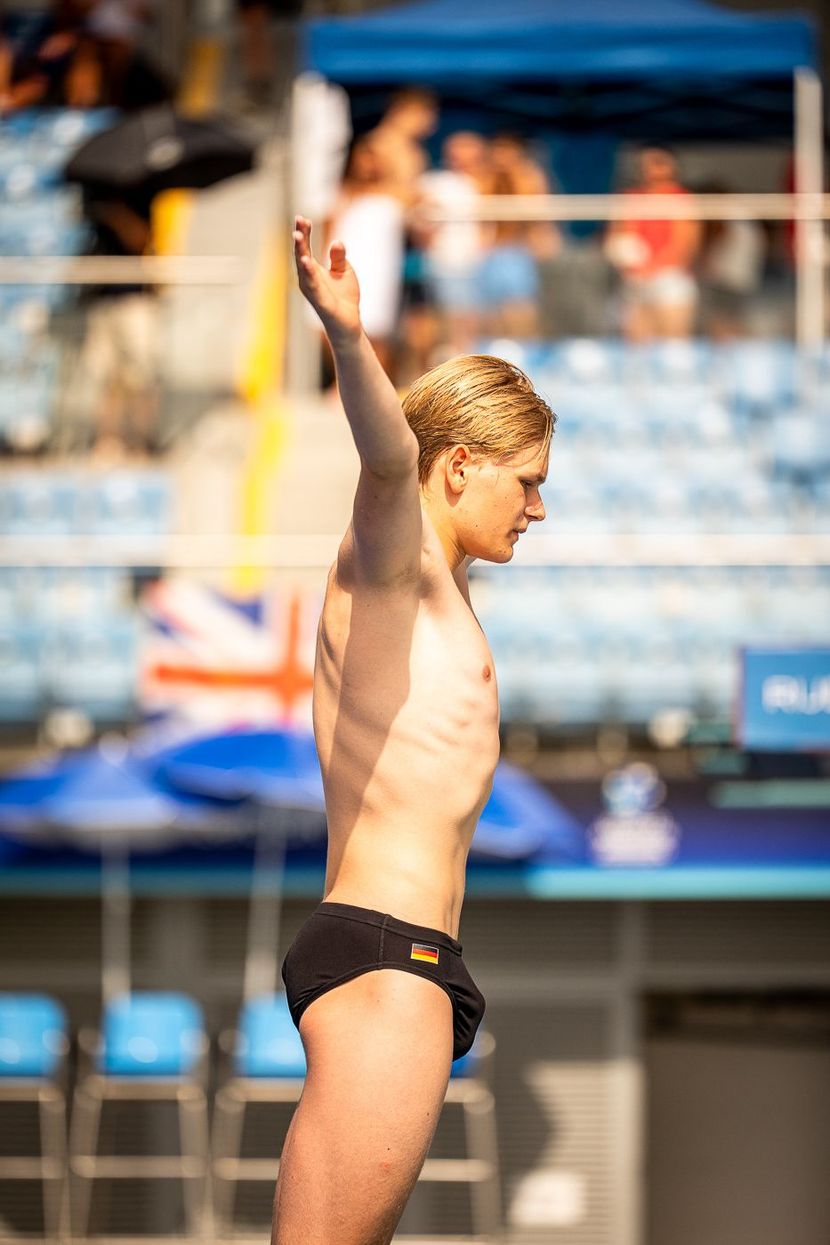
On Day 8, Rudi Bollmann won boys’ 1m gold for Germany, ahead of a 2-3 Mexican finish (for ages 14-15). To close the show, Aleksandra Kedrina of Russia won girls’ platform gold as Australia went 2-3 (for ages 16-18).
RIJEKA, Croatia – Divers from Germany and Russia claimed the last two titles on Friday to close the eight-day, action-packed, sunny, sweaty, breezy, rainy, always interesting, and ever spectacular 2026 World Aquatics Junior Diving Championships.
First, Rudi Bollmann surprised himself by seizing 1m gold (for boys 14-15) and shared the podium with Mexican training partners Ian Caleb Nava Gutierrez (silver) and Miguel Alejandro Sanchez Correa (bronze).
Then, in the grande finale, Aleksandra Kedrina topped two Australians in a topsy-turvy girls’ platform event to give Russia its seventh gold medal of the 17 events held.
Boys’ 1m – Group B (ages 14-15)
When the boys’ 1m final began, Miroslav Kiselev of Russia was aiming to sweep gold in all three individual events in the 14- to 15-year-old age group.
At the same time, Nava Gutierrez of Mexico was attempting to stop the streak, especially after taking silver behind Kiselev in 3m.
Nava Gutierrez started with a few key elements in his favour. First, he had accrued the most points in the first five dives from prelims (which counted toward the final score). Second, he established himself as a contender by earning two silver medals earlier in the week (in mixed team, and 3m springboard). Finally, his dive list included the hardest dive in the competition: a forward twisting 2½ with 3.2 DD (which he saved for the end).
But the plot quickly turned.
Through the four rounds of the final, Kiselev never managed to get out of sixth place. Meanwhile, Germany’s Bollmann was so consistent that, despite having an easier dive list, he took the lead in the second round and hung onto it to claim the gold.
“I’m shaking right now,” said the Dresden-based diver. “This is my first Junior World Championships and my first junior world medal,” Bollmann added. “I felt confident after my third dive, my 105B [forward 2½].”
" I’ll probably put this medal where I put all my medals: over my desk – but this one ranks number one"
Nava Gutierrez had been lurking in fourth place until his final dive, and the tough forward with 3.2 DD propelled him to his third silver medal in Rijeka, 12.25 points behind Bollmann.
Nava Gutierrez said he would like to keep adding difficulty to his dive list. For now, he said he will take his trio of silvers and “hang them in my room, so I can go in there and see them and visualize myself bringing home more medals in the future.”
The bronze medal eventually went to Sanchez Correa, who finished 4.45 points behind Nava Gutierrez to give Mexico a 2-3 finish and give Mexico its 11th and 12th medals this week.
“I’m going to do better in the next one,” Sanchez Correa promised. During these championships, he said, “I learned that it is very important to control yourself for the dives. You need to relax. Today I did respirations, looked at videos – not diving videos, not movies – more like TikTok.”
Girls’ Platform – Group A (ages 16-18)
Australia’s Maggie Grey entered these championships as the B group junior world champion on platform from two years ago. Now 16, the Aussie led two of the four rounds before finishing with a disappointing back 2½ with 1½ twists (with 3.2DD) and ended up 5.95 points behind Russia’s Aleksandra Kedrina for silver.
Kedrina’s gold marked her third medal of these championships (to go with team bronze and 10m synchro bronze). She set a personal best on her second dive, a 407C (inward 3½), which earned 78.40 points.
"It was the best try I’ve done for a while"
“Now I’m waiting to get home and sleep enough. I can’t wait to celebrate with family. Long season, and a lot of stress,” Kedrina said.
Grey, her face flushed with emotion, said “Honestly, I’m a bit disappointed with my result to today but we keep on pushing and hopefully the future brings better things. Divers have good days, they have bad days, and unfortunately this afternoon wasn’t my best. That’s life and we move on.”
The surprise bronze medallist was Kayla Davies, another Aussie, who trains in Sydney. She finished 6.75 points off Kedrina’s lead and just 0.80 points behind Grey.
“I was stoked to just make finals,” Davies said. “When I came up from the water and saw that I was in second, I was like: oh my god!”
Medal standings
Russia 13 medals (7 gold, 4 silver, 2 bronze)
Mexico 12 medals (3 gold, 5 silver, 4 bronze)
China 8 medals (3 gold, 3 silver, 2 bronze)
Germany 5 medals (3 gold, 1 silver, 1 bronze)
Canada 4 medals (1 gold, 1 silver, 2 bronze)
Australia 5 medals (2 silver, 3 bronze)
Ukraine 2 medals (1 silver, 1 bronze)
Great Britain 1 medal (1 bronze)
Fiji 1 medal (1 bronze)