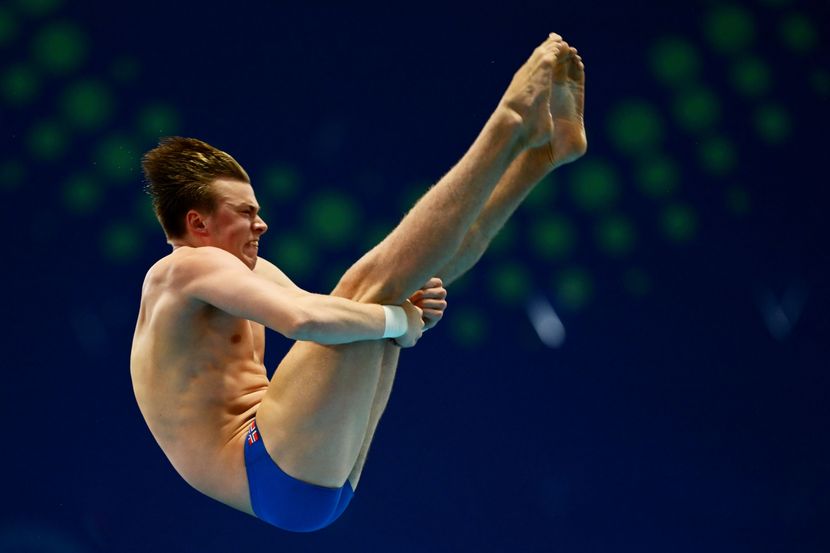
Isak Børslien, the rare elite diver from Norway, splits time as an emergency medical technician.
At major international diving events, it’s rare to see a dark blue hoodie that says NORWAY on the back.
If you see one, it probably belongs to Isak Børslien (pronounced: EE-sock BURS-lee-in).
In early August, Børslien, 20, will represent his nation’s best hope for a diving medal at the 2026 senior European Championships in Paris, France. He already captured two bronze medals at the Junior Europeans, and a silver at the 2024 Junior World Championships in Rio de Janeiro, Brazil.
All the while, Børslien has led a double life back home in Bergen. When he’s not at the pool, he is an emergency medical technician (EMT) working toward a career as a rescue paramedic on Norway’s Search and Rescue (SAR) or Air Ambulance (HEMS) helicopters.
He has already saved multiple lives, including three heart attack victims. He also helped deliver a baby.
The rescue work, he said, “It’s the dream of my life. I would say it’s harder than going to the Olympics.”
Norway’s SAR and HEMS crews are highly specialised and extremely selective.
Certification takes four years of work and school (which Børslien will complete the in five years due to his diving career). After that comes a year of required military service. When he is 26, he can finally apply for the job, but the cutoff is 36, and during that 10-year gap, he will have only one or two chances to qualify for boot camp. From the 400 people at boot camp, maybe three are selected to do a year of field training before securing the job.
Isak’s father, Dag, was one of them.
Not only did Isak grow up surrounded by rescue work, his hometown is also Norway’s aquatic hub.
The national arena, known as AdO, opened in Bergen in 2014. Its namesake, Alexander Dale Oen, was a famous swimmer with a bright future. Oen was a 2008 Olympic silver medalist and 2011 world champion in the 100m breaststroke. In 2012, Oen collapsed while training in the US, and died unexpectedly at age 26.
When Børslien was 9, he attended a diving show to celebrate the arena’s anniversary and was riveted. His dad knew a coach there, so Isak started diving more and more and eventually quit gymnastics.
Børslien’s coach, Espen Bergslien, 36, remembered one of those first training sessions.
“He reminded me a bit of myself,” said Bergslien who dove at the 2013 and 2015 World Aquatics Championships and was vying for a berth at the 2016 Rio Olympics when a broken wrist ended his career.
“Right away,” his coach said, “it was apparent how much fun Isak was having and his [outstanding] aerial awareness. He’s quite a maniac on a trampoline! So I was like, ‘Okay, this kid could be something.’”
It helped, of course, that Børslien had a giant trampoline at home.
“It’s in the garden,” Børslien said. “My dad built a house around it so I could jump all year ‘round. It has a roof and a terrace on top.”
Seven years later, Børslien won his first major international medal: bronze on platform at the 2023 Junior European Championships in Rijeka, Croatia. It was a huge surprise. The year before, Isak recalled, “I was like, ‘Ugh, I’m never going to take a medal.’ I saw the people getting medals, and I was like: ‘That’s not going to be me.’ Then, I don’t know, I just dove very good, had a very steady list, and got away with the bronze.
“It was a beautiful outside pool with great views. It was sunset. My whole family was there,” he added. After his first dive, people cheered. After his second dive, more people cheered. “It built up until the last dive,” he said, “and then everyone went crazy. It almost felt like people were supporting me more because I came out of nowhere.”
A year later, at 18, he took bronze in the 3m event at the Junior Europeans in Rzeszow, Poland, and proved he could be a threat on the springboard, too.
Then, in 2024, Børslien stared working full-time on an ambulance crew. That meant 12-hour shifts, both day and night, for about 37.5 hours per week – and yet, that November, he still took silver on 3m at the 2024 Junior World Championships in Rio de Janeiro, Brazil.
“I had so little training before Rio,” he said. “I had no idea I had that kind of potential in diving.” Afterwards, he called a meeting with his boss, and they decided that he could work about half as many hours.
Rio also marked the end of his junior career.
When he transitioned to senior-level diving, he said it was a bit awkward: “I felt small. I feel like I’m going back to the start. I don’t have the same confidence I did at Junior Worlds.”
Somehow, Børslien has the presence of mind to save a life in an emergency, but finding confidence on his “make-or-break dive,” a back 2½, sometimes proves to be harder.
“I’ve never really thought about it that way,” he said of the contrast.
"The feeling of saving a life is indescribable. You feel very vulnerable when you see that life can change quickly"
“The main difference is that in diving, I know I’m going to be nervous. I know what’s coming. It’s very predictable. But in the work I do, you never know what the day is going to bring. You can get sent out on a job, but on your way, you get switched to another person. Then you have to snap out of what you planned. I never really thought about being confident and being nervous in both. I kind of thought it was different, but maybe it’s more similar than I thought.”
For now, he said, “I just need more competition and more exposure to the best divers in the world. I’ve done all the dives I need to do. I just need to get them stable because these dives require a lot of strength and technique.”
After doing double duty on both 3m and 10m at the World Aquatics Diving World Cup in Montreal in late February 2026, Børslien and his coach decided to focus on 3m with an eye on the future. In the past, Børslien sustained back and shoulder injuries from the 10m. “The risk is lower on springboard,” he explained, “so I can keep going longer.” Also, at 186cm (6-foot-1), he said, launching from a cement tower can be tough. “When you have more weight and more mass to drag around to do the somersaults, it goes slower. I can still jump high, but it’s not enough.”
Already, the focus on springboard has paid off. About two months after making that decision, in early May 2026, Børslien broke his coach’s 11-year-old Norwegian national points record on 1m at the Bergen Open at his home pool.
Then, in Spain in June, Børslien took silver on 1m springboard at the Madrid International Diving Meet.
But the big event for 2026 will be the European Championships, where he plans to contest both 1m and 3m. In 2027, he hopes to be at the World Championships in Budapest, Hungary. And, after that, perhaps make his Olympic debut at Los Angeles 2028.
Norway has never won an Olympic diving medal. The closest was seventh place at the 1988 Seoul Games by 19-year-old Kamilla Gamme in women’s 10m. Norway’s best Olympic result by a male diver was ninth place at the 1948 London Games, by Rolf Stigersand on men’s 10m.
Asked what Børslien’s defining quality is as a diver, his coach said, “Definitely, spatial awareness. He knows where he is in the air, so he rarely fails a dive.” As a team, the coach said, “our biggest strength is his ability to understand movement. He’s easy to coach. With my language and how I show what I want him to do – I also try to explain how it might feel. We’re on the same page. We just connect when we talk.”
Børslien adds, “Often, coaches have looked at Espen explaining something, and then I just went up and did it exactly.”
“Yeah,” his coach said, “It’s almost like typing on a computer and pressing, ‘Enter.’ That’s how it feels sometimes.”