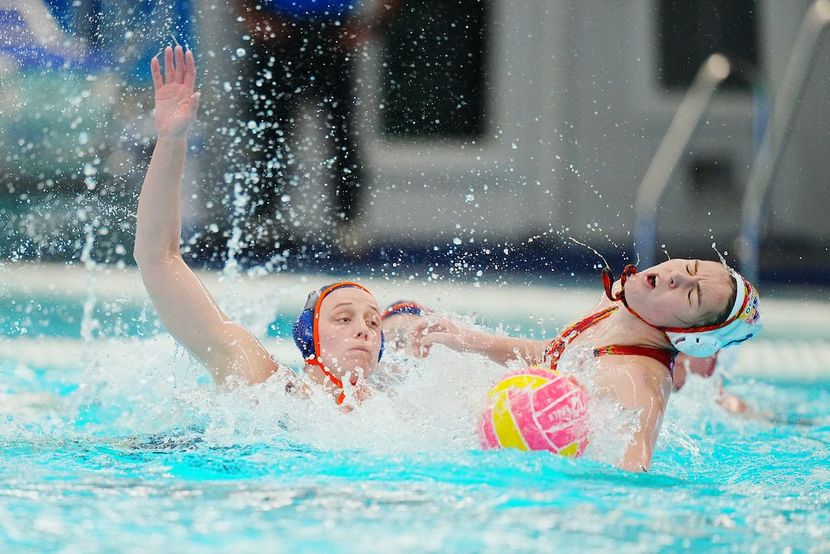
Statistics tell the tales and United States of America’s top ranking came with excellent figures, bringing it back on top after the pain of Paris 2024; the ecstasy of Doha 2024 and the disappointment of Singapore 2025.
Overview
This tournament was all about finding out the top non-qualified five teams for the Southern Hemisphere’s premier water polo tournament in 2026, the World Aquatics Women’s World Cup Finals in Sydney, Australia.
There were two segments to the six-day tournament with the first three days full of expectant excitement with the top four gaining automatic inclusion. Considering Australia was automatically qualified as the host nation, the top four — Netherlands, United States of America, Spain and Italy — gained their tickets for Sydney.
That meant last year’s finalists, Greece and Hungary, Australia and Japan would contest the critical Round 5-8 tournament. With Australia in, only one from Greece, Hungary and Japan would gain the final qualification spot. Australia was a nuisance team, in fact, and its second win over Greece — a 17-6 trouncing — proved to be Greece’s downfall. In a three-way tie on six points, Australia finished fifth, Hungary sixth and Greece seventh. Thus Greece, who beat Hungary 14-9 on day four, finished with minus six to Hungary’s minus three — the difference between qualifying and not.
In the top tier, USA emerged as the leading nation, followed by Netherlands, Spain then Italy.
Sydney-side
With the Sydney Finals still 10 weeks away, the teams know their opponents in the cu-throat quarterfinals. USA will play the No 2 qualifier from the Division II tournament in Malta, China; second-ranked Netherlands clashes with Russia, the Division II winner; third-placed Spain takes on Hungary and fourth-ranked Italy plays fifth-ranked Australia. From there it is straight to semifinals and classification matches.
Statistics
Australia
The Aussie Stingers could have expected a better finish than fifth, given it led by two against Netherlands and lost by six, then inexplicably imploded against Italy, leading 7-2 and even 7-5 at the final break only to fall in a penalty shootout. The week improved markedly with two wins over Greece and the expected three points against Japan to force a three-way tie after Hungary had the better of the Aussie Stingers on the final day. The better goals differential between the three meant Australia finished fifth, Hungary sixth and Greece, sadly, seventh. Australia shot at 43.5 per cent and converted extra at just 34 per cent with 47 attempts.
Greece
Greece struggled throughout with the injury sustained by captain Eleftheria Plevritou in the clash with Netherlands on day three. She was sorely missed. A day later, sister Vasiliki Plevritou also went missing, suffering from a pre-tournament injury that apparently re-surfaced. Throw in head coach Haris Pavlidis being ousted in the second-day clash against Netherlands and Greece was rudderless. Antonios Vlontakis, 2005 World Championship and 2004 World League bronze medallist, took over the reins for the rest of the match and the next, losing both. This disruption, led to Greece’s downfall, now having to look toward next year’s World Cup and World Championships for a hopeful repeat performance of 2025. Greece’s overall shooting was just 41 per cent and the extra plays returned 17 from 42 (40.4).
Hungary
Hungary presented a team without regular captain Rita Keszthelyi and the redoubtable Natasa Rybanska. The first three days weren’t the kindest to the Magyars, losing to USA, beating Japan by just four goals and losing to Spain by six. It again beat Japan to face Australia for the do-or-die decider, where it triumphed. Head coach Sandor Cseh had a “tantrum” and was red-carded, having to sit out the next match. This created an “imbalance” in the team dynamic, but it should be much better presented for the Sydney Finals. Hungary shot at 45.1 per cent and 38.9 per cent on extra.
Italy
The Setterosas’ penalty-shootout win over Australia and a fantastic 12-10 margin over Netherlands were enough to secure a top-two finish in the group behind Netherlands and ahead of Australia and Greece. The fact it lost the next three was irrelevant in a way, although fourth position and an encounter with the host nation with a partizan crowd, will be a tough ask, especially with the way Australia closed out its tournament. With youngster Olimpia Sesena — voted best young talent — toiling in goal, Greece has a star in the making and a back-to-strength team will make a huge difference. Italy had a 40.9 per cent conversion rate on shooting and only 20 from 45 (44.4) on extra. The power of Chiara Ranalli from outside proved potent, scoring 10 goals.
Japan
Japan brought joy on every occasion it hit the water. Presumably trailing all the top teams, its results speaks for itself, not gaining 10 goals in only one of the six matches. It fought valiantly, obliged with counters and sharp shooting and relied on teamwork instead of the normal “leave it to Yumi Arima” syndrome of the past. In fact, Arima scored only six goals in the first two matches and did not reappear for the rest of the week. Japan managed 33 per cent shooting and seven from 16 (43.7) on extra but felt the effect of not having its leader in the water.
Netherlands
The Dutch started strongly and then stumbled against Italy going from 9-7 up early in the fourth to succumb 12-10, scoring a late goal. It was one of Italy’s defining moments, coming a day after blitzing Australia. Netherlands shot at 43.1 per cent and a commendable 57.1 per cent on extra. All field players scored and the goalkeepers were exceptional. Netherlands is the European champion and will be chasing a record ninth crown and the first since 1999.
Spain
The Spanish had an easy start against Japan and then hit the wall with Netherlands four goals to the better — an unusual situation for Jordi Valls’ team. It bounced back against Hungary and Italy before finding another obstacle in USA, losing by two in the lowest scoring match — 7-5. More pain came in the last day with the Dutch succeeding by one — 8-7. Spain shot 43.2 per cent and only 15 from 37 (40.5) on extra, its Achilles heel. Only one player failed to score and three made double figures.
United States of America
USA, currently, is back on top of the world, a position it knows so well. The Jewel Roemer-led team (although the captaincy was spread around) had a 50 per cent scoring rate and 14 from 23 (60.8) on extra, proving why it was best in Rotterdam. Emily Ausmus top-scored with nine ,showing that the goals were spread around among all field players. USA showed intent on day one against Hungary but lost in a shootout against Spain on day two, its sole blemish. Two of the latter wins were by two goals, showing how close the competition is at this level. Ryann Neushul was exceptional, gaining the award for Most Valuable Player.
Goalkeepers
Spain’s Martina Terre took out the top goalkeeping award and rightfully so with 54.1 per cent saves (46) compared from nearly 152 minutes in the cage. Only Italy’s Sesena had more minutes at more than 171, making 45 saves at 42.9 per cent. Australia’s Gabriella Palm had the next highest minutes at 155 for her 43.2 per cent (35 saves). Hungary’s Boglarka Neszmely made 38 saves for 48.7 per cent. USA’s Amanda Longan was next best with 35 saves at 60.3. Greece’s Ioanna Stamatopoulou had more than 135 minutes in goal for 33 saves from 80 shots — 41.3 per cent. Dutch goalie Laura Aarts was on 45.8 per cent with 22 saves and countrywoman Britt van den Dobbelsteen had a 52.6 percentage (20).
Leading Scorers
Hungary‘s Hajdu was best in a tournament not known for blowouts and where goals were shared within teams. She nailed 18 goals at 45 per cent, five more than team-mate Zoe Lendvay with 13 (72.2). Japan’s Eruna Ura and USA’s Neushul, Greece’s Stefania Santa and Siouti all scored 14 with Ura striking at an impressive 60.9 per cent. Lendvay was joined on 13 by Spanish star Elena Ruiz. On 12 goals were Eszter Varro (HUN), Roemer (USA), Eleni Xenaki (GRE) and Ausmus (USA). Scoring 11 goals were Aussie pair Alice Williams and Abby Andrews and USA’s Jenna Flynn. The only player in the top 77 with 100 per cent was Netherlands’ Kittylynn Joustra with eight goals.
Other Statistics
Hajdu made six goals on extra; Bea Ortiz (ESP) five penalty goals; Ausmus and Hajdu were best on action goals with nine each; Siouti topped the goals from the top with four; Vanda Valyi (HUN) and Simone van de Kraats (NED) were best on sprints with 15 from 19 each; five players scored two counter goals; Paula Camus (ESP) and Varro netted six goals from centre forward; Ausmus and Hajdu were best on action goals with nine.
Conclusion
Women’s water polo is where it wants to be — many teams jostling for positions and no team absolutely dominating currently. With the rise of lesser teams filling the ranks and the inclusion of Russia and China in the Finals, Sydney will be a festival of the sport, especially since the series is intertwined with the men’s competition.
The format for Sydney sees women’s quarterfinals of 22 July; men’s quarterfinals on 23 July; four women’s matches on 24 July; two women’s classification matches (5-8); men’s classification match (5-8) and men’s semifinals on 25 July and the medal clashes for both men and women on 26 July.
The joy of using the same length pool means matches are integrated without the need for making pitch changes.