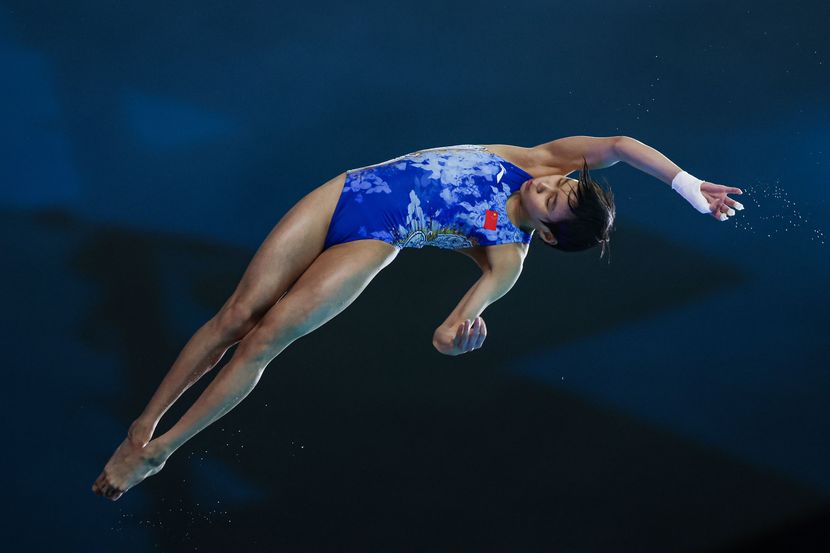
This weekend, Beijing hosts the World Cup Super Final where 90 of the world’s best divers will compete in nine events. Once again, the individual events will feature an exciting head-to-head knockout format.
All eyes will be on Beijing’s distinctive Water Cube this Friday, Saturday, and Sunday as divers from 16 nations will finish the compact 2026 World Aquatics Diving World Cup season.
The action will begin on Friday with all four synchro events and the mixed team final.
Saturday will feature the men’s 3m springboard and women’s 10m platform.
On Sunday, the Super Final will close with the women’s 3m event followed by the often-dramatic men’s 10m platform contest.
The host nation, as usual, will be extremely difficult to beat.
Two months ago in Montreal, divers from the People’s Republic of China swept all nine gold medals and captured all four silver medals in the individual events as well. Its collective performance was not only a stunning display of excellence, but it also demonstrated unfathomable depth because two of its double medalists were only 13 and 14 years old. Two of its other gold medalists were just 15 and 16.
China’s lineup will also include female veterans Chen Yiwen, 26, on 3m and Chen Yuxi, 20, a 10m specialist who, like Chen Yiwen, has 11 Olympic and world championship victories. Experience on the men’s side will come from Wang Zongyuan (another 11-time world and Olympic champion on 3m) and Lian Junjie (who has six world and Olympic titles, all in men’s 10m synchro events).
Headliners from other countries will include the reigning world champion on men’s 3m, Osmar Olvera Ibarra of Mexico, and the reigning world champion on men’s 10m, Cassiel Rousseau of Australia.
Another fan favorite, four-time Olympic medalist Jack Laugher of Great Britain, 31, is slated to team up with Anthony Harding, 25, in men’s 3m synchro.
The last time we saw all these athletes was in late February at the World Cup in Canada. Back then, Laugher had only been training for two weeks after taking a six-week hiatus to let bones in his left wrist heal. (Yet he and Harding took 3m synchro bronze.) Rousseau had just wrapped up a snowboarding vacation in Japan. (He earned the 10m bronze.) And Olvera Ibarra’s father had gone on a local radio station to urge all the Mexican fans to come to the pool to watch his son take silver in 3m synchro with his Olympic silver-medal partner Juan Manuel Celaya Hernandez and see the 15-year-old Cueva Lobato twins (Mia and Lia) capture bronze in 3m synchro.
Nine weeks later, the competition should be tighter and everyone should be more polished.
Also returning to the Super Final (for the second year in a row) is the knock-out format in the four individual events.
Here’s how it works: 12 divers are seeded and matched with another diver to create six head-to-head pairings. The divers in each pair will do three dives each, and the athlete with the higher cumulative total will advance to a six-person semifinal.
The semifinal is a little different. There will be two groups of three divers. Men will do three additional dives; women will do two additional dives. Scores from the head-to-head round will be added to the semifinal scores, and the athlete who has the lowest cumulative score in each group will be eliminated. The four remaining athletes will compete in the final.
In the individual finals, everyone will start with a clean slate. Each of the four finalists will perform their full dive list (6 dives for men, 5 dives for women). The diver with the highest score wins. All stages will take place in a single session which lasts about two hours.
Where to Watch the 2026 Diving World Cup Super Final
You can watch all the events, live and on demand, from the Diving World Cup Super Final by checking out our Where to Watch Guider here.