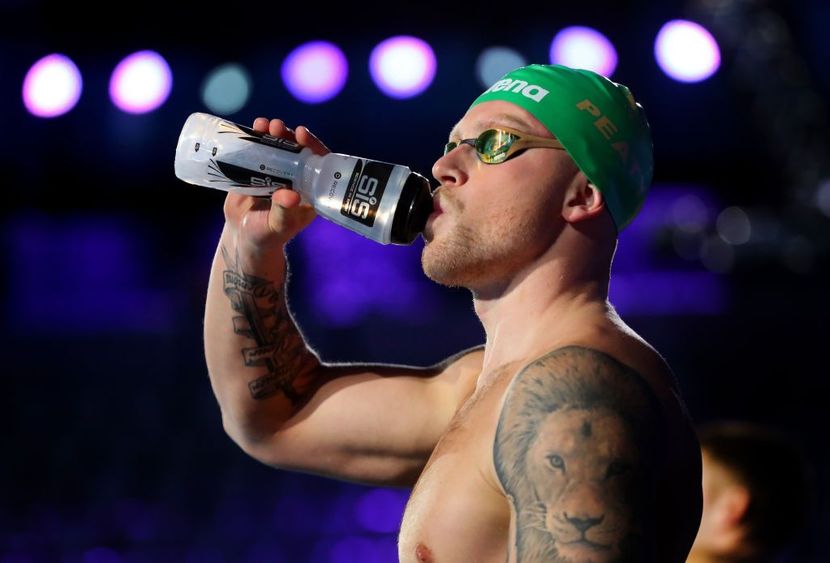
Timing your nutrition can be just as important as what you eat. Andrew Shepherd, Performance Nutrition Lead at Loughborough University, explains how swimmers can fuel before, during, and after training to boost energy, aid recovery, and maximise performance.
Knowing which foods make up a balanced diet is one thing; knowing when to eat them for maximum benefit is another. Breaking down nutrition, either by day or by meal, can be a really helpful tool for swimmers.
From there, this allows you to adapt based on training load, and have sight of the peaks and troughs that might be coming up throughout the season. Shepherd has outlined a rough guide below to help swimmers get the most from their training fuel.
The first task is to identify how frequently you expect to be fuelling throughout the day. Shepherd gives the example of: “You might have eight - ten feeding opportunities in a day across snacks, meals and fluids, and we'll balance those, based on the demands of the training that you’re in.
“We'll essentially signify a fuelling opportunity which will either be high carb, moderate carb, or low carbohydrate. The proteins and fats will be mixed in around that.”
Two - Four Hours Before
Although less applicable for early morning sessions, Shepherd advises that ideally, swimmers should start thinking about fuelling for their session as early as two - four hours before.
“Digestion runs on a set time frame. We would usually go with a mixed meal - carbs, colour, protein - two to four hours before. It can be small, medium, or large, depending on how people feel, whether they want to go into the session feeling very full, or lighter if they’d feel a bit nauseous.
“Some good options for this type of meal might be a sandwich, wrap, a breakfast cereal option, or your ‘meat and two veg’.”
60 - 90 Minutes Before
“Here, you could have something smaller and lighter that’s lower in fat, but higher in carbs and protein. Something like a rice pudding, yoghurt, fruit, flapjacks or Soreen bars - something easy and simple that can be on the go.
“If people struggle with volume at that point, you can go for a fluid option. But you just have to be careful it doesn't become super sweet and really easy to digest. If it gives up its energy within 20 to 30 minutes, it's not going to help because [your body] will be in the wrong place when you then get in the pool.”
30 Minutes Before
“We would look to have something like a small handful of carbohydrate-based foods only (eg. dried fruit or fruit juice) 30 minutes or so before [training]. The reason to remove the fat and the proteins [at this point] is that fat is much slower to digest - it can take two to four hours.
“In the 60 to 90-minute pre-training meal, we remove the fat to keep digestion speed up, not because fat is bad - it's just not appropriate at that time.
“Essentially, all three of those meals are looking to release their energy when you step on the block, or when you start your activity.”
Post Training
“Once we’ve finished training, the body has its best opportunity to refuel. Carbs and protein [are great] at that point, and the crude number for carbohydrates would be 1g per kilogram of body weight in that window immediately after training.”
For the protein element post-training, Shepherd advises that up to 30g of a high leucine source (which is an essential amino acid found in animal protein) will help to repair muscle tissue and aid recovery.
“We would add 20 to 30g of protein to that from a high leucine source - essentially a chocolate milk is basically exactly that.”
Alternatively, mirroring the type of small meal that he advised for the 60-90 minute pre-training window will also help to replenish the body with exactly what it needs post exercise.
Trial and error is going to be important for any of these meal-times. If, at any point, you find yourself unable to digest a certain type of meal before training, it’s important to remember that you can train your gut, rather than viewing it as a lost cause.
He added: “You can train your gut with practice and consistency. We can start with a bit and then increase it, rather than going to a place where you feel unwell and it puts you off as a result.”
‘Do More, Fuel More’
As a high-volume sport, swimmers are susceptible to under-fuelling, something that Shepherd says he has seen often. “It's not novel or new or exciting, but swimming has struggled with the same things for a long time. It's, ‘are we fuelling enough and getting that balance correct?’ ‘are we staying well enough to be in the pool?”
Overall, the right fuelling strategy should help to keep you in the pool, illness free and ready to perform at your best the next time you step on the blocks.