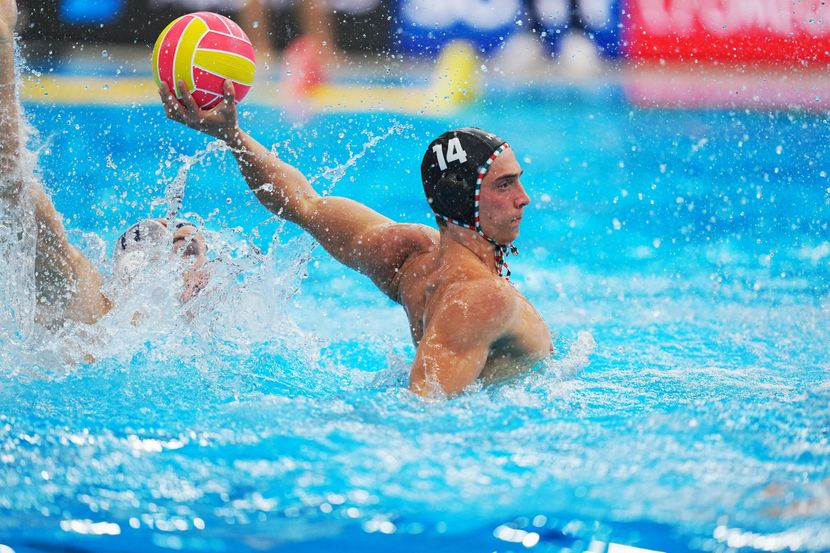
Most players’ trajectory to the bigger stage is gentle. Not so for Hungarian 2023 junior world champion Akos Nagy who has been catapulted into the limelight, earning accolades and a silver medal at last month’s European Championships in Belgrade, Serbia, following silver at last year’s World Aquatic Championships in Singapore.
Akos Nagy hails from the city of Tatabanya, about 60km west from Budapest.
“My mother was a competitive swimmer and obviously she wanted me to learn swimming as soon as possible. However, I wasn’t too good in swimming and I was about to quit but I was told to wait for a bit as a new coach would come soon to run water polo trainings for youngsters.
“And there he came, Zoltan Kovary, who really made me fall in love with water polo. I was regularly training together with the 2001 age-group (three years older), so when I played in my own age-group, I felt comfortable and enjoyed it pretty much.”
On his targets from an early age: “I know it won’t sound great as you see young kids talking about wanting to become Olympic champions, but I all I wanted was to feel great. I loved the atmosphere, to go the pool after school and it was great to feel that incomparable tiredness only a good practice can give you. All in all, training together with the boys and bringing the best out of each other gave me the ultimate joy and that was more than enough for me.”
On being picked for age-group teams and then to the senior national team, he said: “My approach didn’t change much when I was first called to the age-group national teams. I just loved to train and loved to play. Then, when just recently I was selected for the senior team — that was something different.
“All of a sudden, I had to realise how far I got from the tiny pool of Tatabanya. And I should say, that this triggered something. I started really taking care of the tiny details like when to go to bed, to take the vitamins every single day. You know, I just felt, however, silly it may sound, that I AM a water polo player now.”
On playing together with Marton Vamos (HUN) and Dusan Mandic (SRB) in Ferencvaros: “To put it short – it’s awesome. I enjoy every single moment of being together with the two greatest left-handed players of our time. Whenever I have any uncertainty, any doubt, I can turn to them any time; they both made sure that I should come forward with any questions I may have.
“Of course, you can also think of finding the solutions on your own, but when you are together with two geniuses of water polo, you’re better to go to them and check out what else you can do in certain situations. And I just want to use this unique chance to benefit from it as much as I could — I really feel honoured and lucky to have such an opportunity which others may only dream of.”
Please give us an example: “Well, if I should recall my last question, for an outsider it may sound weird, but at this level the little details can make a big difference. So, when we do pressing in defence and you attach yourself to your rival in a way that you stand between him and the other attacker holding the ball, how should I pull my legs under myself to make sure that my man cannot free himself easily and drive towards our goal.”
On being the only left-handed player in the Hungarian team for the Belgrade Europeans (in Singapore, they were three — Marton Vamos, Gergely Burian and him — but now, for different reasons, he was the only leftie. For Hungary, this occurred for only the second time in the last 40 years — 10 years ago, also in Belgrade, Marton Vamos was the only left-hander at the Europeans, otherwise, there were at least two in the roster at every single major.)
“It was a huge responsibility on one hand but a huge relief on the other as this choice by our head coach Zsolt Varga is a true sign of trust. And all other players came with positive feedback, our captain, Krisztian Manhercz, sat down with me to talk through what should come next. The main message was not to stress at all, and the other older players told me that any time I feel I need help, I should talk to them right away.
“Honestly, at the beginning of the championship, the pressure was almost unbearable for me. but as time went by, I opened up and talked a lot more to the others. And yeah, they kept telling me, ‘Akos, just shoot, don’t worry if you miss one, go for the next’ and that helped to score those goals in the big games.”
He scored crucial goals — two against Spain in the decisive match to reach the semis; three against Greece, in the semis, and one against Serbia in the final.
On the experience of Belgrade 2026: “I think, on the whole, we did well at these Europeans, although we really feel sorry for the final — perhaps it will stay with us for our entire life. This is a wound which needs to be healed for long. Each of us had great moments; we saw phenomenal games from all our players during the fortnight, so I think we can be really proud of what we’ve achieved.”
On being selected for the Best Seven alongside Mandic, Manhercz and Stylianos Argyropoulos: “This is obviously a tremendous honour and gave me even bigger motivation for the future. Standing on the stage, I felt that I received that MVP plaque on behalf of our team. Without them, I couldn’t have got this merit.
“My own assessment is that I can be satisfied with my performance, but I see that there is room for improvement, mostly in defence. I’m a maximalist, so I always explore what I could have done better. If you ask me if I had been content with the level I reached in Belgrade, I’d say yes — but now I feel I could have even done more.”
On the level of water polo in his club and in the national team, he said: “If you put aside the matches we play in the league against lower-ranked teams, I should say that the level is very much the same in the Champions League and at the big championships in the international competition — that is, the absolute highest. And I feel privileged that I can play for Ferencvaros, which won the most prestigious titles now twice in a row, and also for Hungary, which reached back-to-back finals at the Worlds and at the Europeans.”
On the transformation from a talented under-20 world champion into a well-built senior player, he pointed to body mass. “I cannot be grateful enough for my club and my coach Balazs Nyeki to secure a smooth path for me, which leads you from the age-group teams to the senior level. In today’s water polo you can exist in the elite only with a certain mass of muscle.
“When I joined Ferencvaros, I weighed 86 kilos. Now I’m 94. They were patient with us, and we went step by step, so it was really a well-defined building process.
“To highlight the difference, I can tell you, that in the youth club, KSI, we worked with certain weights, now I can pull six-seven times bigger weights in the gym. In the pool, when it’s body versus body, you need the strength to create the space for yourself in offence and to be able to guard any of your rivals in defence. This is one part as we also do special workouts to maintain the laxness you need for good shooting,” he said.
Some consider him an alien as he usually reads books on flights or during long afternoons instead of being attached to his phone. Also, on Sundays, you’ll never reach him as he goes to digital detox (as he describes), keeping himself away from any screen around.
With the Worlds in Budapest 2027 and the LA Olympics in 2028, Nagy was pragmatic: “Of course, you need midand long-term targets; still, I prefer going forward day by day and not thinking of grand goals like the Los Angeles Olympics or the home Worlds next year. Those are still too far for me and if you don’t give your full focus on the very next practice, your level can drop easily.
“No doubt, I really want to earn the opportunity to play at those tournaments, but I’m rather looking for my daily motivations and build myself step by step, as I’ve done that so far.”
(With tremendous assistance from Gergely Csurka)