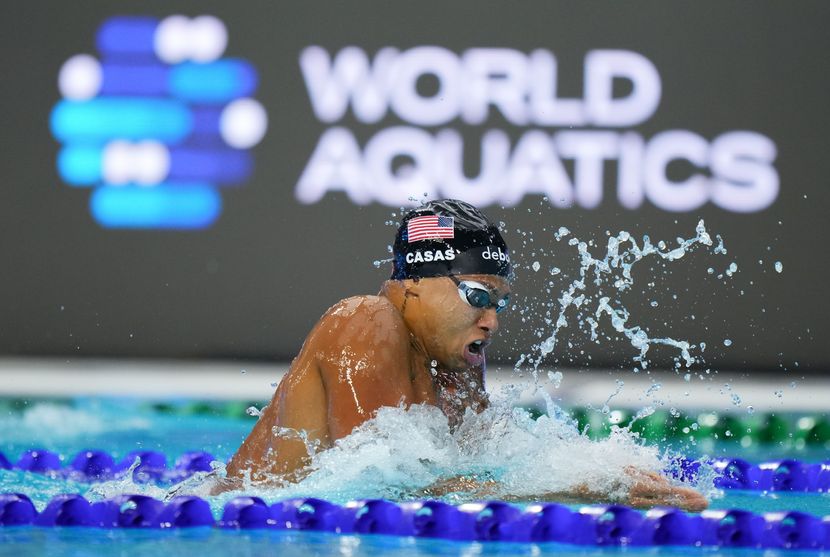
World Aquatics has released its comprehensive Post-Event Results Report for the 2025 Swimming World Cup, delivering an in-depth analysis of athlete performances, participation trends, and record-breaking achievements across the three-stop circuit in Carmel, Indiana; Westmont, Illinois; and Toronto, Ontario.
With three North American cities hosting in rapid succession, the 2025 Swimming World Cup delivered a dense, high-performance October racing calendar that highlighted both the depth of global talent and the continued rise of performances in the 25m swimming pool. World Aquatics has now released the Post-Event Results Report for the 2025 Swimming World Cup—an in-depth statistical review of all performances across Carmel, Westmont, and Toronto.
This publication builds on World Aquatics’ expanding suite of data-driven reports, following previous editions covering the World Aquatics Championships and the Olympic aquatic sports analysis for Paris 2024. As with those reports, this latest document is designed to provide valuable insights for fans, coaches, National Federations, and technical stakeholders focused on performance progression across the sport.
The full Swimming World Cup Results Report is available HERE.
A Three-Stop Circuit Marked by Exceptional Performances
The 2025 World Cup once again demonstrated why the series remains a proving ground for established champions and emerging talents alike. Across the three cities, 42–46 National Federations were represented per stop, with athlete participation peaking at 385 competitors in Westmont.
Throughout the tour, swimmers set one of the most prolific record-setting swings in recent World Cup history, including 13 World Records, 30 World Cup Records, and multiple Continental Records.
Toronto in particular produced a surge of world-class racing, with eight World Records and 14 World Cup Records falling across the three-day meet—cementing its reputation as one of the fastest short-course stops in the series.
Athletes Who Defined the 2025 Circuit
Several athletes emerged as consistent high performers across all three events:
Josh Liendo (CAN) brought home two of the most electrifying swims of the series with a World Record in the men’s 100m butterfly and a World Cup Record in the 50m freestyle in front of a home Toronto crowd.
Kate Douglass (USA) delivered one of the strongest overall campaigns of the series, winning the 100m freestyle at all three stops and setting World Records in both Westmont and Toronto. She swept the breaststroke events as well, reinforcing her range and technical dominance. Kos won the Women's Overall 2025 Swimming World Cup crown.
Gretchen Walsh (USA) continued her upward trajectory with exceptional sprint results, including a World Record 23.72 in the 50m butterfly during Stop 1 and multiple World Cup Records in the 100m butterfly and 100m medley.
Kaylee McKeown (AUS) dominated the backstroke events, lowering the 200m backstroke World Record twice during the series—first in Westmont and again in Toronto—while adding further World Cup records in the sprint backstroke.
Lani Pallister (AUS) controlled the women’s middle- and long-distance freestyle, posting a World Record 7:54.00 in the 800m freestyle in Toronto and setting new Oceanian records across the 400m, 800m, and 1500m distances.
Hubert Kos (HUN) led the men’s field, setting World Records in both the 100m and 200m backstroke in Toronto and winning all three stops across the 50m, 100m, and 200m distances. Kos won the Men's Overall 2025 Swimming World Cup crown.
Caspar Corbeau (NED) delivered a breakout World Cup season in men’s breaststroke, breaking the World Record in the 200m breaststroke in Toronto and sweeping all three stops of both the 100m and 200m events.
Participation and Performance Insights
The Post-Event Results Report provides a full statistical breakdown of the 36 individual events contested at each stop, including:
Athlete participation across National Federations and club representation
AQUA Points rankings for all women’s and men’s competitors
Event-specific analyses of fastest reaction times, splits, and scoring profiles
Finals cut-off times, illustrating depth across all three competitions
The evolution of the historical World Cup and World Records
The data confirms several global trends:
Sprint events continue to sharpen, with 50m and 100m disciplines accounting for a high proportion of new records.
Distance events for women saw significant performance progression, driven by Pallister, Fairweather, and others.
Men’s backstroke and breaststroke events delivered some of the strongest performances of the entire series.
Momentum Toward 2026 and Beyond
The 2025 Swimming World Cup showcased both the high-performance depth of the field and the accelerating pace of short-course improvements globally. The performances across Carmel, Westmont, and Toronto reinforce the value of the World Cup series as a key benchmark in the lead-up to the World Aquatics Championships and the Olympic qualification cycle.
To explore the full results, data visualisations, and performance analyses, view the Post-Event Results Report for the 2025 Swimming World Cup HERE.