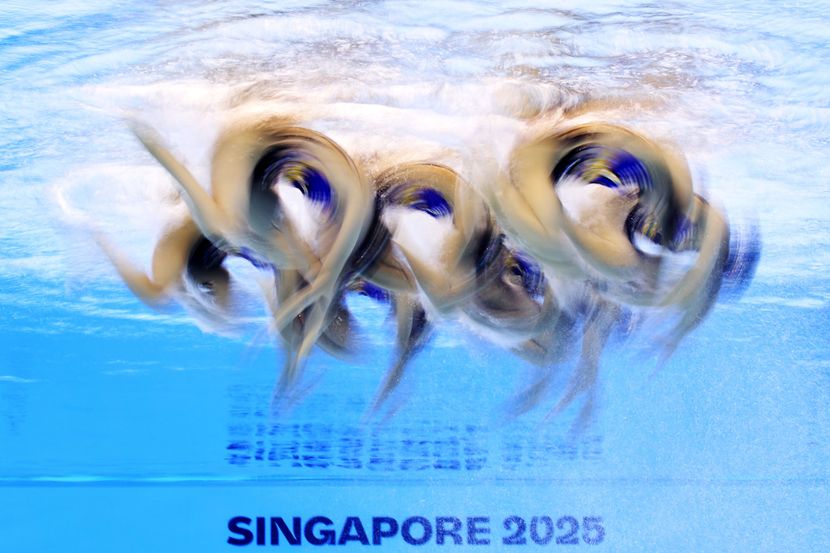
2025 saw a host of established stars, together with emerging talents, dazzle artistic swimming audiences around the world with ground-breaking creativity and confidence, helping push the boundaries of the sport.
Additional ‘tweaks / revisions’ in 2025 though have further improved not only fairness and transparency but also rewarded those bold enough to take creative ‘risks’.
China, Spain, and Austria were among the nations that truly excelled in the post-Paris 2024 season.
To fully reflect on the significance of the season, World Aquatics spoke to Canada’s triple Olympian and World champion Jacqueline Simoneau, who retired after Paris 2024, for her take on the major moments 2025.
“Across the board, there’s a sense that nations are no longer afraid to try something bold, which is great for the sport,” Simoneau tells World Aquatics.
Q – There were so many fascinating moments this season, which you have been able to take in both while watching from afar, but also in person at events. How do you assess the development of artistic swimming over the last 12 months?
“It’s been a really special season for me,” says Simoneau. “Watching from afar gives me a wider, almost aerial perspective of the sport; how it’s evolving, how different nations are adapting and how athletes are expressing themselves under the new rules. But being on-site at major events brings me right back into the energy that made me fall in love with artistic swimming in the first place.
“Stepping away from competition has allowed me to appreciate the sport in a more holistic way. I’m noticing the nuances of strategy, choreography, and team culture more than ever before and I feel incredibly proud seeing the next generation push the boundaries of what’s possible.”
Q – In terms of innovation and entertainment value, who has impressed you the most during the 2025 season?
“This season has been full of creativity, but a few really stood out. China; as always, continue to redefine technical precision with artistic risk-taking—they’ve found a really strong balance. Spain; especially in the Mixed Events and Team Acrobatic routines, brought a cinematic, theatrical flair that audiences connected with. On the Solo Events, athletes like Iris Tió delivered some of the most emotionally engaging performances of the year.
Q – Let’s talk a little more about Iris Tio, because as you say her continued development has been outstanding. She really has become a true star of the sport over the last year…
“Iris’s growth this season has been remarkable,” continues Simoneau. “She’s always had beautiful lines and artistry, but in 2025 she added a level of maturity, depth, and athletic confidence that elevated her performances.
“What impresses me most is her musical sensitivity—she connects with the audience in a very honest and intentional way. She’s becoming one of the most complete athletes in the sport, pairing technical refinement with real emotional presence. She’s absolutely one to keep watching as we move toward 2026!”
Q – How impressed were you with the return of Austria’s Anna Maria Alexandri and Erini-Mariana Alexandri? They had a challenging time at the Paris 2024 Olympic Games and were considering their futures in the sport, but they’re now back and look stronger than ever.
“Their return has been one of the highlights of the season,” says Simoneau.
“Both Anna Maria and Erini-Mariana bring an intensity and competitive fire that immediately elevates the field! You can tell that they are veterans in the sport, but what stands out is not just their physical comeback, but their mental resilience.
“They returned with routines that were both technically demanding and artistically sophisticated, as if they never stepped away. Their experience shows in the way they handle high-pressure moments and their presence undoubtedly raises the level of every event they enter.”
Q – China attained historic Team and Duet success at Paris 2024 and took a clean sweep of the Team titles at Singapore 2025. Do you feel anyone has shown the kind of potential to rival China in the years ahead?
“China remains the clear leader in the Team events, but the gap is definitely closing,” Simoneau insists to World Aquatics. “Italy, Spain, Ukraine, Japan, and France have all shown steady progress this season, strengthening their depth, increasing difficulty, and refining their overall team identity.
“If this trajectory continues, we could see a much more competitive field in the coming years, with several nations positioning themselves to challenge China more closely.”
Q – A year on from the Paris 2024 Olympic Games, how do you think the world’s best artistic swimmers are placed in terms of adapting to new rules and progressing the sport?
“Paris 2024 was a turning point,” Simoneau states. “A year later, you can really see athletes and coaches understanding how to maximise the scoring system rather than react to it. The new rules have pushed the sport toward greater athleticism, clearer scoring criteria, and more distinct team identities.
Simoneau continues, “We’re seeing more creativity in choreography, more daring acrobatics, and a more objective technical foundation! There’s still room for refinement—as with any major rule shift—but overall the sport is moving in a very positive direction.
“I think the balance between athletic difficulty and artistic storytelling is becoming healthier, and it’s creating a more engaging product for fans and broadcasters!”
The World Aquatics Artistic Swimming World Cup season will consist of five events in 2026, beginning in Medellin, Colombia (13-15 February), before returning to Paris, France for the second leg (27-29 March).
The second half of the tour will see athletes head to Xi-an, China (1-3 May), before the concluding ‘regular season’ World Cup in Pontevedra, Spain (29-31 May).
The Super Final will take place in Toronto, Canada, from 19-21 June.