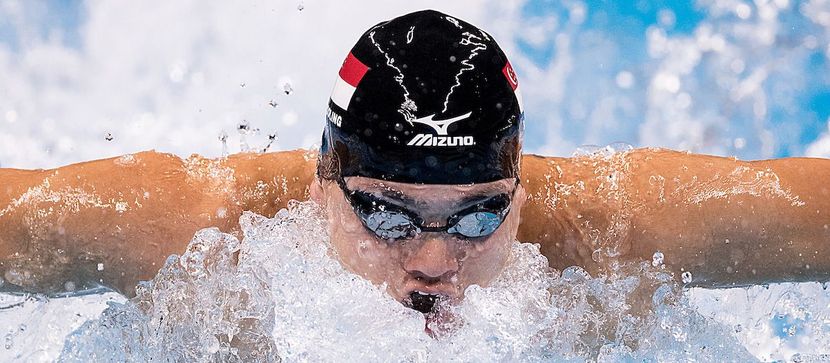
Michael Phelps in an illustrious triumvirate on an Olympic podium yet none of the trio was the champion. The answer to that golden riddle was Joseph Schooling, a name previously little known beyond Asia and outside the world of swimming but one which will now be always remembered as that of the historic first Olympic champion in any sport from Singapore.
There the 21-year-old stood on the top step of the Olympic podium after a runaway win in the 100m butterfly final with the surreal sight of three of the sport’s finest champions beneath him in a unique three-way tie for silver. Michael Phelps, 22 Olympic gold medals and counting, stopped in his tracks after sweeping all four titles he had contested in Rio’s Aquatics Stadium.
©Giorgio Scala / Deepbluemedia
Next to him, South Africa’s Chad le Clos, who had deposed Phelps as 200m fly champion at London 2012 only for the peerless American to reclaim his realm in Rio, and next in line, European champion Laszlo Cseh, the shaven-headed Hungarian so often upstaged by Phelps but a medallist now nonetheless at four Olympic Games.
Schooling had, however, given them all pause for thought as the fastest in the heats and semi-finals and his triumph in the final was brutally emphatic, breaking Phelps’s Olympic record from Beijing 2008 as he hit the wall in 50.39, the third-fastest man in history behind the sub-50s of Phelps and Milorad Cavic (SRB) of the shiny-suit era. Phelps, Le Clos and Cseh, for once in total unison, arrived 0.75sec behind, like everyone else in the stadium stunned to see all three on the identical time of 51.14.
“A three-way tie is pretty wild,” Phelps said. “I saw second next to my name and then I looked up again and then I looked over at Laszlo and Chad like, huh, we all tied for second, that’s kind of cool.” Le Clos was equally nonplussed. “Strange is not the right word. We need to create a new one for that,” he said. “I got a silver tie in London (2012), so to get a three-way tie is crazy. Maybe in Tokyo (2020) a four-way tie. That’s the way it’s going.”
Schooling could scarcely believe he had beaten them all.
“I need to let this moment sink in, realise what I’ve done and then I’ll have a better understanding of what I accomplished. But right now all I can say is I’m really honoured and privileged to have an opportunity to race in an Olympic final alongside huge names like Michael, Chad and Laszlo, guys that have redefined the sport.”
It was all good-natured cheerfulness on the podium, Phelps, Le Clos and Cseh raising their arms together to cheers all round the stadium as they stepped up to receive their silver medals and then Phelps, the old master, chatting affably to the new champion afterwards as they made their lap-of-honour circuit of the pool deck, the Singapore national anthem having been played to hail an Olympic title for the first time ever. “He said: ‘Good job, that was a great race’,” Schooling said. “I told him, ‘Four more years?’ and he said, ‘No way’. If he changes his mind, that would be fun. I like racing Michael.”
For all his low profile outside Asia, Schooling has made his presence felt in the swimming world in the years since his Olympic debut as a 17-year-old at London 2012, where he was eliminated in the heats of the 100 and 200 butterfly. He made the semi-finals of the 200 fly and 200 individual medley at the 2013 FINA World Championships in Barcelona, won the 100 fly gold at the 2014 Asian Games in Incheon (KOR) alongside silver in the 50 fly and bronze in the 200 fly, and made the podium at the 2015 Worlds in Kazan (RUS) with a bronze in the 100 fly behind Le Clos and Cseh.
“Joe is tough,” Phelps said. “He had a great year last year and has had a really great last two years, so hats off to him. He swam a great race.”
Schooling is Singapore born – he is due to begin his national military service after the Games, deferred so he could focus on training for the Olympics – but he moved to the USA in 2009 to further his swimming career and has been coached by Spanish Olympic bronze medallist Sergio Lopez (Singapore’s current head coach) in Jacksonville, Florida, and Eddie Reese at the University of Austin in Texas. In that sense it is a gold medal mined in the USA, like those of the night’s three other newly crowned Olympic champions – Katie Ledecky, who demolished her own world record in winning the 800m freestyle by a street; Maya Dirado, who stopped the Katinka Hosszu express in the 200m backstroke after the Hungarian had won gold in each of her three previous Rio individual finals; and Anthony Ervin, the astonishing 35-year-old who deposed defending champion
Florent Manaudou of France in the 50m freestyle almost 16 years after winning the event at the 2000 Sydney Olympics.
Nonetheless, Singapore can be rightly proud of their first Olympic gold medallist. “It’s been a hard road. I’ve done something that no one in our country had done before,” Schooling said. “It’s been a tough road, I’m not going to lie. The first guy through the wall, it’s always bloody. I had to take that blow and I’m thankful and blessed that I have the ability to accomplish this. I hope this opens a new door, opens more doors for sports in our country and hopefully I set a precedent for a lot more guys to come up.”